Ingenious: Smart Shirts
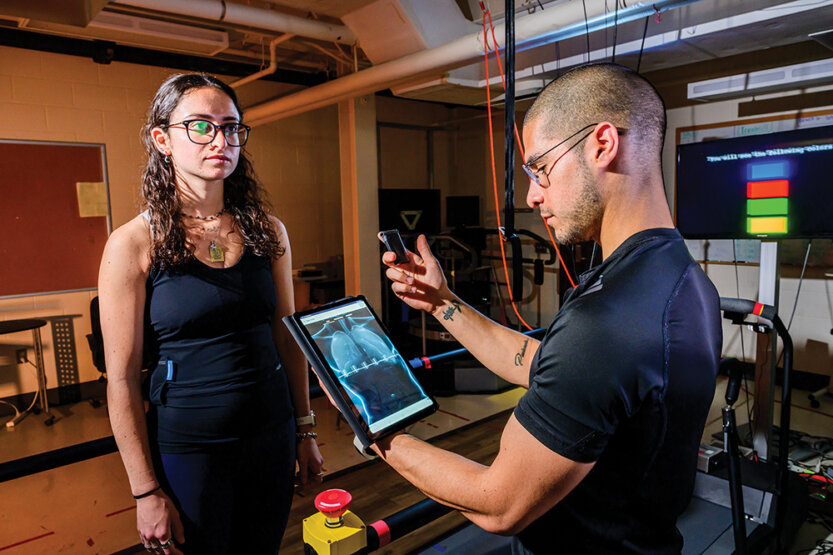 The smart shirt can obtain a single-line electrocardiogram recording of a person’s heart. (Image by Fred Zwicky)
 The Shirt on your back might just save your life. At the very least, it could provide warning signs that might prevent a cardiac event from striking out of nowhere.
A Carle Illinois College of Medicine team has been studying “smart shirts” since 2021 and has found that they are highly effective at measuring heart rate recovery—that is, how much a person’s heart rate lowers one minute after strenuous exercise.
“Heart rate recovery is a critical indicator of cardiovascular fitness and autonomic nervous system function,” says Manuel Hernandez, teaching associate professor of biomedical and translational sciences at Carle Illinois College of Medicine. He adds that abnormal heart rate recovery has been associated with heart failure, diabetes mellitus, coronary artery disease, hypertension, and sudden cardiac death.
Hernandez has been conducting the smart-shirt research with Richard Sowers, professor of mathematics and industrial and enterprise systems engineering, along with several Illinois graduate students.
In the first 2021 study, 38 participants, ranging from 20 to 76 years old, walked on a treadmill at varying speeds and inclines, while wearing a commercially available smart shirt, the Hexoskin, from Montréal-based Carré Technologies. Study participants were classified as high risk if their heart rate went down by only 28 beats per minute or less, one minute after they stopped exercising.
To collect electrocardiogram data, the Hexoskin shirt has a conductive element embedded across the chest. A second band of elastic material by the wearer’s navel monitors respiratory rate. A third sensor, tucked into a pocket near the hip, provides information about walking gait and balance.
Illinois researchers have been gathering gait and balance data for some time from several types of wearable sensors to track motor impairment in those with Parkinson’s disease. Smart-shirt data has additionally shown promise in detecting symptoms associated with anxiety disorders.
Although cardiovascular feedback also can be obtained from a Fitbit or a smartwatch, “The great thing about the smart shirt is it allows us to get a single-line electrocardiogram recording across your heart, as well as your respiratory rate,” Hernandez says. “It also has an embedded recorder that allows all the data to be captured throughout the day.”
Smart-shirt data are higher quality than data from smartwatches, he adds, and the shirt can be washed, once the non-washable components are detached. So far, its only major drawback is its limited capability to fit a range of body types.
Nevertheless, considering that the traditional way to evaluate heart health usually involves costly tests and equipment, smart shirts continuously monitor an individual’s heart rate as they go about their daily activities.
“People have a way of avoiding the doctor, especially in middle age,” Hernandez says. “And by the time [they] do get to the doctor, it could be something urgent. Smart shirts focus on prevention and early detection.”