The Nine Lives of REO Speedwagon

In the fall of 1966, Illinois undergrads Alan Gratzer, ’70, and Neal Doughty, ’68, lived across the hall from each other on the second floor of Townsend Hall (in the Illinois Street Residence Halls) and quickly became best friends, spending their free time exploring the university’s steam tunnels, among other totally unsanctioned activities.
One day, they walked through the tunnels from ISR to the Florida Avenue Residence Halls, where they emerged and scared the daylights out of passersby, before wandering into the FAR basement. There, they found a piano, and to Gratzer’s surprise, Doughty sat down and began to play. And he was good.
Gratzer, who’d been playing drums in rock bands since his early teens, began inviting Doughty to play with his then-current band, Potami. Soon, the friends were jamming regularly and felt that rare thing people dream about, whether in love, friendship or performance—chemistry.
On the final day of the Spring 1967 semester, Potami decided to part ways with their frontman and form a new band with Doughty—who, ironically, didn’t sing. But no matter. Doughty had other contributions to make.
On the first day of classes in Fall 1967, Doughty walked into his “History of Transportation” course and saw a weird phrase written on the chalkboard: “REO Speed Wagon.” He knew immediately that he’d found a name for the band. (He subsequently learned that it had been an early model of delivery truck—with “REO” pronounced “REE-oh”—designed in 1915 by Ransom Eli Olds, of Oldsmobile fame.)
The band combined Speedwagon into one word, began booking their first shows and found a local following, thanks to their loud and raucous live performances, filled with covers of songs by the Youngbloods and Moby Grape.
No one knew it at the time, but REO Speedwagon would go on to become the most important band to ever come out of Champaign-Urbana.
Over the next 57 years—57 years!—REO would grow from a beloved local garage band into a regional sensation, and from a national touring act into one of the most popular rock bands in the world, winning millions of fans and making music history in the process.
Here, Illinois Alumni presents that history—from the early shows at university residence halls to REO’s final concert in June of 2025—through the eyes (and ears) of its most loyal fans: the generations of U. of I. students and alumni who welcomed them home, generation after generation.
Along with Gratzer on drums and Doughty on keys, REO Speedwagon’s original lineup included Mike Blair on bass and Joe Matt on guitar. Everyone in the group, except for Doughty, sang.
Like most bands, REO got their start by playing at local parties. The group’s very first show, for which they were paid $40, was at the Zeta Beta Tau fraternity house, and it was a memorable one: it turned into a food fight.
Before long, REO was booking shows at residence hall parties, playing a mix of popular British Invasion songs by the Beatles and the Rolling Stones, and West Coast rock that hadn’t yet broken through in the Midwest by bands such as the Doors and the Jimi Hendrix Experience.
But, of course, it took time to build its fan base. And at least some potential fans, like John Matras, ’70 LAS, were put off by the name.
“I remember REO Speedwagon as a band we wouldn’t cross the street to see for free!” recalls Matras. “One conversation at FAR went, ‘Who’s playing at that mixer in the basement of PAR?’
“‘Speedwagon.’
“‘Speedwagon? What else is going on?’
“I wonder if it would have given me more bragging rights if I’d actually gone to that mixer!” he says.
Confusion about the name aside, it didn’t take long before REO had graduated from frat parties and residence halls to local bars, such as the Illini Brown Jug.

After starting out in local music clubs, REO was playing international gigs, such as Switzerland’s Montreux Rock Festival, by the mid-1980s. (Images courtesy of llini Media; By David Redfern/Getty Images)
“I remember seeing REO at the Brown Jug with a friend, even though we were underage,” says Craig Poffenberger, ’73 LAS. “That certainly didn’t matter in Champaign’s campus bars back then! I recall that, through the smoky haze and strong beer odor, there was never a wilder scene than when Speedwagon covered Chuck Berry’s ‘Johnny B. Goode’ and the Rolling Stones’ ‘Gimme Shelter’ and ‘Street Fighting Man.’ They worked hard on their craft.”
Soon, they were playing larger, more popular rooms, including Chances R in downtown Champaign and the Red Lion Inn at Third and Green, which became their home base from the late 1960s through the late ’70s.
“In 1968, I was a sophomore and 18 years old, and REO was playing at the Red Lion,” recalls Phil Strang, ’72 MEDIA. “We had heard that if you went there after 12:15 a.m., you could get in and not have to be carded or pay. By the time I was 19, I had a fake ID that said I was 21, so I never had to sneak in to see them again!”
As REO honed their act, they weathered lineup changes (Blair and Matt graduated and left the band, starting a long tradition of personnel shakeups within REO) and tried to find a signature sound (including the temporary addition of a horn section).
They were very much a band that was still figuring things out and, despite graduating to nightclub gigs, they were still open to less glamorous jobs, such as playing the Snyder Hall parking lot on a Saturday night—
anything that would help expand their audience.
But the campus bar scene was where the band really took off, and at the Red Lion, REO found its core audience: U. of I. students who liked their music loud, fast and rocking.
“Like many overwhelmed and overworked graduate students during the 1970s, I needed a place to relieve the pressure and release excess energy,” says Mark Michelson, MA ’72 LAS, PHD ’79 LAS. “As its slogan went, the Red Lion helped to put it ‘all together’ for me when I needed that. It had its house band, REO Speedwagon, with their hard and loud rock; exuberant, if not always skilled, fans dancing in close quarters; and energetic and mainly positive vibes. REO was a level (or two or three) above other bands playing in C-U then. They were vibrant, melodic and powerful; I and the other Red Lion aficionados simply couldn’t stand, or sit, still when they played.
“Those nights at the Red Lion helped carry me through those grad school years (relatively) successfully.”
One of the hallmarks of REO’s live show, especially in their early days as a cover band, was their performance of the Rolling Stones’ “Sympathy for the Devil,” which they played at a much faster tempo than the Stones. Perhaps more than anything else, that song gained them a dedicated following in the late 1960s, before they started performing original material.
“We would yell, scream and sing along when they sang ‘Sympathy for the Devil,’” says Cheryl Berman, ’74 MEDIA. “It was our favorite REO Speedwagon song, even though it came from the Rolling Stones.”
“We would sit on the floor of the Red Lion and just listen to them,” says Cindy Wodetski Leonard, ’72 LAS, “and when they closed with ‘Sympathy for the Devil,’ we would all jump up and dance.”
As the band took shape, fan favorites began to emerge among its members, including lead singer Terry Luttrell.

Onstage, REO had a blast. Left: On tour in Minneapolis, 1987; (right) Singer Terry Luttrell playing air guitar at Wheeling (Ill.) High School, 1971. (Images by Michael Smeltzer; Courtesy of Jim Steinfeldt/Getty Images)
“Luttrell used to play air guitar before it was a thing,” recalls Michael Smeltzer, ’72 LAS, MS ’83 MEDIA. “You know how people would make fun of Joe Cocker because he would do funny things with his hands while he played? Well, Terry would do that. He would stand right next to the guitar player [whomever it happened to be at the time], and he’d be playing air guitar and just having fun.
“The whole band was having fun, and when they were on stage, they gave it 100 percent. They always sounded good, and when you went to see them, you knew what you were getting. You couldn’t go to an REO concert and not leave smiling and exhausted from bouncing around. People really got into it!”
Luttrell performed with REO from 1968 until 1972 and appeared on their self-titled first album (1971) before later joining the local band, Starcastle.
For many other fans, the highlight was Gratzer’s drumming or Doughty on keys. (Todd Armour, ’85 ACES, says, “The one huge thing that really set the band apart was Neal Doughty and his jazz keyboard! Brilliantly played in an era that was transitioning away from the Hammond organ, he set REO apart from everyone of the day.”)
But undoubtedly, the most popular member of REO Speedwagon was Gary Richrath, who replaced Steve Scorfina as the lead guitarist in late 1970.
“Before he joined REO, Richrath was in my band, Feather Train,” says Geoff Poor, ’71 LAS, “and I remember when I auditioned him thinking that there was just something about him, you know? He was a rock-and-roll star. The guy just had presence. And tremendous rhythmic chops—he was so dynamic, rhythmically, and he became an incredible lead guitar player. But I didn’t have any idea that he’d be the songwriter he became. When he joined REO, he was a perfect fit. And a creative force. And he just got better and better and better and better. He was the star.”
Richrath’s chops on the guitar were evident to everyone who saw him play.
“My college roommate, Debbie MacKron, ’74 ACES, was later married to Gary,” recalls Ann Spurgeon, ’75 LAS. “I would go with her to the Red Lion to see the band, and I just loved the way he played. I play acoustic guitar, so I knew a little bit, and I couldn’t believe how fast and accurate he was. He did things with the guitar I don’t think I’d ever heard before, like muting the strings and strumming it. And his fingers just flew across the frets. He was a really amazing guitar player.”
With Richrath on board, REO hit its groove, began performing original songs and played packed shows all over the Midwest, developing a loyal following in the process. In 1971, record producer Paul Leka happened to see the band perform an incredible outdoor show in Peoria, Ill.—the audience going nuts in the pouring rain—and quickly got them a recording contract with Epic Records.
In the lead up to the album’s release, REO’s regional stature continued to grow, and their fans in Champaign-Urbana began to expect big things for the band.
“I recall going to the Red Lion to hear them in the early ’70s for a ridiculous cover charge of 25 or 50 cents,” says Ray Mentzer, ’74 LAS. “This was the time of their first album. My friend Lenny Wanex, ’74 LAS, convinced us all that they’d be a success. He kept us informed of when and where they’d be playing, and we went all the time.”
In addition to the Red Lion, “REO played at Chances R, on Chester Street in Champaign,” recalls Wanex. “It was a long trek from the Florida Avenue Residence Halls—more than a two-mile walk—but well worth it. Chances R had a larger dance floor than other bars and was a great place to go dancing. It had places to sit on two sides of the dance floor in addition to a balcony that had tables set up two-deep. You could get a better view of the band from the balcony, and when REO played, the place was packed.
“I bought their first album when it came out in the fall of 1971. There was a record store on Wright Street, just off Green, and it was my first album purchase. I couldn’t wait to get home and play it, and I still have it. I had a feeling REO would go far, and they did.”
As REO’s popularity grew, so did its opportunities, including the chance to headline one of the first rock concerts at the university’s new Krannert Center for the Performing Arts, which had opened in 1969.
“That Krannert show [Oct. 16, 1971] was one of the best concerts in the U. of I.’s history,” recalls Brian Miltner, ’73 LAS. “Dan Fogelberg, ’73, and REO had just released their first albums. Dan opened and played some mellow music. But before REO came on, a local boogie band named Duke Tomato and the All Star Frogs blew the roof off the place. They always closed their set with a song that was classic boogie and had the audience doing conga lines throughout Krannert for 20 minutes. Finally, REO took the stage. They screamed, ‘Let’s rock ’n’ roll!’ But the audience’s reaction seemed to say, ‘Give us a break! We just boogied for 20 minutes!’ After a while, the audience caught their breath and had a great time.”
Despite their momentum locally, sales of REO’s first album didn’t meet Epic Records’ expectations, and soon, singer Terry Luttrell left the band. They found a new frontman in Kevin Cronin, a Chicago-based singer-songwriter whose folky tendencies brought a new element into REO’s hard rock sound.
Cronin would leave after one album due to creative differences. REO would record three albums with Michael Murphy as the singer before Cronin returned in 1976. He would remain with the band for the next half-century.
But first things first: Throughout 1972, the band continued its rigorous tour schedule, as it prepared to release its second album (and first with Cronin): R.E.O/T.W.O. Unsurprisingly, it was a huge hit in Champaign-Urbana.
“They were all over WPGU at the time,” says Rick Kubetz, ’76 MEDIA, EDM ’10, “and in late fall, the Red Lion hosted an album release party for R.E.O/T.W.O. The place was packed. It was warm and loud inside, and I had a great view of Gary Richrath and his Les Paul guitar.
“The band played all the tunes from the new album. ‘Golden Country’ and ‘Music Man’ were my favorites, and I had already been to Record Service to get my own vinyl copy.”
REO was such a local phenomenon at the time of R.E.O./T.W.O.’s release that area high school students even made unsanctioned merchandise, much to the band’s delight.
“In Centennial High School shop class, I silkscreened a number of REO logos—from the sleeve of the R.E.O./T.W.O. album—to some white T-shirts,” recalls the future State Farm Center event supervisor Dave Roesch. “One night my friends and I were at the Steak ’n Shake on Green when three or four of the band members walked in, a bit buzzed. Gary Richrath got up and came to our table and asked, ‘Where did you get that shirt?’ I told him I made it, and they all had a good laugh. I still have one in a wood frame.”
Despite their growing fame, REO remained accessible to their fans, often playing to crowds of 750 at the Red Lion—nearly double the bar’s capacity. Gratzer recalls it being so packed that it was hard to tell where the crowd ended and the band started, and people even hung from the rafters.
“I remember seeing them there,” says Carl Palczewski, ’75 ENG, “and you could be there before the music started and watch them set up and tune their instruments and even hang by the stage and talk with them. And I remember that the place was really, really jam-packed when they were there. I don’t suppose the fire marshal would have been pleased.”
As the band continued to tour in the mid-1970s, their following in the Midwest grew. Their album sales were respectable—with Ridin’ the Storm Out (1973), Lost in a Dream (1974) and This Time We Mean It (1975) charting on the Billboard 200—but widespread mainstream success eluded them.
Doughty jokes that, for a long time, REO thought of themselves as “the World’s Biggest Opening Act.” It seemed that anytime a national tour came through the Midwest, whether it was Aerosmith, Joe Walsh or Black Oak Arkansas, the bookers relied on REO to warm up the crowd, knowing that many people would show up simply to see them.
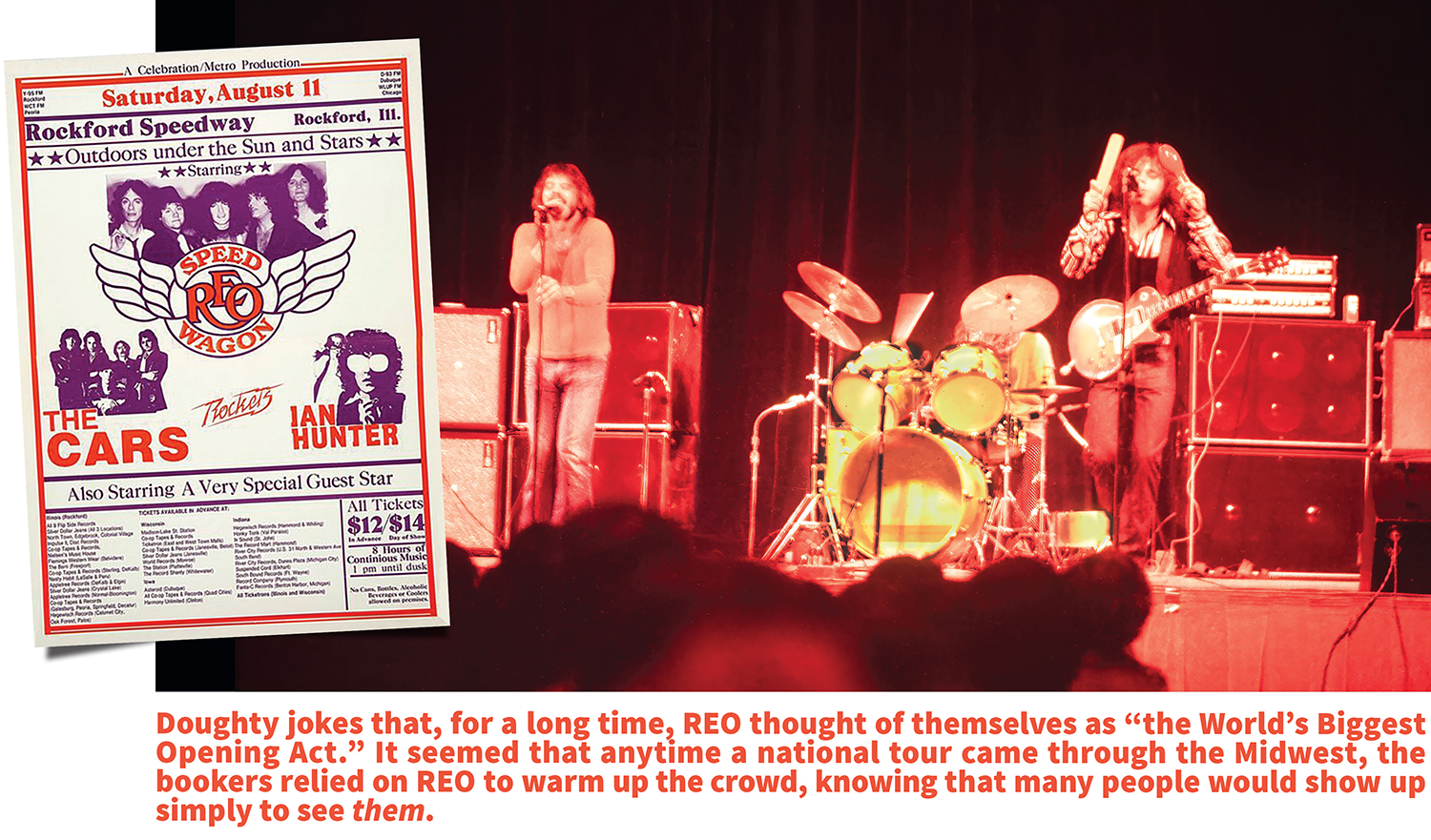
Left: Opening for Sly and the Family Stone at Assembly Hall, 1971; (right) Poster for a headlining gig in Rockford, Ill., with The Cars and Ian Hunter as their opening acts, 1979. (Images by Michael Smeltzer; Courtesy of Illini Media)
Although REO seemed poised for a national breakthrough, they didn’t forget their roots at the Red Lion. The dive bar remained their home base, and they performed there often, sometimes playing shows in other parts of the country and then flying their Cessna back in time for last call.
“I was a bartender there,” says Miki Tosic, ’77 LAS, “and it was awesome—a new live band almost every night of the week (I still don’t know how they managed that), with speakers up to the ceiling that blew the doors off the place.
“I remember well when REO would play there. The nights they were a headliner were incredible, but I think we all enjoyed it even better when they would just drop by unannounced and jam with whoever was playing that night. One band in particular, Silver Bullet, would always have them come up and play a few numbers.
“Word would get out up and down Green Street that ‘REO is at the Lion!’, and the other bars would empty out and people would swarm in. I’m pretty sure we were way beyond ‘legal capacity’ those nights.
“I also clearly remember Bruce Hall playing in other local bands at the Lion before he joined REO, and he was always a stand-out, which was a little unusual for a bass player. He was always very friendly to us bartenders and everyone in the bar, and so when REO asked him to join [in 1977], we were all thrilled. It was like ‘one of our own’ had made it to the big leagues.”
The year 1978 was a turning point for the band. The release of their album, You Can Tune a Piano, but You Can’t Tuna Fish, garnered them a much wider audience, with the songs “Time for Me to Fly” and “Roll with the Changes” cracking Billboard’s Hot 100 chart. The album itself peaked at No. 29, becoming REO’s highest charting album to date, and it went on to sell 2 million copies in the U.S.
But their follow-up, 1979’s Nine Lives, was viewed as a commercial disappointment by Epic Records, and at the company’s insistence, REO shifted away from their hard rock roots and adopted more of a pop sound, complete with power ballads, for its next album.
That decision would change the band’s fortunes forever.
“It was quite a plunge into the deep end,” Doughty says about the release of Hi Infidelity (1980), the band’s ninth studio album, which went to No. 1 on the Billboard chart and stayed there for nearly four months.
“For years, we were plugging away, and it was a slow, gradual upswing,” says Alan Gratzer. “Then, Hi Infidelity hit, and the curve just skyrocketed, right to the top. It was hard to believe. All of a sudden, we’re filling baseball stadiums, and people are stealing the hats off our heads.”
“It was surreal,” says Doughty.
“We were in Chicago to play the International Amphitheater,” recalls Gratzer, “and we sold out four nights. And I just thought, ‘Oh, my god. This is unreal…. We’re in another world now.’ And you kind of get used to walking into a room, and all of sudden, everybody’s staring at you. It’s a little disconcerting. But you get used to it, and you just kind of go with it.
There’s nothing else you can do.”
“And the crazy thing is,” says Doughty, “for 10 years, we thought that’s exactly what we wanted! And then, when it happened, it was overwhelming.”
Hi Infidelity would produce four top-40 singles (including the No. 1 hit, “Keep on Loving You”) and would go on to sell more than 10 million copies, becoming the top-selling album of 1981 and vaulting the band to a level of stardom few acts have ever achieved.
Following the band’s superstardom, their tour schedule—and the massive stadiums they now filled—made it next to impossible for them to play at the Red Lion Inn.
In 1981, REO played one of the largest concerts in the Assembly Hall’s history, topped only by acts such as Elvis Presley, Johnny Cash and Garth Brooks. But aside from another Assembly Hall appearance in 1983, for much of the ’80s, Illinois alumni and students had to get their REO fixes through albums and by traveling to see the band in bigger cities.
After reaching the top of the rock music summit with Hi Infidelity, REO quickly got back into the studio to record its follow-up, 1982’s Good Trouble. Although the album peaked at No. 7 and sold more than 2 million copies, it was considered a huge disappointment by the band, both commercially and creatively, and—with a few exceptions—they stopped playing its songs live shortly after its release.
The band bounced back with its next album, Wheels Are Turnin’ (1984), which featured REO’s biggest hit, the No. 1 single “Can’t Fight This Feeling.”
Deep into the 1980s, REO remained hometown heroes in Champaign-Urbana, playing a sold-out show at Assembly Hall in 1987, on tour to promote its Life as We Know It album. For many U. of I. students from that time, it was their first opportunity to see the band in concert.
“I was a freshman, living in Allen Hall,” says Helena Kale, ’91 LAS. “REO was playing Assembly Hall, and my floor mates and I decided to go. It felt like such a long walk to get there! But it was my first time at Assembly Hall for an event, and it was exciting. The place was packed, and we sat way up in the cheap seats.
“REO was one of my favorite bands, and they played everything I wanted to hear. I think they played ‘Can’t Fight This Feeling’ for the encore.
“I had no idea about their connection to the U. of I. before that concert, but it made me an even bigger fan. I remember thinking I had picked the coolest place to go to college. Walking back to Allen, we took a shortcut through the cemetery and felt like we were so cool and grown up.”
“I had a great time when REO returned to Assembly Hall in ’87,” adds Thomas Durbin, ’89 ENG, MS ’91 ENG. “The entire place was jumping, and it felt like a big family homecoming. They nearly blew the roof off with all the energy they brought to the stage. It was evident that they were happy to perform at home, and the crowd responded with equal enthusiasm. It is one of my favorite concerts ever.”
By the late 1980s, REO was in decline, plagued by a changing musical landscape and disappointing album sales. In 1988, after more than 20 years in the band and tired of life on the road, drummer Alan Gratzer decided to retire. Guitarist Gary Richrath, whose relationship with singer Kevin Cronin had been rocky for years due to personality conflicts and Richrath’s drug problems, left the band the following year. As the band entered the 1990s, its fortunes seemed dismal. Nevertheless, REO remained an institution in Champaign-Urbana and was still popular with U. of I. students, even as its lineup changed yet again.
“When I was in college, it was past their heyday at the Red Lion,” recalls Jay Vivian, ’93 LAS, “but REO songs were a staple at O’Malley’s!”
In 1990, REO tried to rebound, releasing their final album with Epic Records: The Earth, a Small Man, His Dog and a Chicken. It was the last REO album to reach the Billboard charts, topping out at No. 129.
By 1993, the band was at a low and, after sharing a bill with a ventriloquist in Mexico City, REO announced that they would break up at the end of their tour.
Following the announcement, they began to sell-out their tour dates, and the renewed interest in the band caused them to reconsider, and keep going.
Like virtually every band that lasts for decades, by the 21st century REO had become a legacy act—mostly playing their old hits for a dedicated audience of fans, on tours with other popular legacy acts, such as Styx and Chicago. But wherever you looked, from the Red Lion to concert halls across the country, you could still find REO making a difference in people’s lives, whether it was the rekindling of wonderful memories or the creation of a new love.
“On Dad’s Day weekend in 2013, I thought I’d show off the bar where I’d been working,” recalls Shane Harris, ’14 AHS. “My dad and I walked into the Red Lion, and he lit up with a smile. I asked if he’d been there before, and he said, ‘Yes, many times. I wasn’t sure if it was the same place, but I used to watch REO Speedwagon play on a stage right over there.’ As we explored the bar, he smiled and reminisced. I thought I’d be showing off the bar to him, but it ended up being a perfect Dad’s Day weekend hearing his stories.”
“My favorite memory of REO occurred on July 21, 2018, in Tampa, Fla.,” says Sheryl Gunning Jameson, ’89 LAS. “I grabbed a last-minute ticket with my neighbor, and while at the concert, I met a guy named Dave, who became my husband in 2022! For a wedding gift, we received a Cameo from REO’s bass player, Bruce Hall, who told us he met his wife at a concert, too. We are thrilled that REO will always be a big part of our love story!”
REO was still going strong as they entered the 2020s. But several of its members were in their 70s, and the physical demands of touring were beginning to show. In 2023, after 55 years on the road, founding member Neal Doughty announced that he would no longer tour. The band continued without him, but there were more changes to come. Later that year, Bruce Hall took a leave of absence to have back surgery, and
his ability to return to the band caused a very public dispute with singer Kevin Cronin.
In 2024, using the language of divorce, REO announced that it would no longer tour, as a result of “irreconcilable differences” between Cronin and Hall.
Over its 57 years, the band released 16 studio albums, in addition to several live albums and compilations, selling more than 40 million copies to date.
As REO ended its nearly six-decade career as a touring band, many of its longtime fans grew reflective.
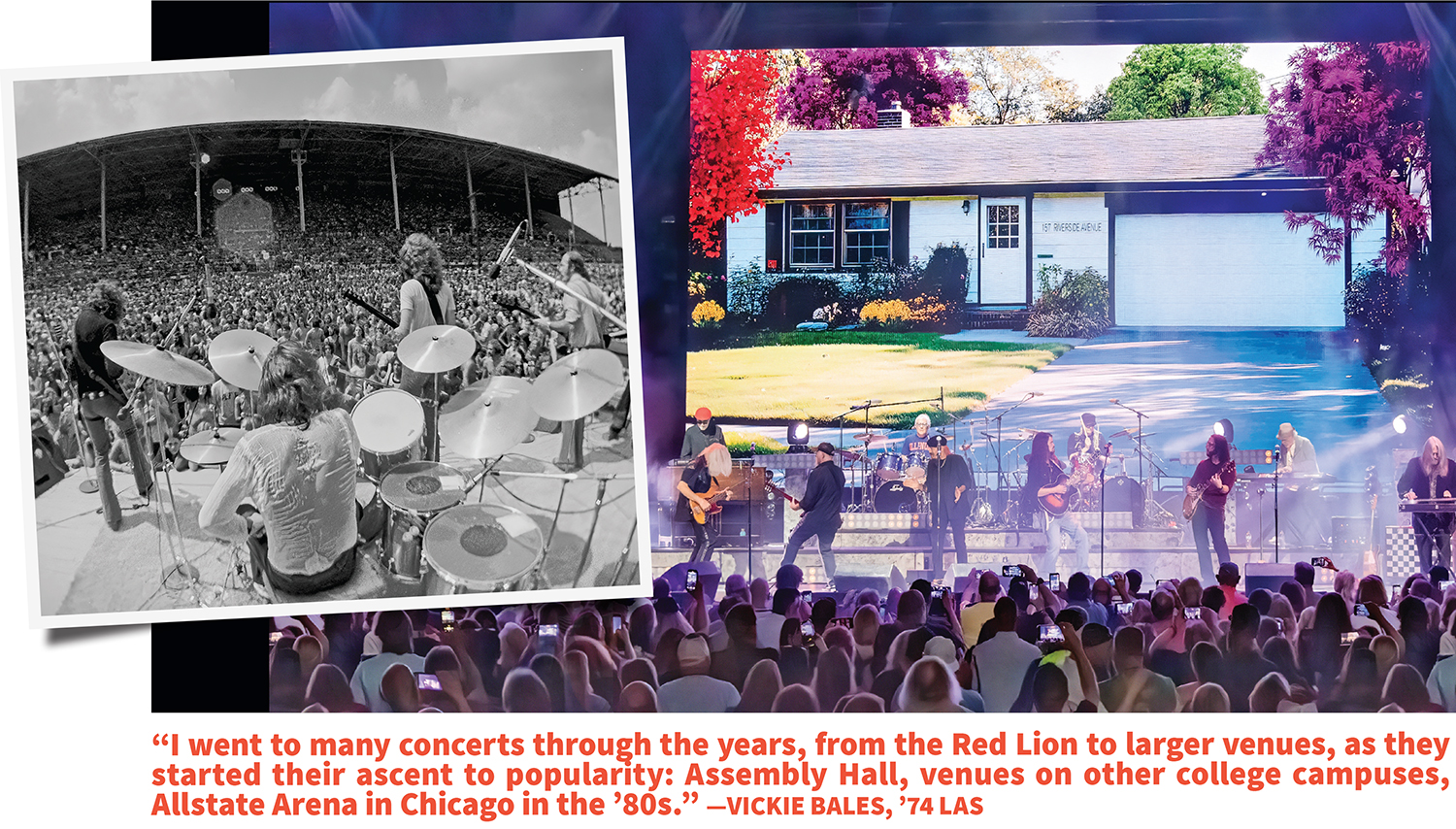
The beginning and the end… Left: Performing at the Illinois State Fairgrounds, 1973; (right) REO’s 2025 tribute concert at State Farm Center, with a back-drop of “157 Riverside Avenue,” where they lived during the recording of their first album. (Images courtesy of Michael Smeltzer)
“I started going to the Red Lion in 1970,” says Vickie Bales, ’74 LAS, “and then started working there in 1971. My housemate Debbie MacKron caught the eye of lead guitarist Gary Richrath and, through her, I became friends with the band—always a fan, but also friends.
“They were by far the best musicians in town at the time. They had a lot of energy and stage presence (and they flirted with the girls!). I saw a few lead singers rotate through, such as Terry Luttrell, Michael Murphy and Kevin Cronin. I missed Gregg Philbin on bass when he left but loved Bruce Hall all those years. I always kidded Dave Amato and Bryan Hitt for being the ‘new guys.’ [They joined the band in 1989, on guitar and drums, respectively.]
“I went to many concerts through the years, from the Red Lion to larger venues, as REO started their ascent to popularity: Assembly Hall, venues on other college campuses, Allstate Arena in Rosemont, Ill., in the ’80s. The last time I saw them live was in my new hometown of Paso Robles, Calif., about five years ago. Because of my history with the band, I got great seats and backstage passes. I mostly recall being amazed that they were still on the road, after all these years, singing the same songs. We’re all getting older!”
In June of 2025, several of the surviving members of REO reunited for a one-night-only tribute concert at State Farm Center. The participants included founders Alan Gratzer and Neal Doughty, bassist Bruce Hall, singers Terry Luttrell and Michael Murphy, guitarist Steve Scorfina, and family members of the band. (Kevin Cronin, who continues to perform REO’s catalog under his own name, was on the road with former members Dave Amato and Bryan Hitt and could not participate due to a conflicting tour date.) The show also featured a tribute to guitarist Gary Richrath and bassist Gregg Philbin, who had passed away in 2015 and 2022, respectively.
In the days leading up to the concert, the band revisited many of its former local haunts, including the recording studio in nearby Tolono, Ill., where they often rehearsed, the old Vriner’s Confectionary that appeared on the back cover of R.E.O./T.W.O. (now an event space called The Venue CU), and the Red Lion (a reboot of the original bar, which opened in 2010).
Hundreds of fans packed into the Red Lion to welcome the band home. Many of the well-wishers were in their 70s and remembered seeing REO there in the early years. But a small, and no less enthusiastic, contingent was made up of current U. of I. students.
“I’m a huge fan of REO Speedwagon,” says Amelia Conroy, ’26 LAS, “so when I heard they were returning to Champaign for their last concert, I was so excited! I was originally introduced to REO a few years ago by my parents, who were big fans back in the day. When I told them the band might be at the Red Lion, they encouraged me to go! And I am so happy they did! It was such a cool experience! I got to talk to Alan Gratzer!”
Finally, the day arrived: The tribute concert. Thousands of REO fanatics showed up at State Farm Center to wish the band well and to relive their own memories of seeing REO live over the past 50 years. They left feeling like they got their money’s worth.
“Their final show was a wonderful concert and a wonderful tribute,” says Roger Prillaman, ’76 LAS. “It was so, so cool to see Terry Luttrell back on the REO stage. Bruce’s bass playing was absolutely stellar. Alan’s drumming was spot-on, even after being away from the band for decades. Neal’s keyboards were just as solid as ever.
“My opinion…and I am sure I’m not alone in saying this…. They should keep it going! Why not?”
“For me, after 37 years of being away from it, I was slightly unprepared for how incredible the reception was!” says Gratzer. “I just thought, ‘Wow! You know, the last time I was in a band, there were no cell phones and people filming you all the time.’ I felt like the Beatles!
“People were so kind, so complimentary. It was a fun thing to experience. But, you know, the day after I got back home, I had to take the garbage cans down to the end of the driveway and get back to a normal life!”
“It was a love fest!” says Doughty. “My wife was there, and she had never seen Alan and me play together. She was in tears, going, ‘Wow, you’re the two guys who started this whole thing, and now you’re back here doing it again, in the town where it started,’ and I think a lot of people felt the same way. There were nothing but positive vibes, people smiling while they’re filming you, going, ‘Oh, my god, I can’t believe these guys are back together again!’
“It was a magical experience for everyone, including us.”
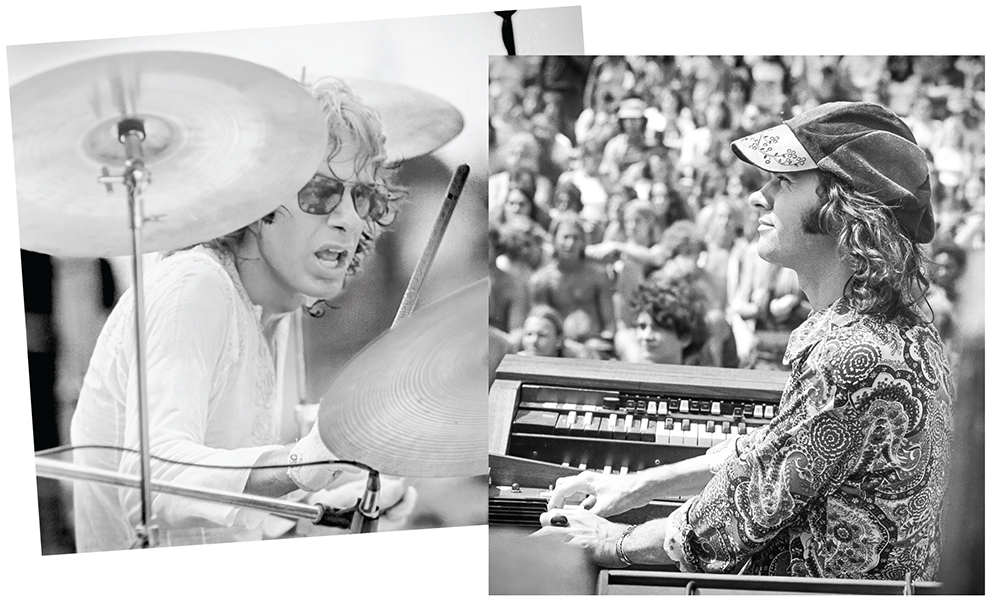
REO founders Alan Gratzer on drums and Neal Doughty on keyboard, performing at the Illinois State Fairgrounds in Springfield, 1973. (Images by Michael Smeltzer)
In the Beginning
REO founders Alan Gratzer and Neal Doughty remember the band’s early days
Neal Doughty: The Beatles had made every kid in the world want to be in a rock and roll band, and once we decided that we were going to start a band together, it was just so exciting that we were actually doing it. I’d never done anything like this.
Alan Gratzer: I had started three bands in high school, and I just loved to play. I’d play along with records all the time in the basement.
ND: For our first show, we played at a fraternity house… .
AG: ZBT [Zeta Beta Tau]….
ND: That’s right. And when we got there, they had the whole dining room—all the walls—covered with brown paper. Our stage was a bunch of tables stuffed together, and they had invited a sorority to dinner. But what the sorority didn’t know was that they were gonna break into a food fight! And that explained the paper that was hanging all around the walls. They just started throwing food around, and I remember it took Alan about a week to get all the mashed potatoes out of his drums!
AG: Yeah, I had mashed potatoes all over my drums!
ND: But the good news was, we did get paid $40!
AG: And then, for the next four years, we just worked our tails off, playing bars and fraternities and clubs and after-proms—just honing our craft. We got tight and kept getting better, stuck together until we found the right personnel, and then things took off.
ND: And we sure had some fun!
AG: Maybe someday we might even get into the Rock and Roll Hall of Fame! But maybe not. I don’t know. Whatever happens, 60 years later, the two of us are still great friends. I think we got really lucky.
The Good, the Bad and the Strange
20 facts about REO Speedwagon
Before co-founding REO Speedwagon, keyboard player Neal Doughty had never played in a band—aside from his high school marching band.
REO Speedwagon started as a cover band, and its early concerts at local clubs, such as the Illini Brown Jug, often netted the members as little as $3 each, which they spent on donuts.
The first media coverage of REO was a March 28, 1968, article in The Daily Illini, titled “Speedwagon Versatile.” It observed co-founder Neal Doughty’s prowess with pinball machines at the Illini Brown Jug. (It also misspelled Doughty’s name as “Coughty.”)
In 1968, REO drummer Alan Gratzer paid for a classified ad in The Daily Illini to sell his Slingerland drum set, minus the cymbals, a “$450 value” he was willing to part with for $275. Four years later, bassist Gregg Philbin did the same, listing his 1959 Fender Precision bass for $150.
In the band’s early days, you could see them play in venues ranging from residence hall parties and the Illini Union to local county fairs, sorority fundraisers and the Main Quad.
Gratzer and Doughty attribute their success as a cover band not only to their loud and fast style, but also to their song selection. Many of the West Coast bands they covered were unfamiliar to U. of I. students, and that unfamiliarity led many fans to believe that REO had written the songs themselves.
REO’s manager, in the early years, was their U. of I. classmate and future Rock and Roll Hall of Fame inductee
Irving Azoff, who would go on to be-come one of the most powerful executives in the music business, managing acts including the Eagles, Harry Styles and Cardi B, and leading Live Nation. REO was his very first client.
Most of REO’s first two albums were written at the Red Lion Inn, where the band rehearsed and often performed.
The classic REO song, “157 Riverside Avenue,” was named after the address where they stayed in Westport, Conn., during the recording of their self-titled first album (1971).
The back cover of R.E.O./T.W.O. (1972) shows the band at Vriner’s Confectionary, the downtown Champaign candy store that satisfied local sweet tooths from 1898 to 1997.
In 1977, REO successfully convinced Epic Records that its live shows captured the band in its full glory and that they should be allowed to record a live album—a ballsy move for an act that hadn’t had a bona fide hit record. But REO was right, and fans responded. By the end of 1978, Live: You Get What You Play For had sold more than 1 million copies.
REO’s longtime soundman, Robert “Bub” Phillippe, held the tuna fish that was immortalized on the album cover of You Can Tune a Piano, but You Can’t Tuna Fish (1978). Phillippe found a “really cool, odd, large” tuning fork, bought a frozen tuna at the Long Beach fish market and met photographer Tom Wilkes at Joshua Tree to capture the shot. A quarter-century later, the cover would appear on Pitchfork’s list of “The Worst Record Covers of All Time.”
REO’s Hi Infidelity (1980) album stayed at No.1 for 15 weeks. It is one of only 27 albums to top the charts for that long—a list that includes records by Johnny Cash, Adele, Beastie Boys, Prince, Queen and Taylor Swift.
In 1981, a Lockheed Loadstar airplane that had once belonged to REO—and still included their logo on the side—crash-landed in a small town in North Carolina. The plane, which the band had sold years before, was filled with all manner of illegal narcotics and allegedly had ties to the Colombian drug kingpin Pablo Escobar. It was quickly seized by the U.S. Drug Enforcement Administration.
The biggest concert REO ever played was at the 1985 Live Aid fundraiser, proceeds of which helped provide famine relief in Ethiopia. The show was broadcast to more than 1.5 billion people around the world.
REO sponsored Olympian speed skater and Champaign native Erik Henriksen, who competed in the 1984 and 1988 Winter Olympics.
REO’s 1996 album Building the Bridge made such an impression on President Bill Clinton that he used its title track as the theme song of his re-election campaign.
In 2001, the City of Champaign designated Main Street between Chestnut Street and Neil Street as “Honorary REO Speedwagon Way.”
REO’s final studio album was a Christmas record called Not So Silent Night…Christmas with REO Speedwagon (2009), featuring renditions of “Winter Wonderland,” “Deck the Halls” and “Blue Christmas,” among other classics.
The band’s final show, “Honoring the Legacy of REO Speedwagon,” was a fundraiser for cancer research. The proceeds benefitted the Moffitt Cancer Center, where Bruce Hall’s son Tommy had received treatment for testicular cancer.
Sound Check
A C-U DJ picks his top five REO albums
By Larry Fredrickson
(After attending the U. of I. in the mid-1970s, Larry Fredrickson left school to play drums for the band Ginger, which featured REO’s Terry Luttrell. In the 1980s, he got into radio, and for more than 40 years has worked for the Champaign-Urbana stations WDWS, WHMS and WKIO.)
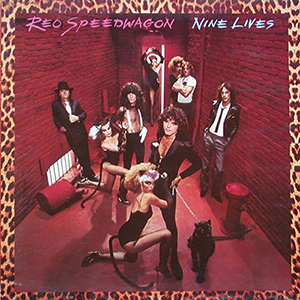
1) Nine Lives (1979) REO’s last truly rocking album before they decided on a softer ballad approach. Nine Lives was a reflection of REO’s roots, led by the hard-driving guitar of Gary Richrath. Favorite track: Bruce Hall’s “Back on the Road Again.”
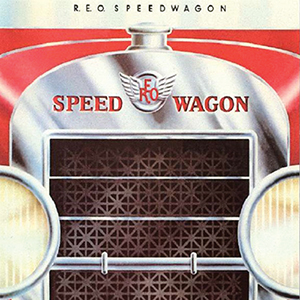
2) R.E.O. Speedwagon (1971) The very first REO album, with Terry Luttrell on lead vocals. This album featured songs written by everyone in the group and included such fan-favorite classics as “Sophisticated Lady” and “157 Riverside Avenue.”
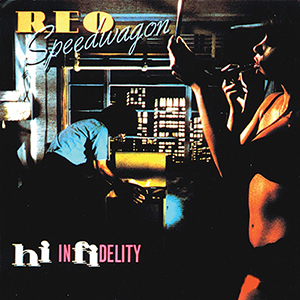
3) Hi Infidelity (1980) The album that vaulted the group into superstardom, featuring the No. 1 single “Keep On Loving You” and the No. 5 hit “Take It on the Run.” Music fans connected with Hi Infidelity, and it ultimately sold more than 10 million copies.

4) You Can Tune A Piano, but You Can’t Tuna Fish (1978) REO’s first hit studio album, its songs “Roll with the Changes” and “Time for Me to Fly” became live performance favorites. With its memorable cover, it eventually sold more than 2 million copies.

5) Ridin’ the Storm Out (1973) Its title track, written by Richrath and including Neal Doughty’s Moog synthesizer intro, was REO’s first crowd-pleaser. The genius of the guitar solos produced spine-tingling experiences for listeners.
(Album cover images courtesy of Epic Records)