Ingenious: Minecraft-Inspired
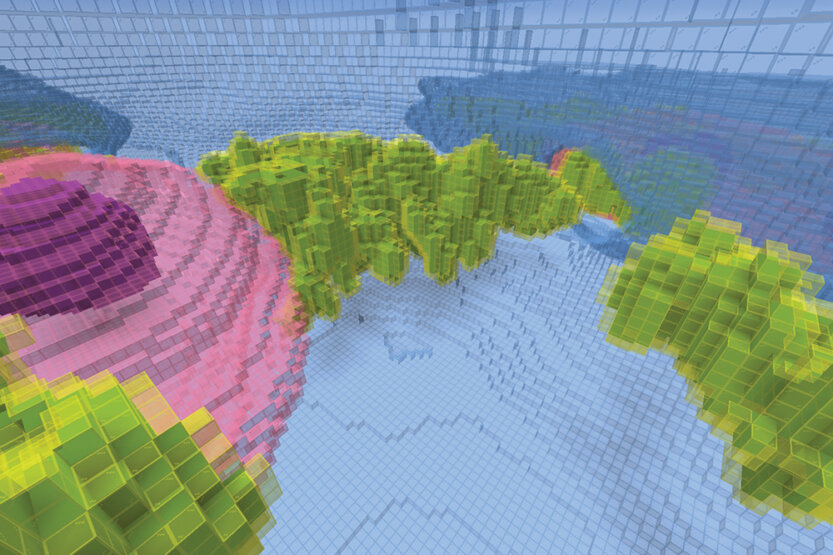 Using an optical microscope, researchers rendered a healthy breast cell in 3D and imported it into Minecraft. (Image by Kevin Tan)
 Zaida Luthey-Schulten was presenting one of her lab’s cell models at Seattle’s Allen Institute in 2021 when a Microsoft intern approached her and observed, “That model looks like it could be in Minecraft, don’t you think?”
That triggered a brainstorm for Luthey-Schulten, professor of chemistry and director of the U. of I. Center for Quantitative Cell Biology. She asked her team which of them had played Minecraft when they were younger, the video-gaming sensation in which players build their own online worlds out of virtual blocks. Then she asked them to think about how the lab’s cell models could interface with the game.
A week later, postdoctoral team member Zane Thornburg, PHD ’23 LAS, came to her with an idea for importing their models into Minecraft. The result was CraftCells, a video game in which users can enter the micro worlds of living cells, including bacteria, yeast and cancer cells.
Those worlds, experienced through virtual-reality headsets, are based on 3D images of real cells. As Luthey-Schulten explains, “The 3D images you see come from state-of-the-art experiments and simulations, published in some of the top journals like Science, Nature and Cell.”
To create the images, the team used a variety of advanced microscopes. To create yeast-cell images, for example, graduate student Tianyu Wu processed cryo-electron tomography data from a collaborator’s experiments. Through CraftCells, explorers can now see the fine structures within the yeast cell, including ribosomes (which synthesize protein) and the nucleus envelope.
Graduate student Kevin Tan, MS ’25 ENG, used an optical microscope to create images of both healthy and cancerous breast cells. This gives CraftCells gamers the ability to not only compare differences between the two types of cells, but also to “shoot” the cancerous cells, mimicking laser- ablation treatment.
Tan, an avid Minecraft player since age 13, also developed a “rollercoaster” that takes CraftCells users on a ride through cellular membranes, racing past cells’ twisting, double-helix DNA. And for those players who just want to blow things up, they can place stacks of TNT in a cell and ignite it with flint and steel—a popular Minecraft feature.
As in Minecraft, player-explorers can break apart cell blocks and build their own structures. They also can click on a hotbar to manipulate various cell layers to better understand how they’re assembled.
Luthey-Schulten’s team further personalized their research by giving themselves cheek swabs and putting their cells on an optical microscope. They then created 3D images of the cheek cells and imported them into Minecraft, allowing them to virtually “enter” their own cells.
CraftCells is constantly evolving, as the team adds new features, seeking to integrate more game-playing options with educational components.
“Anybody who has taken a biology course probably gets tired of opening a book and seeing everything in 2D,” she says. “I’m not happy in 2D anymore. I want to see it in 3D.”