From the Top
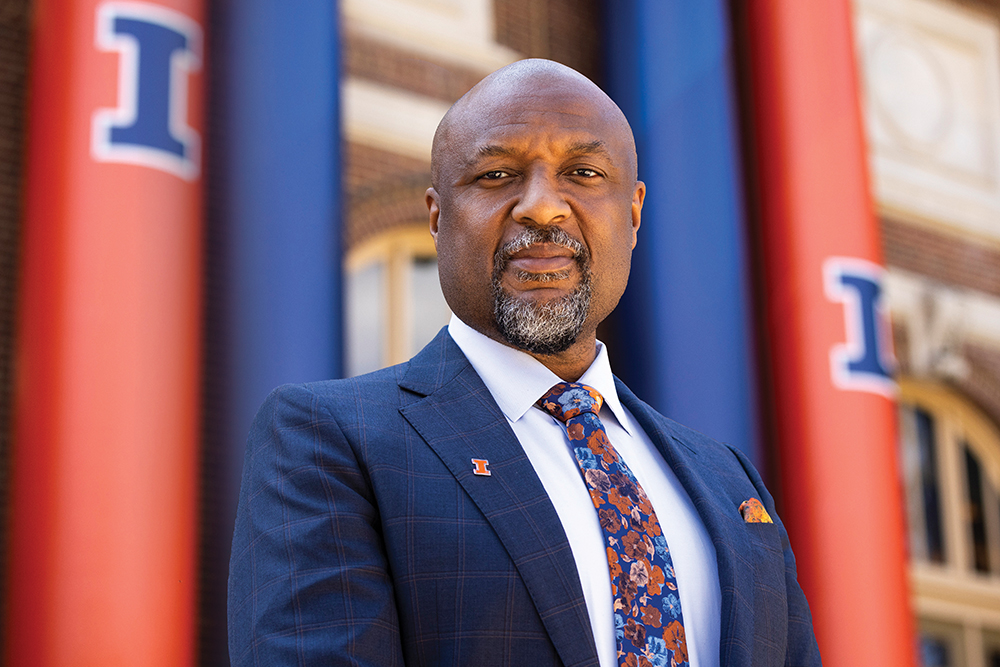
Charles Lee Isbell, Jr., is the 11th Chancellor of the University of Illinois. (Image by Michelle Hassel)
Welcome and congratulations on your new position. Can you share some of your impressions of Illinois?
I’ve always known that this is a great place with great bones. When I was a young professor at Georgia Tech in the early 2000s, I was part of a project with folks at Illinois who were doing climate modeling. They needed some computing and machine learning people on the team, so I came up here multiple times over several years. I have a lot of fond memories of working with people here. U. of I. has always had a warm place in my heart.
What made you say, “I’m going to take this position”?
There are a small number of universities in this country that are well placed to lead conversations about where higher education needs to go. These conversations are twofold—conversations about the environment we’re currently in and generational conversations about the proper role of an elite public research university. For the past 20, 30, 40 years, higher education has been moving in one direction, and it’s time to start talking about what we need to be doing next. And I just love the idea of being part of a university that can lead that kind of conversation.
Where do you think higher education needs to be going?
We need to be moving into more interdisciplinary research and interdisciplinary education. Working on big problems is going to require lots of different perspectives and lots of different ways of thinking. We also need to figure out how universities can have a dialogue with all their constituencies. Not just with students, faculty, staff, and alumni, but also with people who will never set foot on the campus of a university like this, but who are, nonetheless, part of the community we serve. I further believe that Illinois should embrace its role of being a giant, top-tier public university, with strong humanities and social sciences, strong STEM, and growing efforts in the health sciences. And let’s not overlook our land grant charter. We need to ask what it means to bring all of those things together and live up to our mission in the middle of the 21st century.
What is the hardest part about this job?
It’s very easy for people to see me as an abstraction. I’m not a real person. I’m a title. I’m an entity that’s very, very far away. And people can think or say anything about me that they want to because I’m not real. Not seeing others as real is the root of a lot of bad things that happen in the world. So, let me emphasize that I am a real person. I watched Star Wars seven times in the first couple of months after it came out in 1977. I even have a light saber in my office. I own 22,574 comic books. I play racquetball and ultimate Frisbee. I listen to Chicago blues while I’m doing interviews—like now. I have experiences, and I have beliefs about the world. I am a person, and I would like for people to see me that way. And I promise that I will return the courtesy of seeing them as individual people as well.
What would you like to share about race Relations in this country?
I have a real strong sense, as do my parents and my children, of what it means to be Black growing up in America. I was raised in a Southern Baptist tradition, and it influenced a lot of the way that I’ve seen the world. I’ve experienced prejudice and hate. I hope those experiences help me to have sympathy and empathy for the experiences of others. Empathy, I think, is the most important thing—the ability to put yourself in others’ shoes and see into their life and what they’ve been through and how they feel.
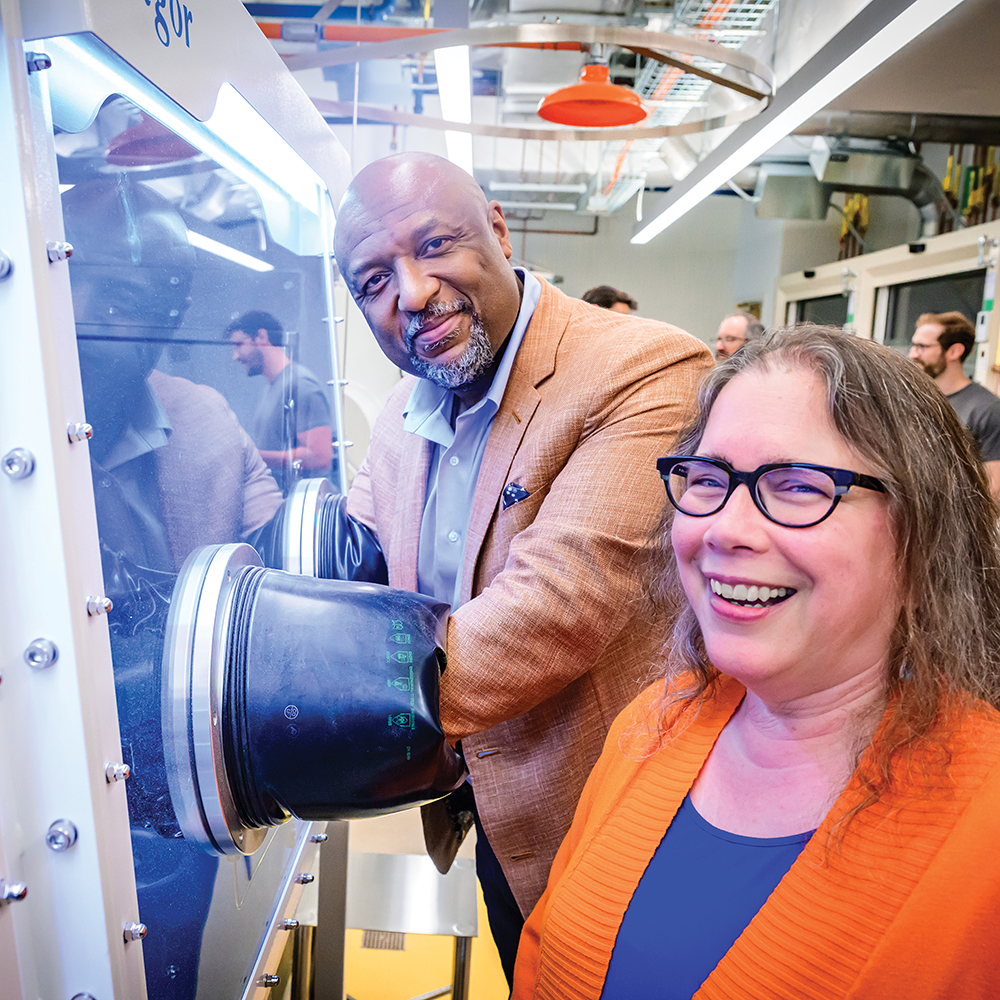
Chancellor Charles L. Isbell, Jr., and Chemistry head Cathy Murphy tour the new Peter Beak Advanced Synthesis Laboratory. (Image by Michelle Hassel)
What drew you to science and technology?
Early on in my life, when I was as young as 8 years old, I knew that I wanted to be a professor, and I wanted to do computer science, although I didn’t know what either of those things really meant. After graduating from high school, I stayed in Atlanta, went to Georgia Tech and had a wonderful time. I was a computer science major from day one, but I minored in Spanish as an undergrad as well as history and psychology. Three minors. You could do that sort of thing at the time if you didn’t realize you were taking too many classes. I wrote plays and poetry in Spanish, and I even had a rap that was half in Spanish that I would sometimes perform. Somewhere along the way, I became an orator. I would give speeches, which taught me how important it is to be able to connect to groups of people.
Tell me more about growing up. I understand you were born in Tennessee, but woke up as the moving truck pulled into Atlanta.
Yes, I became sentient when I landed on Washington Road at the age of three-and-a-half. My childhood in Atlanta was wonderful. I’m the eldest of three boys. We went to public schools. Moved around quite a bit, lived in various parts of Atlanta. Changed schools four times. There was lots of support from my younger brothers and the people around me and my parents. My mother and father were divorced when I was eight-and-a-half. But they’ve stayed friends, and I remain connected with my father. He moved back to Chattanooga and started a barbecue business. The best barbecued pork in all of Georgia, Alabama, and Tennessee. And he’s won the awards to prove it.
Let’s talk about the robot you built in high school.
It really wasn’t much of a robot. But it was about asking myself, “How do I take these motors and these wheels and put them in an encasing? What kind of device can I build to control the robot?” And I fell in love with the idea of being able to create something that was intelligent, something that could play with me. That’s when it really solidified that I was interested in AI (which for a long time was known as machine learning)—creating something intelligent that can understand you, can be a lifelong partner.
How do you view the growing concern over the evolution of artificial Intelligence and its impact on the world?
Amara’s Law says that we overestimate the impact of technology in the short term, and we underestimate it in the long term. When technology is new, we imagine all kinds of things it can do, and they almost never happen. But decades later, the world is a radically different place because of that technology. Take the internet. It’s been around since the 1960s. In the early 1990s, with the creation of the Mosaic browser (which, of course, came out of this university), it became popular. People were talking about how everything was going to change in the next three years. There were predictions about how file-sharing protocols like FTP and Gopher were going to change everything about science. Most of that didn’t happen, certainly not in the next two or three years. The vast majority of people in 1991 did not foresee the impact of the internet on journalism. But now journalism is in a completely different paradigm. Nor did they predict the impact the internet would have on education, with MOOCs [massive open online courses] and other online education options now available to, essentially, everyone in the world. We’ve also now got ubiquitous social media, a completely different way for people to interact with one another, both for good and for ill.
The evolution of AI is comparable. Twenty years from now, the world is going to be a radically different place because of AI. And our job—all of our jobs—is to figure out what that world might look like and how to shape AI so that it benefits the greatest number of people.
That’s a tall order.
We’ve done it before.

“We want alumni to talk to us,” Chancellor Isbell says. “Let us know about the real concerns that they see out there, and what they are hearing.” (Image by Michelle Hassel)
What can alumni do to further the mission of this university?
We want alumni to talk to us. Let us know about the real concerns that they see out there, and what they are hearing. And give us—students, faculty, staff, the administration, everyone—ideas about how we should be thinking about the world. We also want alumni to talk to the world about what this university is doing and what this university is capable of doing. Alumni are our best ambassadors because they can speak from the heart and from their own experiences to the kind of institution we are. We need our alumni to help us communicate with people who’ve never interacted with us, never been a part of this place. The role of alumni is to be a liaison, an ambassador to the outside world and to the university itself.
What would you most like to accomplish as Chancellor?
Here’s what I believe fundamentally. This university should be able to influence every single social, political, and technological decision in the world. We’re big enough, we’re broad enough, we’re powerful enough. We’re deep enough. It should be the case that with anything that anyone is doing out in the world that has import, anything that matters, big or small, someone asks: “What is Illinois’ position on this? How has Illinois worked on this? How can Illinois help us to think about this?” And it may be the role of the chancellor at Illinois to answer those questions. It may be the role of an Illinois faculty member. Those may be questions for alumni of Illinois or friends of Illinois. But Illinois should be top of mind when people are thinking about ways to frame the world, to understand problems about the world, and to solve those problems.
Tell me about the “family tree” of your academic ancestors that hangs over your desk.
On the genealogy chart of my academic ancestry, I am there at the very bottom. Above me are my two Ph.D. advisors. And above them, their advisors. And then their advisors. And their advisors and their advisors and their advisors, going way, way back. Galileo’s in there somewhere, Copernicus is in there somewhere. Also Jacobi and Hess, which is impressive, particularly to an engineer or mathematician. There are a lot of Americans, a lot of Germans, a lot of Italians, a lot of French. The chart describes the world of research and academia over the last several centuries and how I and others are connected to that today. There’s all of this brilliant work that predates me and anything that I ever did. I am just a part of a long story going back.
Remember, we’re all someone’s ancestor. We all want to be good ancestors. We want it to be the case that 25 years from now, 50 years from now, 158 years from now [Editor’s Note: The U. of I. was founded in 1867], those who come after us will look back and say, “This set of people, perhaps in very challenging times, made good decisions. They tried to do what was right, and we are in a better place because of the work that they did.” The future will be built on the way this university thinks of itself. And we want the people who come after us to look back and see us wave to them and say, “Hi.” And know that we did the very best we could.
About the Chancellor
Accolades for work in artificial intelligence, and a commitment to education in computer science
On July 17, 2025, Charles L. Isbell, Jr., became Chancellor of the University of Illinois Urbana- Champaign and vice president of the University of Illinois System. Previously provost at the University of Wisconsin-Madison, Isbell holds a bachelor’s degree in information and computer science from Georgia Institute of Technology, and master’s and doctoral degrees in electrical engineering and computer science from Massachusetts Institute
of Technology.
A long-time faculty member and administrator at Georgia Tech, Isbell built his academic career as an esteemed teacher and mentor, an administrator committed to computer science education, particularly for underserved communities, and a storied researcher in artificial intelligence. Isbell’s work in AI, in his own words, focuses on “how to build autonomous agents that must live and interact with large numbers of other intelligent agents, some of whom may be human”—a complex problem space known to exist in hundreds of thousands of dimensions. He has received numerous accolades, including fellowship in the American Academy of Arts and Sciences. He and his wife, Sheila, have two children, Cody and Joni. —MT