Memory Lane: Lou Henson Comes to Town
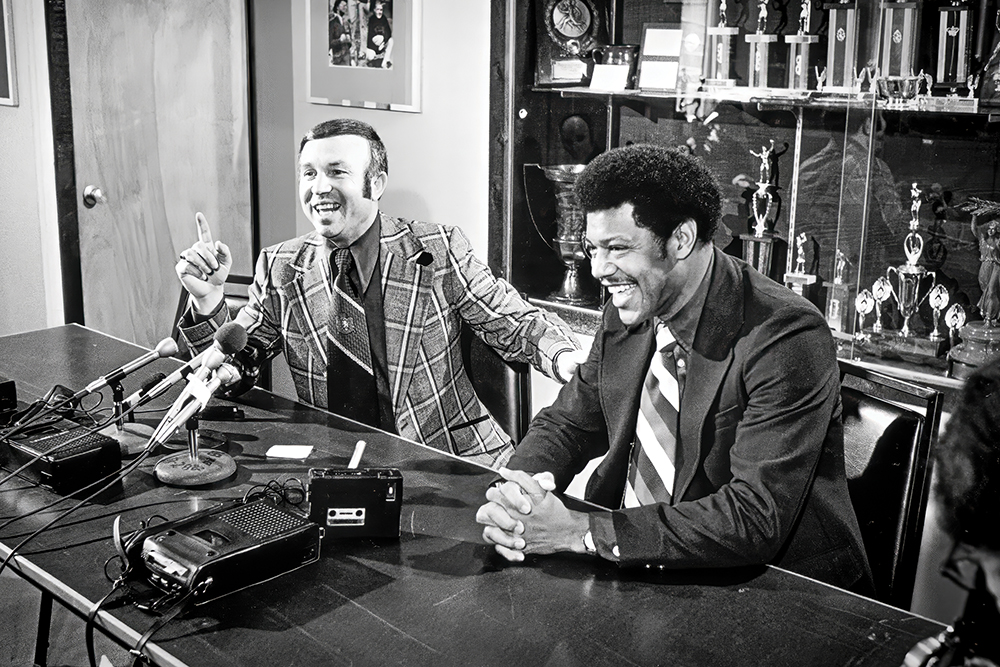
Coach Lou Henson, left, and assistant coach Tony Yates, right, at Henson’s first press conference, 1975. (Image by Michael Smeltzer)
It was a cold April day in 1975, the crisp, clean smell of winter still in the air, and in the Varsity Room of Memorial Stadium an eager crowd gathered to meet the next Illinois men’s basketball coach.
The basketball program was then at a low point, with two consecutive last place finishes in the Big Ten, attendance in a precipitous decline, and the sudden departure of head coach Gene Bartow after only one season.
Two days earlier, Bartow had left for UCLA—then the most coveted coaching job in the nation, following the legendary John Wooden’s retirement—and his resignation had Illini fans reeling. “We’d been counting on him,” says Peter Korst, ’76 ENG, MS ’78 AHS, “and we felt like he abandoned us.”
Fortunately for Korst and the Illini faithful, Athletic Director Cecil Coleman had a plan.
Less than 48 hours after Bartow arrived in California, Illinois had hired a new coach, and as Coleman stepped to the microphone to introduce him, there was an air of excitement among the press conference crowd of reporters and players, who were hopeful that a new regime might signal a change of fortune for Illini basketball.
Virtually everyone in the room expected the new coach to be Don DeVoe from Virginia Tech. In fact, newspapers from all over the Midwest had already reported on his hiring in their morning editions.
So, it seemed to be nothing more than a formality when Coleman stood before them and announced that the new head coach of Fighting Illini men’s basketball would be…Lou Henson from New Mexico State.
The crowd gasped—genuinely shocked—not only because the press had gotten it wrong, but also because so many of those present were unfamiliar with the 43-year-old Henson—despite his track record, which included a 1970 Final Four appearance, five NCAA tournament teams, and 11 winning seasons.
“I was in the room,” says retired photojournalist Michael Smeltzer, ’72 LAS, MS ’83 MEDIA, “and the initial reaction from some of the players was, ‘Lou who?’ [But] the more they listened to Lou talk, the more they warmed up to him. By the time the press conference was over, everybody in the room was on board.”
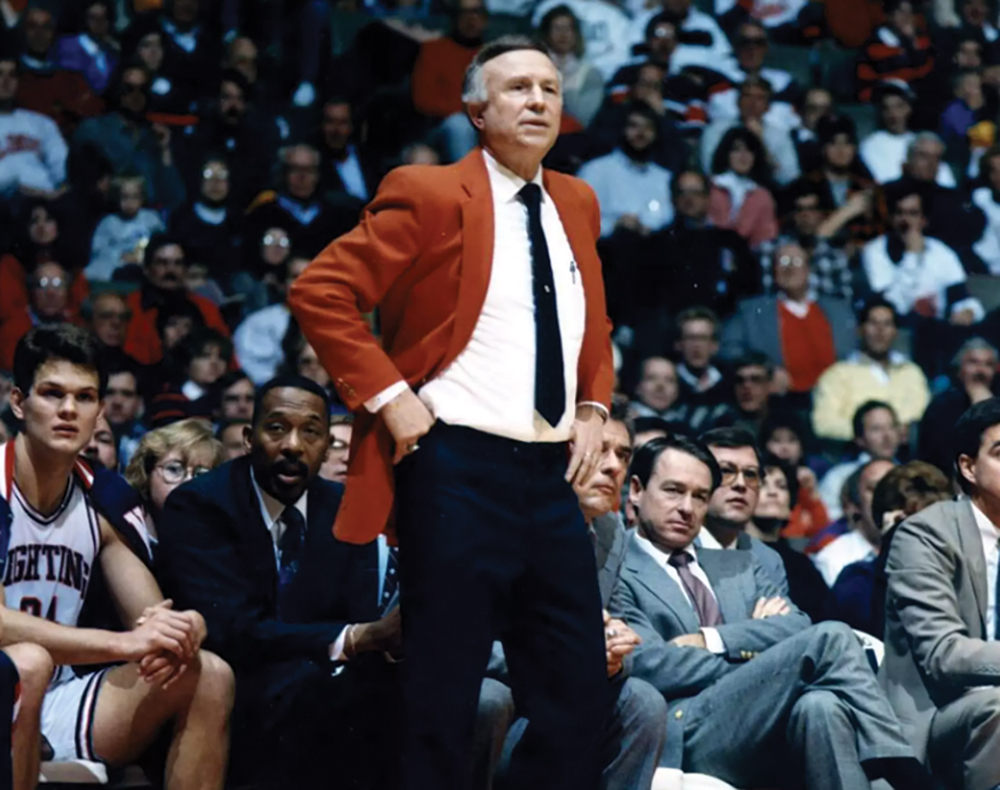
In his first season at Illinois, 1975–76, Lou Henson’s trademark “Lou-Do” hairstyle was in full effect, but he had yet to discover his famous orange sportscoat. (Image courtesy of U. of I. Division of Intercollegiate Athletics)
Just as Coleman knew they would be. He had worked closely with Henson years earlier, when they were both athletic directors in the Missouri Valley Conference. Coleman knew exactly who, and what, he was getting by hiring Henson. It would be the most consequential hiring in the history of Illinois basketball.
Over the next 21 years, Henson would prove his mettle over and over again, with 19 winning seasons and 12 NCAA tournament appearances, and Illini fans would come to love him—not only for his success on the court, but also for his integrity, sincerity, candor, and humor, which often put the people around him at ease.
Those qualities were apparent at his first press conference. Whereas many new coaches would overpromise or talk with zeal about the great season ahead, Henson was realistic. He made no bones about the challenges he faced. “I think Illinois can be a national power,” he said, “but I realize that it’s not going to happen overnight.”
Henson had been in this situation twice before, taking over a failing college basketball program and turning it into a winner. Hearing him talk, the audience felt confident that he could do it again—this time at Illinois.
Privately, Henson understood just how difficult this job would be, later writing about the “general apathy” fans and the university then felt about the basketball team, as well as the U. of I.’s inability to recruit in-state high school players (especially from Chicago), who weren’t even willing to make official visits to campus. What’s more, to the vast majority of Illini basketball fans, Henson was an unknown quantity. And an outsider in Illinois, which made his job even harder.
Henson knew that to succeed, he would have to change those things. And his first step towards meaningful change was in talking to people.
“That first year, Lou and his staff visited more than 400 high schools [in Illinois],” says the News-Gazette sportswriter Loren Tate, ’53 MEDIA. “They wanted to form as many relationships with coaches as possible.” Over time, all those hours on the road paid off, and throughout the 1970s, ’80s, and ’90s, Henson’s teams featured elite players from throughout the state who would later play in the NBA, including Eddie Johnson, ’83 LAS, Nick Anderson, and Kendall Gill, ’93 LAS.
But his first season at Illinois would be rough, and he spoke openly about it.
“One day, Lou was talking to a class of students,” recalls then-Illio sports editor Ken Dunwoody, ’76 MEDIA, and he said, ‘Do you see this table in front of me? It could get around most of our players!’”
But, jokes aside, Henson took that 8-18 team from the year before and led them to a winning record (14-13).
How? “Lou’s teams controlled the ball,” says Tate, “and they played outstanding defense.”
For Illini fans, after the down years and the departure of Bartow, Henson’s early results were encouraging.
“It was great to see the progress,” says Al Pacer, ’71 BUS. “That was the second year in a row Indiana went undefeated in Big Ten play, but after Lou took over, the disparity between the two programs quickly narrowed.” Even against that all-time great Indiana team (which would go on to win the national championship, with a 32-0 record), Henson’s Illini kept the score close on the road, losing by only 10 points.
“We knew we didn’t have a good team that year,” adds Korst, “but we also felt like Lou was keeping us in most games.”
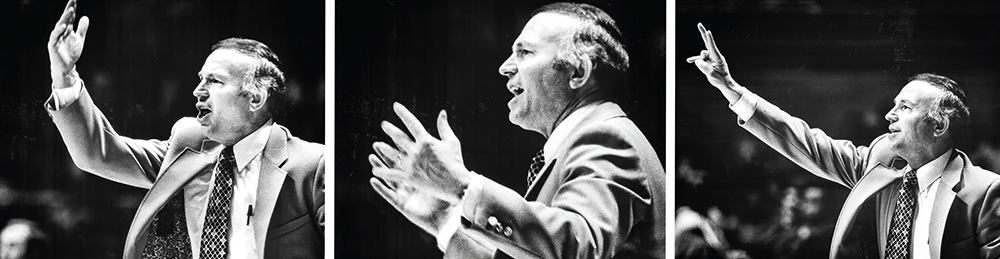
Lou Henson’s passion for basketball, competitive nature, and devotion to his players was obvious to anyone who saw him on the sidelines. (Images by Micheal Smeltzer)
Sometimes, Henson did that by surprising the opposition. Famously a proponent of man-to-man defense—driving around campus, he would even roll his window down and shout “play man-to-man” at playground pick-up games—Henson upended Nebraska’s scouting report by starting out in a zone. “Lou almost never played zone,” says Tate, so the tactic was jarring, and it worked: Illinois won the game, 60-58.
Slowly, but surely, Coach Henson turned Illinois into one of the nation’s best college basketball teams by recruiting players that fit into his system, preparing for each game as if it were the national championship, and forming strong relationships with his student athletes, who wanted to make him proud, both in basketball and in life.
But winning is not the only thing that endeared Henson to Illinois basketball fans.
They also loved him for the respect he showed to his players. In post-game radio interviews, Henson was not shy about pointing out what he saw as the team’s mistakes or things they needed to work on, “but he would not pick out an individual,” says Tate. “Everything was about the team. ‘We didn’t play defense, we didn’t pass the ball,’ and so on. He would never call out a specific player.” His deep respect for and kindness towards his players was obvious to anyone who listened.
For many alumni, that kindness was among Henson’s defining qualities. Whether he was talking with a new recruit, a reporter, a fan on the street, or an undergrad on campus, he treated everyone the same: with respect and genuine courtesy.
“When I met Coach Henson, I was 21 and newly married,” says Alan Solow, ’76 LAS, who worked at Henson’s summer basketball camp and became a lifelong friend. “He was the first adult who treated me as an equal. If he asked me a question and I gave him an answer, he treated it seriously. What that did for my self-confidence, at that age, was transformative. It changed my life.”
For those who knew him, Henson’s success was not at all surprising. “If you spent 15 minutes with him,” says Solow, “you knew he was going to succeed. He had tremendous confidence. He had a track record that he really didn’t brag about. And he had a clear basketball philosophy that he could articulate. He gave you the sense that he knew what he was doing. He was also one of the most competitive people I’ve ever known, and I mean that in a good way. He didn’t like to lose. He played to win.”
When Henson retired from Illinois in 1997, he left behind a legacy that most college basketball coaches aspire to: a school record of 423 wins, a 1989 Final Four team (boasting a roster made up entirely of players from the State of Illinois), one Big Ten title, and hundreds of former student athletes whom he guided both on and off the court, with one main goal: to help them grow into good humans and responsible adults.
In 2015, the university recognized Coach Henson’s central place in Illinois basketball history by naming the court at State Farm Center in his honor. Lou and his wife Mary—who’d been his confidant and sounding board for his entire career—were on the floor, both decked out in orange and blue, beaming, with a sell-out crowd on its feet. It was a fitting tribute to one of the true giants of college basketball, and you can rest assured that no one present was asking, “Lou who?”
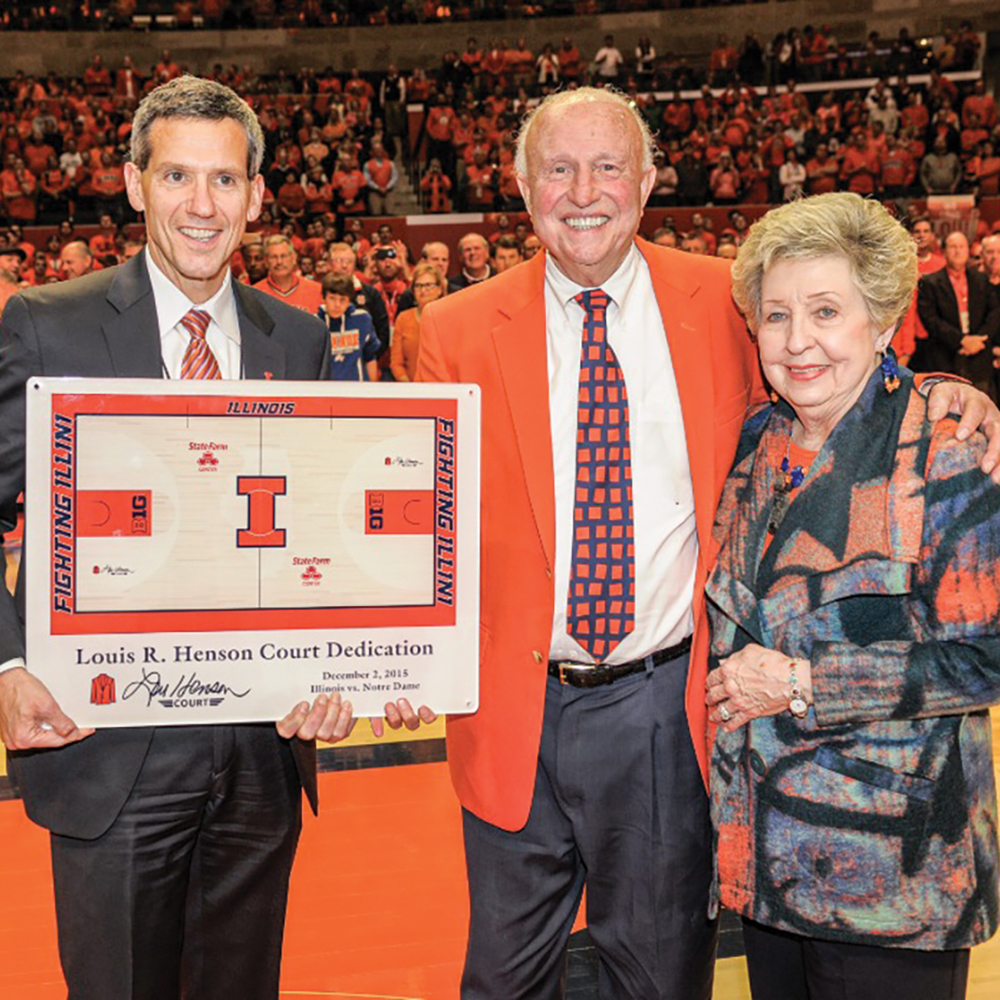
In 2015, the U. of I. renamed the court at State Farm Center in Henson’s honor. (Image courtesy of U. of I. Division of Intercollegiate Athletics)
ORANGE KRUSH
How I helped Coach Henson create the nation’s greatest cheering section
By Willard Broom
In the summer of 1975, I was a young assistant dean of student programs and services. One day, I received a call from the basketball office asking if I’d have lunch with Coach Lou Henson, who had an idea and needed some help.
Coach had convinced the Assembly Hall to add 150 seats to the floor for a student cheering section as a way to bring more energy to the arena. But he needed help finding students to sit there. That would be my task, and I readily agreed. How hard could this be?
Almost impossible, as it turned out!
Student interest in basketball was at an all-time low, and I couldn’t give the tickets away. Eventually, I found a core group of 20 undergrads who felt confident that they could fill the seats.
I asked Coach Henson if he could tell the students about his idea himself, and a couple weeks later, we went to his house. Mary Henson made snacks, we had a nice visit, and Coach did an inspiring job of explaining what he wanted them to do.
“I would like for you to stand at the beginning of the game and cheer the team’s defense! In fact, stay standing until the other team scores!” he said, in what would turn out to be an iconic instruction.
Coach’s enthusiasm sparked an already-excited group, and they easily found enough students. The group called itself “Orange Crunch.”
Over the past 50 years, Orange Krush (as it’s now called) has grown into one of the nation’s best-known cheering sections. Today it still begins each game by cheering on the Illini defense, standing until the opponents’ first made basket—just like Coach Henson wanted. And they cheer for our offense, too!
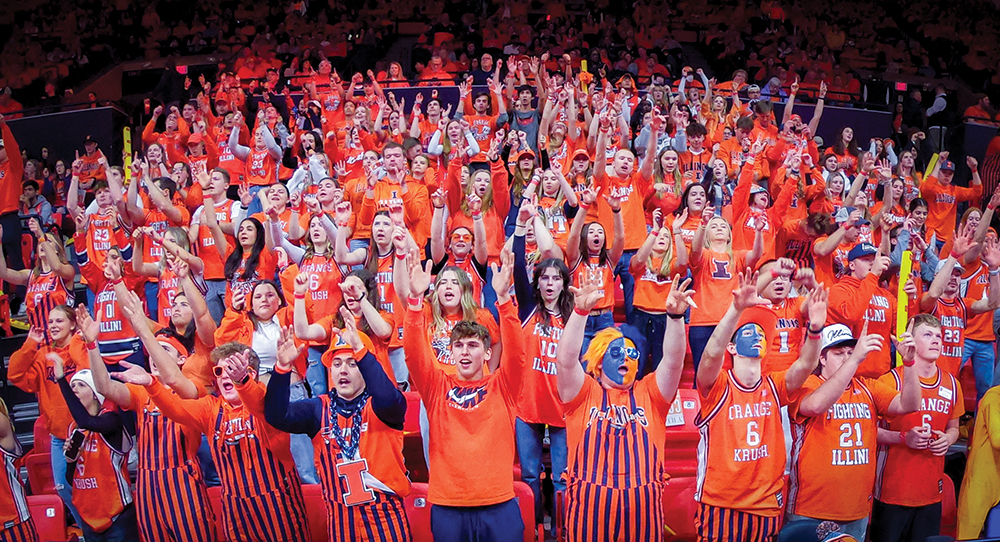
Members of the Orange Krush cheer on the Fighting Illini mens basketball team. (Image by Fred Zwicky)