Brighter Future
From tiny life forms that inhabit the gut to a satellite in orbit a million miles out in space, research at Illinois journeys along an infinite scale spanned by science, technology, and human vision. The discoveries are no less astounding than the range of these inquiries into the nature of life, the universe, and everything else. What follow are the stories of 10 ongoing research projects at the U. of I. and their payoffs, from practical to transformative, that make the ever-evolving quest for knowledge endlessly worthwhile.

Current innovations include AI-enabled, real-time remote sensing to monitor land and livestock using airplanes, satellites, ground sensors, and, of course, drones. (Image by Coit/Grainger College of Engineering)
CROP SCIENCES
Tomorrow’s Agriculture Now
The Project: I-FARM
Forty acres and a mule this is not. Start instead with 80 acres of prime Champaign County land, about a mile from campus. No plow-pulling equines at this unique U. of I. farm. Intelligent devices do the planting. Weeding, too. Machines soar overhead to check out crop conditions. Domestic animals are tricked out in sensors that monitor their weight, health, and location.
Synergy and sustainability are the bottom line at I-FARM (Illinois Farming and Regenerative Management), a test bed to develop agricultural technology that is “fundamentally more sustainable, profitable, affordable, and scale-neutral,” says ACES professor Girish Chowdhary, primary investigator on the three-year, $3.5 million project. Innovations under development include AI-enabled, real-time remote sensing to monitor land and livestock using airplanes, satellites, ground sensors, and, of course, drones. An app will allow farmers to access the data they collect on their farms with an integrated dashboard customized to their particular needs.
A clever little robot plants cover crops while the corn is still growing; another knows how to spot-weed (no more pesticides!). A collaboration among NCSA, iSEE, and the Center for Digital Agriculture at Illinois, with significant support from the USDA, I-FARM is conceived as a living laboratory and offers regular workshops, field days, and webinars for the farming community.
The Payoff: Reduced labor and healthier, more abundant crops for farmers, and budget-friendly food for consumers nationwide.
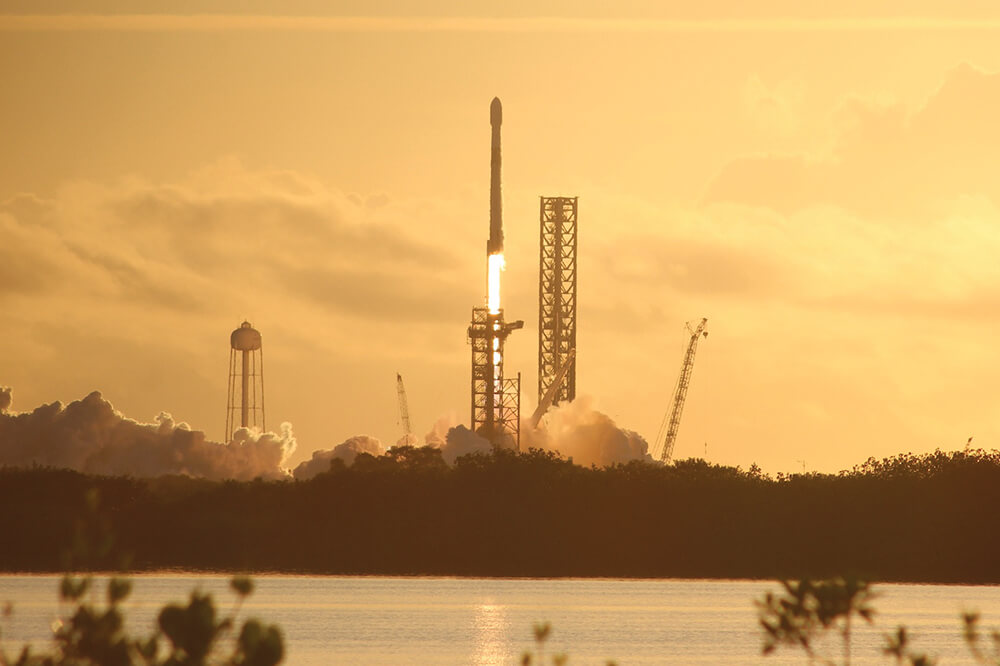
As part of a $75 million NASA mission, the 531-pound observatory blasted off on Sept. 24, 2025, aboard a Falcon 9 rocket. (Image by Andy Olson)
ASTROPHYSICS
Investigating Earth’s Outermost Atmosphere
The Project: Carruthers Geocorona Observatory
Halfway to the sun, a tiny satellite orbits through space, looking at beautiful old Earth and reporting on our planet’s outermost layer of atmosphere. Back in the terrestrial realm, mission leader Lara Waldrop, a U. of I. electrical and computer engineering professor, positions the craft and its cameras to collect data from almost a million miles away. “These ultraviolet cameras on their own spacecraft platform (that we have full control over) are unlike any other experiment that NASA’s ever done,” she says. “We can point anywhere we want.” And, in this case, they’re pointing at the exosphere, Earth’s major protector from space weather, including solar winds and geomagnetic storms, which can affect satellites in orbit, radio communications, air travel, and even power grids.
As part of a $75 million NASA mission, the 531-pound observatory blasted off on Sept. 24, 2025, aboard a Falcon 9 rocket headed to L1, a point in space where the gravitational pull of Earth and the Sun is equal and opposite. This positioning allows the Carruthers Geocorona Observatory to remain in a stable orbital position as it surveys and maps the entirety of the exosphere, including the ultraviolet emissions and hydrogen atoms that form the geocorona (Latin for Earth’s crown). The observatory is named for pioneering astrophysicist George Carruthers, ’61 ENG, MS ’62 ENG, PHD ’64 ENG, who invented the gold-plated telescope that took the first photos of the exosphere from the Moon, as part of the Apollo 16 mission in 1972.
The Payoff: More secure communications and electronics technology on Earth and greater safety for airplanes and astronauts in the upper atmosphere.

“Sports clubs and tourism are powerful institutions that are very often not seen as serious,” says AHS professor Joelle Soulard. (Image by Jen Dahlgren/123RF)
COMMUNITY RESILIENCE
Outplaying Fascism
The Project: Far Right or Far from Right? Examining Community Resilience to Right-Wing Extremism in
German Leisure Contexts
Last June, AHS professor and history buff Monika Stodolska took a tour that followed the World War II campaign of the U.S. 101st Airborne from Normandy Beach in France to Germany. One stop was the site of Berghof, Adolf Hitler’s summer home, razed by the German government after the war. Stodolska, herself a native of Poland, expressed regret that the residence didn’t still exist as a reminder of Hitler’s atrocities. “Our tour guide replied, ‘As if we didn’t have enough brown tourists already,’” she recalls. This was the first Stodolska had heard of brown tourism (aka, braun tourism), which focuses on nostalgia for Nazi sites and is part of a growing far-right movement that promotes authoritarian and racist values, and extends to Nazi military reenactments and desecration and erasure of concentration camp sites. After learning this, Stodolska says, “I started seeing brown tourism everywhere.”
When she got back to the States, she joined with colleagues Joelle Soulard, who is French and, like Stodolska, researches leisure and behavior, and Yannick Kluch, a German native whose studies focus on sports and social justice. Supported by a grant from CHAD, they launched a pilot study of sports clubs, tour com- panies, and museums in Europe—places where it is, unfortunately, common to encounter openly resurgent Nazi values. In response, resistance, too, is openly building. “Some sports clubs are known for a strong culture for fighting fascism,” says Kluch, who is originally from Hamburg. “Those clubs are where we started.”
Their team has conducted in-person and online interviews with tour guides, museum and sports club employees, historical reenactors, and sports fans in Germany, Poland, and Austria about their experiences with right-wing extremism and community resistance. The project’s aim is to identify behavior and practices that provide guidelines for resistance to populism and authoritarianism, which are undermining democratic governance worldwide, especially in South America and parts of Europe. “Sports clubs and tourism are powerful institutions that are very often not seen as serious,” says Soulard. “But when you think about their power, it can be used for good, and we think that this should be really amplified.”
The Payoff: A proven grassroots framework for enhancing community resilience and well-being in the face
of extremism.
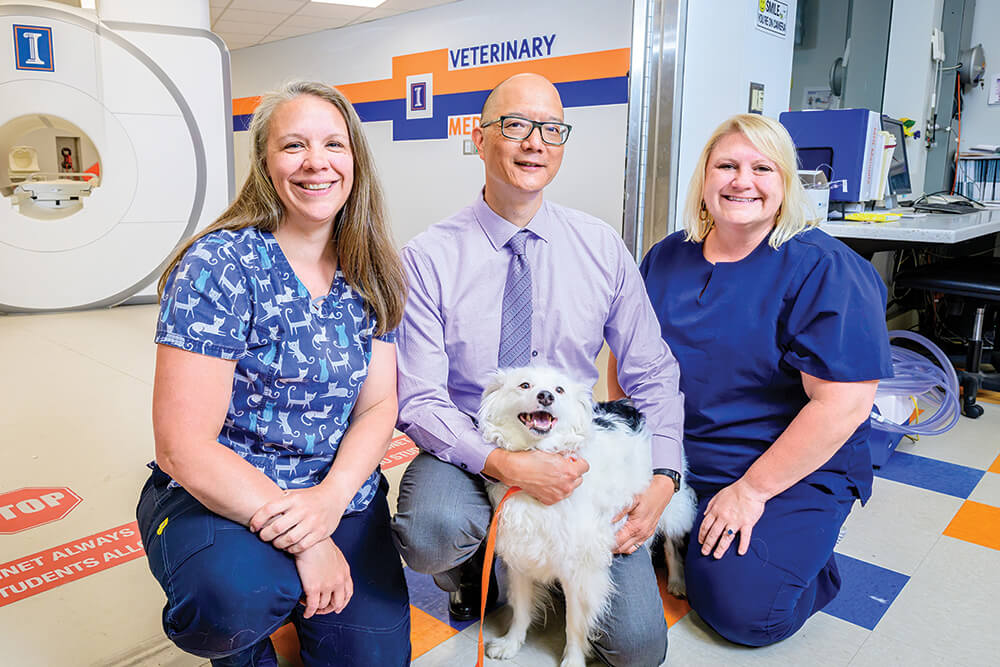
Vet Med colleagues Rebecca Kamerer (left) and Joanna Schmidt work with Tim Fan (center), who leads research on therapies that trigger the body’s natural immune responses to cancer. (Image by Fred Zwicky)
CANCER RESEARCH
Friends For Life
The Project: From Pets to People
Dogs have walked alongside people for uncounted centuries, as helpful hunters and beloved pals. Now, a special new role for canines has emerged as cancer patients whose treatment can help humans. Certain cancers in dogs and cats evince close genetic resemblances to those types of cancers in people. Promisingly, “we are finding that some of these cancers respond similarly to the same therapies,” observes Tim Fan, PHD ’07 VM, a Vet Med professor who is among the U. of I. researchers conducting investigations under the auspices of IGB on the health connections between pets and people.
Fundamental to the research, much of it funded by the NIH, are clinical trials, a range of which are currently addressing cancers in dogs, including osteosarcoma, melanoma, B-cell lymphoma, and bladder cancer.
An especially encouraging initiative is the use of new drug-delivery approaches to safely harness cytokines,
inflammatory proteins that stimulate the immune system but can be toxic if they escape into the bloodstream. Dezzi, a dog whose malignant melanoma of the mouth had survived many conventional therapies, is now four years out from a clinical trial deploying cytokine therapy and has had no recurrence of the disease. The resilient canine patient recently celebrated his 16th birthday. Northwestern University and MIT have been collaborators on the immunotherapy research, which is now being used in human clinical trials.
The Payoff: Life-saving treatments for people and animal companions diagnosed with cancer.

The software taps a high-tech food recognition database that can identify and analyze millions of dishes and meals, from cheeseburgers and fries to pad thai and lamb curry.
NUTRITION
Better Food by Phone
The Project: Visual Nutrition
Whether daydream or nightmare, a chatbot that can track and assess what you eat could one day talk to you on your phone. Using NCSA computer resources, U. of I. faculty and student researchers are preparing an app called Visual Nutrition, which measures the nutritional content of individual meals and provides the user with a detailed diet plan and specific ideas for how to substitute healthier foods for less salubrious ones.
The app analyzes photos of meals that users upload, along with information about their health and dietary needs and goals. No surprise that it works using AI. The software taps a high-tech food recognition database that can identify and analyze literally millions of dishes and meals, from cheeseburgers and fries to pad thai and lamb curry. Customized feedback about sensible and tasty dining choices is sourced from the USDA.
Altogether, there’s a lot for the Visual Nutrition chatbot to share. “It’s like having a nutritionist in your pocket,” quips NCSA’s Volodymyr Kindratenko. Each time you take a picture of your food, it records the carbs, calories, micronutrients, and other data and tells you how healthy the food is. And you can ask it to suggest substitutions. With Sharon Donovan, who holds an endowed chair in health, food science, and human nutrition at Illinois, Kindratenko co-leads the project, which is funded by the Personalized Nutrition Initiative and housed at the IGB. Eventually, Visual Nutrition is expected to be downloadable by consumers through Apple’s App Store and become a platform that can support advanced research in nutrition.
The Payoff: Up close and personal access to nutritional information about the fare you should include in your diet and the food you’re eating right now.
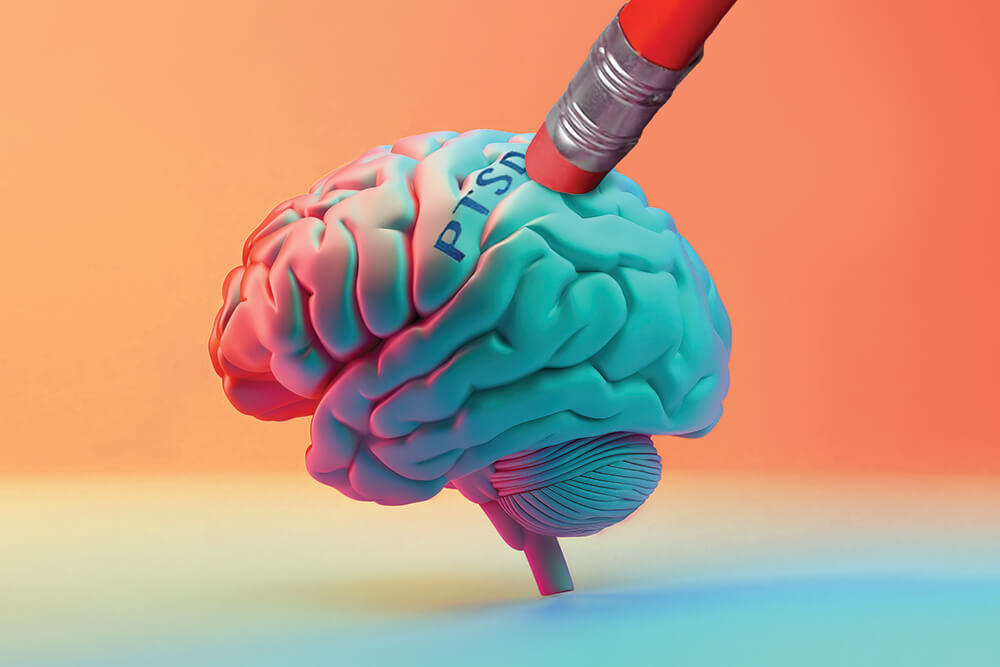
Approximately one-third of the world’s population suffers from PTSD, trapped in the shock and horror of the original trauma, reliving it again and again when triggered by stimuli. (Image by Jen Dahlgren/123RF)
NEUROLOGICAL SCIENCE
Vanquishing PTSD
The Project: Emotions and Memory Systems Laboratory
Memories come, go, and change. But can they be erased? That’s the question being asked at Illinois by a Beckman research group, whose investigations are taking them deep into the brain. Supported by NIH, their work at the Emotions and Memory Systems Laboratory centers on post-traumatic stress disorder (PTSD), the persistent and devastating psychological reaction precipitated by horrifying events such as those experienced in war, terror, physical attack, and sexual assault. Approximately one-third of the world’s population suffers from PTSD, trapped in the shock and horror of the original trauma, reliving it again and again when triggered by stimuli, such as sounds, that evoke those experiences.
PTSD is stored in the brain and the body, which, when triggered by stimuli that evoke the original trauma, respond with feelings of fear and panic, elevated breathing, and rapid heart rate. These reactions are also reprised in nightmares and flashbacks. Current treatment focuses on inuring patients to the disorder by repeatedly inducing the PTSD-caused stress until the physical symptoms no longer occur. Led by institute director Steve Maren, ’89 LAS, the Beckman project is instead focusing on how to disrupt PTSD-related memories. Working with laboratory animals, the team has imaged areas of the brain that fire when exposed to fear-arousing noise, including the amygdala, hippocampus, and thalamus. Ultimately, Maren says, “we hope to start manipulating these parts of the brain to modify that response to either eliminate the negative associations of a memory or remove it altogether.”
The Payoff: In the short term, a wearable device that can tap into the brain to suppress fear memories in real time before they cause distress and dysfunction. In the future, pathways to treat addiction and Alzheimer’s disease, as well as PTSD.
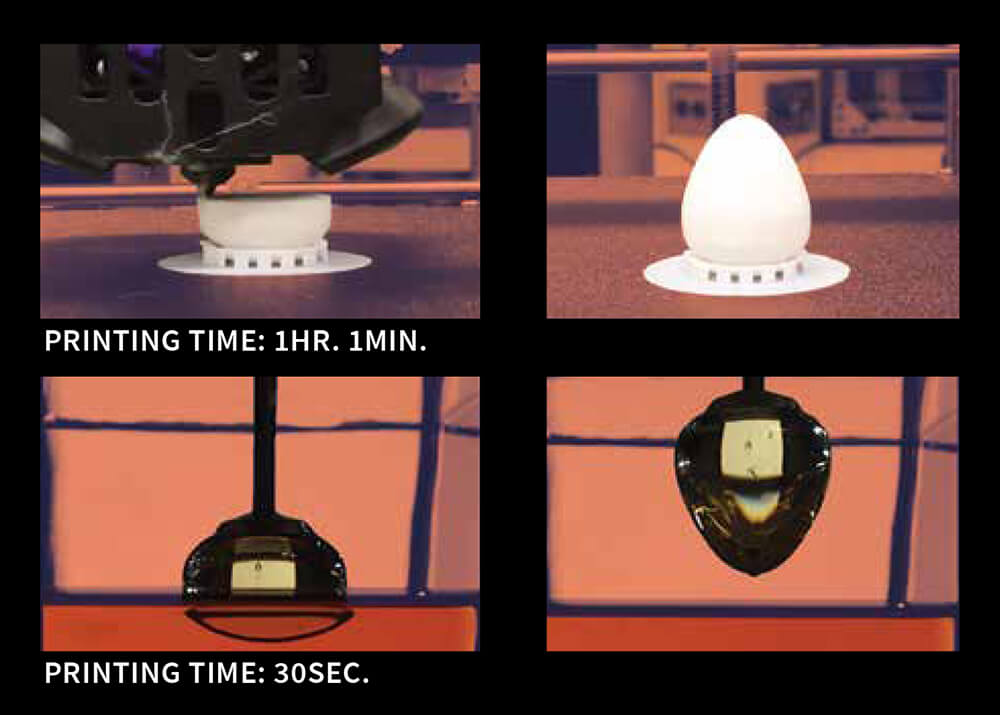
The model builds on adaptive manufacturing, a method that layers polymers in a manner familiar to anyone who’s ever operated a desktop 3D printer. (Images courtesy of Beckman Institute for Advanced Science and Technology)
MATERIALS ENGINEERING
More Malleable 3D
The Project: Growth Printing
Two U. of I. engineers have a new process in hand: a 3D printing breakthrough that facilitates production of round, spherical, and irregularly shaped objects. Dubbed “growth printing,” the new technology deploys rapid heating and cooling of resin to allow the operator to shape objects as they emerge from the printer in a freehand process akin to glassblowing. With support from Beckman, Sameh Tawfick (mechanical science) and Philippe Geubelle (aerospace) designed the process based on how the fast-growing trunks of bamboo plants expand and adapt as they get bigger.
An alternative to the expensive injection molds required in most industrial 3D printing, the model builds on adaptive manufacturing, a method that layers polymers in a manner familiar to anyone who’s ever operated a desktop 3D printer. “Polymer 3D printing equipment has matured, but there are still aspects that make it expensive and very slow,” Tawfick says. “Our goal was to increase the manufacturing speed, size, and material quality while maintaining a low cost. This process is truly fast and inexpensive.” Tawfick, Geubelle, and their team have produced replicas of irregularly shaped natural objects that would have been impossible to create on a conventional 3D printer, such as a pinecone, a raspberry, and a squash. As well as versatile, the process is scalable, with the potential to print very large objects, including wind turbine blades.
The Payoff: Faster, cheaper, more adaptable 3D printing capable of producing objects of many different shapes and sizes on printers ranging from small units for home and office use to large-capacity industrial machines.

The model deploys vanguard technology in AI and optical imaging to ensure that tumor tissue and cells are completely and efficiently excised in surgery. (Image Courtesy of Stephen Boppart/Interdisciplinary Health Sciences Institute)
CANCER RESEARCH
Precision Tumor Surgery
The Project: MarginDX
The margins are a matter of life and death in cancer treatment. When a tumor is surgically removed, no trace of it can be left behind, lest the malignancy remain embedded and impel a recurrence of cancer in the patient’s body. Defining clean margins is extremely challenging for surgeons, who must rely on physical reviews of tissue sometimes several times during a single procedure by a pathologist in attendance outside the operating room.
Last year, U. of I. bioengineer Stephen Boppart, ’90 ENG, MS ’91 ENG, launched a five-year, $33 million ARPA-funded initiative to advance cancer surgery with MarginDX (Margin Diagnostics), a new paradigm for tumor removal. The model deploys vanguard technology in AI and optical imaging to ensure that tumor tissue and cells are completely and efficiently excised in the operating room. The technology allows the surgeon to examine tissue microscopically, using a freehand surgical imaging probe and a robotic arm, with immediate tissue analysis provided by AI.
A benchtop prototype of MarginDX was completed last fall, the product of what Boppart describes as “a heroic effort” in a mode more like a start-up company than an academic research laboratory. A team of more than 75 researchers from Beckman, NCSA, and other U. of I. units, as well as Mayo Clinic and industry and clinical collaborators, worked on optics, robotics, AI, data, and other factors. A single-cart platform suitable for clinical use is the next goal, with the ultimate aim of having MarginDX rolling out for use nationwide and around the world by 2029.
The Payoff: Radically improved surgical and recovery prospects for patients diagnosed with operable cancers.

“In this project, we take the waste and recover the energy and materials to make a usable product,” says ACES professor Yuanhui Zhang. (Image by Jen Dahlgren/123RF)
CLEAN ENERGY
Flying Green
The Project: SAF
Food waste is a cruel anomaly in a hungry world, where more than 30 percent of food is trashed as it moves from farms, transportation, and processing to retail, foodservice, and households. So—why not turn that waste into jet fuel? Improbable as
the idea may sound, that’s exactly what two ACES researchers are doing. With support from the NSF and U.S. Dept. of Energy, post-doc Sabrina Summers, PHD ’25 ENG, and bioengineering professor Yuanhui Zhang have created a two-step process to manufacture SAF (sustainable aviation fuel) from leftovers.
First, a thermochemical process converts biowaste—a category that includes sewage, algae, manure, and agricultural residue as well as food—into high-energy biocrude oil, a petroleum product akin to naturally occurring crude oil. In the second step, the biocrude oil is catalyzed to remove unwanted elements and refined into sustainable aviation fuel. “In a linear economy, we just produce something, use it, and throw it away,” observes Zhang. “In this project, we take the waste and recover the energy and materials to make a usable product” in a circular paradigm essential to an eco-friendly, self-sustaining economy.
Amazingly, SAF forms a loop that reduces carbon emissions during production and transportation as well as combustion, with 80 percent fewer emissions than traditional jet fuel. SAF is also amenable to an abundant range of feedstocks and thus to large-scale production. The fuel has already passed rigorous industry standards, and Summers and Zhang are now
focusing on how to ramp up the
manufacture of SAF.
The Payoff: The aviation industry advances its goal of net-zero carbon emission by 2050. Farther along, SAF could replace other materials, such as petroleum-derived compounds for making plastics.

Research has begun with the study of phages in the mouth, where bacterial pathogens foment tooth decay, gum disease, cardiovascular disease, Type 2 diabetes, and cancer. (Image courtesy of Hatoum-Aslan Lab)
INFECTIOUS DISEASES
Viruses as Guardians
The Project: MIGHTY
In the microbiome, the dynamic realm of the body where trillions of microorganisms support and undermine the health of humans and other living things, phages are guardians of the good, attacking and killing specific unfriendly bacteria while leaving beneficial bacteria unharmed. Not only do these viruses hold the promise of more effective medical treatments of pathogen-borne illnesses, they could become the basis of an alternative to antibiotics, which work by killing off good and bad bacteria indiscriminately.
Under the auspices of the IGB at Illinois, researchers have embarked on MIGHTY (Microbe/phage Investigation for Generalized Health TherapY), a $28 million, federally funded investigation into how to transform phages into antimicrobial agents that can target specific pathogens. In collaboration with several other institutions, the aim is to create a platform to identify phage combinations that will eradicate specific harmful bacteria. Research has begun with the study of phages in the mouth, where bacterial pathogens foment not only tooth decay and gum disease but cardiovascular disease, Type 2 diabetes, and cancer. “Our long-term goal is to usher phage-based therapeutics into mainstream medicine as routine and widely accessible treatments,” says project lead Asma Hatoum-Aslan, a U. of I. microbiologist. “A simple product for oral care is just the start. This platform will support solutions for gut, metabolic, and autoimmune diseases as well.”
The Payoff: Beginning with an easy-to-use, low-cost product, such as a chewable gummy that will improve oral health for everyone, the research promises precision microbial treatments that extirpate specific destructive bacteria.
Units referenced in this article At the University of Illinois Urbana-Champaign
ACES—College of Agricultural, Consumer, and Environmental Sciences
AHS—College of Applied Health Sciences
Beckman—Beckman Institute for Advanced Science and Technology
CHAD—Center on Health, Aging, and Disability
Engineering—The Grainger College of Engineering
IGB—Carl R. Woese Institute for Genomic Biology
iSEE—Institute for Sustainability, Energy, and Environment
LAS—College of Liberal Arts & Sciences
NCSA—National Center for Supercomputing Applications
Vet Med—College of Veterinary Medicine
Elsewhere
ARPA—U.S. Advanced Research Projects Agency
MIT—Massachusetts Institute of Technology
NASA—National Aeronautical and Space Administration
NCI—National Cancer Institute
NIH—National Institutes of Health
NSF—National Science Foundation
USDA—U.S. Dept. of Agriculture