My Alma Mater: Field School
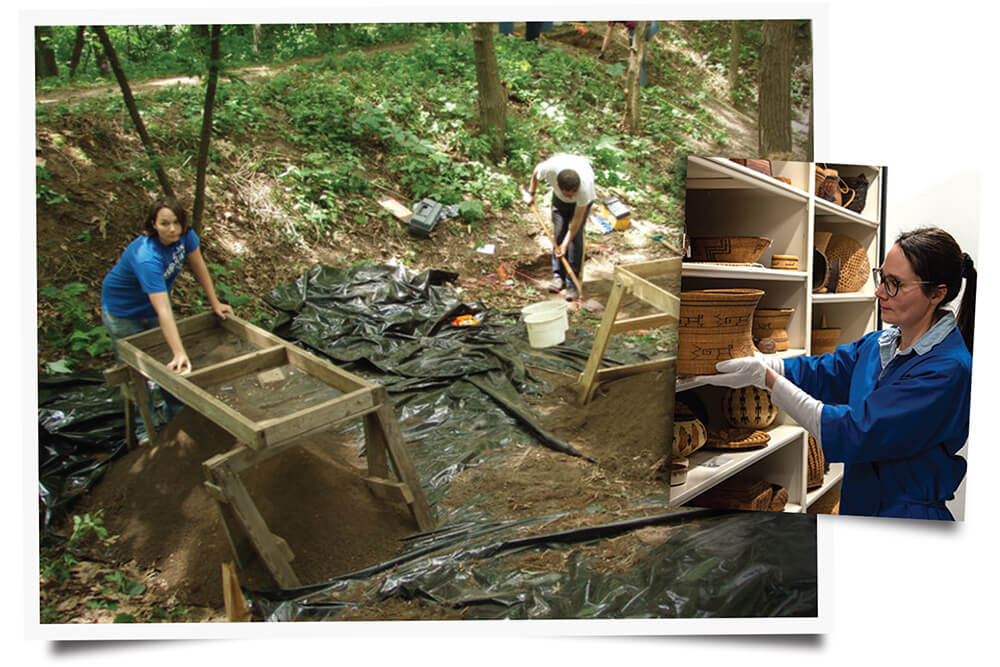
Jennifer Grove’s experience at a U. of I. archaeological field school inspired her to pursue a career in museums. Left: Grove (in blue) at the field school. Right: In collection storage at the Spurlock Museum. (Images courtesy of Jennifer Grove)
The first and most important class I attended through the U. of I. took place not in a campus building, but on the hills of a small town in Wisconsin, at an archaeological field school. Led by Professor Tim Pauketat, the excavation focused on Mississippian settlements linked to the great city of Cahokia. Fifteen years later, one moment from the class stands out as life-changing, and it inspires the work I do today at the Spurlock Museum of World Cultures.
It was about four weeks into our program. At that point, my classmates and I were all used to the daily routine of mapping, note-taking, and not finding very much (except for a lot of dirt). One afternoon, I was digging in a shady spot and found two pieces of chert, the material that stone tools are made from. I wiped them off a little and showed them to one of the lead archaeologists, Robert “Ernie” Boszhardt. I dropped the two flakes of chert into his hand and they fell into each other, clicked into place, and fit together like perfect puzzle pieces.
Ernie exclaimed that had never happened during his 30-plus years in the field! I had found two pieces that had been simultaneously knocked off a larger stone tool in the sharpening or shaping process. In addition, the source of this chert was from the region surrounding Cahokia, more than 400 miles from the dig site in Trempealeau, Wis.!
After excitedly showing the matched pieces to a few people, Ernie handed them back to me, and I returned to my unit. I sat at the edge of the rectangular dirt hole, held my find, and was overcome with a profound sense of human connection across time and space.
This stone had been mined hundreds of miles away, and I considered the trade network it must have passed through, from person to person, each traveling by foot and canoe up the Mississippi River Valley, all the way to this community—to the person who held in their hands what was now in mine.
Someone had been here, right here, nearly a thousand years ago. Antler met stone (Strike! Strike!)and these two flakes fell away, were discarded, buried, and waited for a millennium—for a naïve teenage girl from central Illinois who happened to dig in just the right spot. They waited in the ground, and I saw a glimmer of the person who touched them, shaped them in the creation of a tool they used to sustain themselves and their family. Part of their story was in my hands, and this sense of human connection is why I wanted to preserve material culture as my career.
After my field school experience, I started that process by getting a student position at Spurlock. Working there taught me that while lectures, books, and screens can provide you with valuable information, they lack the tactile and sensory experience of sharing physical space with an historical object. More than a decade later, I am now a staff member at the museum, where I care for personal and societal belongings that hold the stories of those who created, used, and shared them. I am here, doing this work I love, thanks to that U. of I. field school and those two pieces of chert, waiting for me in the Wisconsin earth.
Jennifer Grove is collections storage coordinator at the U. of I.’s Spurlock Museum.
Share your campus experience! Email: illinoisalumni@uillinois.edu