Sweet Virginia
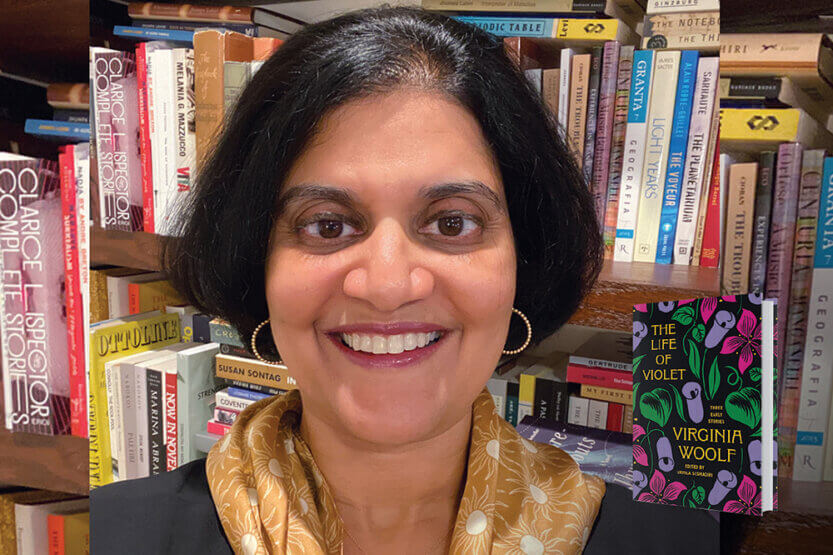 Edited by Urmila Seshagiri, Virginia Woolf’s The Life of Violet is filled with pratfalls, sea-monsters, and other delights that may surprise fans of Woolf’s later, modernist novels. (Image courtesy of Urmila Seshagiri)
 In 1907, the 25-year-old Virginia Woolf, then an essayist and literary critic, wrote her first long work of fiction—a collection of stories—as a private amusement for friends. For decades, scholars regarded the collection as nothing more than a fun bit of fluff. But in 2022, Urmila Seshagiri, MA ’97 LAS, PHD ’01 LAS, upended that assessment by discovering a fully revised, previously unknown version. Scholars now consider it an important step in Woolf’s development as a writer. As The Life of Violet (Princeton University Press, 2025), the book has been published for the first time.
What about these stories might surprise readers who are familiar with Woolf? For one thing, they contain fantasy and slapstick comedy! And the third story takes us into this mythical, ancient Japan, where we have sea-monsters and trees dropping sugared almonds, and this type of playful, extravagant fantasizing that we don’t see in Woolf’s novels.
What made you want to become a Woolf scholar? She makes the reader feel like nothing stands between you and the most intimate, most refined, smallest details, but also the biggest concerns, all at the same time. Woolf’s depth and erudition and endless creativity keep me coming back to her.
For anyone who’s never read Woolf, what do you recommend as a starting point? Well, you could have The Life of Violet as a fun starting point, but if you wanted to read one of the better-known later works, I would say Mrs. Dalloway. It’s joyful. And it is always relevant.
Illinois Alumni, Spring 2026