Ingenious: Sustainable Substitutes
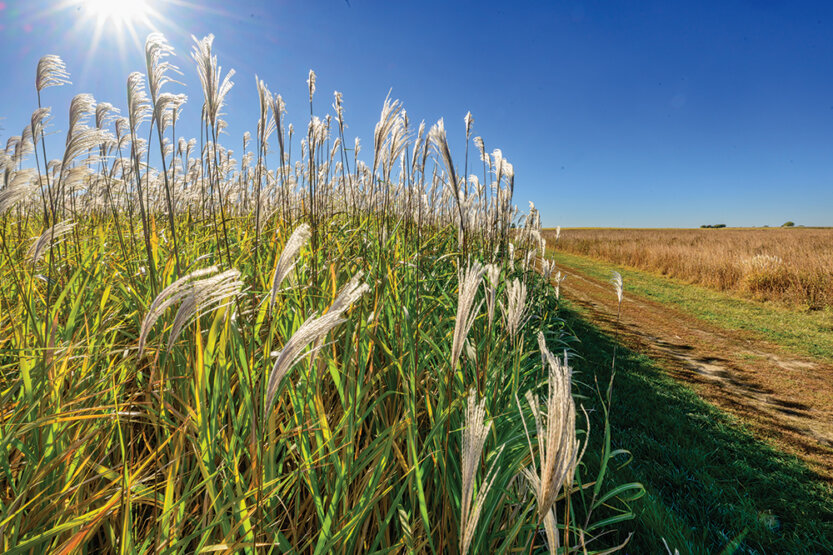 Switchgrass may eventually become the primary source of jet fuel.
(Image by Fred Zwicky)
Switchgrass may eventually become the primary source of jet fuel.
(Image by Fred Zwicky) Professor D.K. Lee still remembers the Korean proverb his grandmother taught him: “Crops grow to the music of the farmer’s footsteps.”
“She was trying to say that you need to go into your fields every morning and afternoon to see what’s going on,” says Lee, an agronomist in the Dept. of Crop Sciences. “The crops are listening for your footsteps.”
Today, Lee continues to give that level of attention and care to the lives of plants, and his commitment has made him an authority on bioenergy crops. He even developed a new switchgrass variety, Independence, which holds promise as a sustainable jet fuel.
But innovations on the farm are nothing new for Lee, who began helping with his family farm in South Korea “as soon as I learned to walk,” he says.
When he reached middle school, he even tried his hand at raising rabbits, tending to 200 of them. However, Lee soon received a lesson on the importance of marketing, when he discovered that no one was interested in buying his rabbits.
Undeterred, he went on to successfully grow and market Korean bellflower root in college, “making pretty good money” until he moved to South Dakota in 1999 to work on his Ph.D. He arrived at the U. of I. in 2008.
Until 2017, no switchgrass varieties had been evaluated on a large commercial scale specifically for biofuel production. But Lee and others changed all that, testing new varieties such as Independence on larger plots across four states: Illinois, Iowa, Nebraska, and South Dakota.
Switchgrass has multiple benefits for the environment because it improves soil health, reduces erosion, and cuts down on nitrogen leaching into water. “It’s also relatively easy to work with and has a potential for high biomass yield,” Lee says.
Right now, the economics are not there for using switchgrass as fuel for jets, heavy-duty trucks, and ocean ves-
sels, but Lee sees his job as setting the stage for the future. Today, switchgrass is most economical on “marginal land” that has physical issues, such as poor drainage, low fertility, or high erodibility.
“If land is producing only 70 percent of the average for row crops like corn or soybeans, then switchgrass will be a better option,” he says. “It all depends on crop and energy prices.”
Lee notes that most farmland in the Midwest is under vegetative cover only five or six months of the year, so “it’s a shame if we don’t use our good ground the rest of the year.” That’s why he is also experimenting with winter oilseed crops such as canola, rapeseed, and other members of the brassica family.
He sees these bioenergy crops as sustainable substitutes for petroleum in many products, such as single-use plastics, polyester, and other materials people use every day.
“Eventually, those things may have to be replaced with a renewable source,” he says. “Crops like switchgrass and miscanthus are the future.”
Illinois Alumni, Summer 2026