Planting the Seeds of Success

Through numerous programs, JJK FAN shows kids and teens how to feed their bodies, their minds, and their community. (Image courtesy of JJK FAM)
It’s midday at the Seed to Table summer camp in the Jackie Joyner-Kersee Food, Agriculture, Nutrition Innovation Center (JJK FAN) in East St. Louis, Ill. The kids have spent the morning learning how to plant, tend to and, yes, even weed a vegetable garden. Now the campers are pivoting into the kitchen to make healthy produce-based snacks with Grace Margherio, a 4-H youth development educator with University of Illinois Extension. “After Seed to Table,” Margherio says, “they can visualize how their food grows on plants and want to be more involved in growing and cooking it.”
Agriculture is not usually what first comes to mind when people think of Jackie Joyner-Kersee, the six-time track-and-field Olympic medalist considered the greatest heptathlete of all time. But as a native of East St. Louis whose family struggled at times to put food on the table, Joyner-Kersee has long been dedicated to creating opportunities for local children to flourish in a chronically impoverished city that’s also a food desert.
By combining the resources of its four founding partners—the Jackie Joyner-Kersee Foundation, the University of Illinois Urbana-Champaign, the Donald Danforth Plant Science Center, and the East St. Louis nonprofit organization Lansdowne UP—JJK FAN shows kids and young teens how to feed their bodies, their minds, and their community. Through numerous programs at its growing East St. Louis campus—a new 24,000-square-foot center that opened this spring—JJK FAN also shows how the combination of food, science, and innovation creates lives and livelihoods so people can thrive.
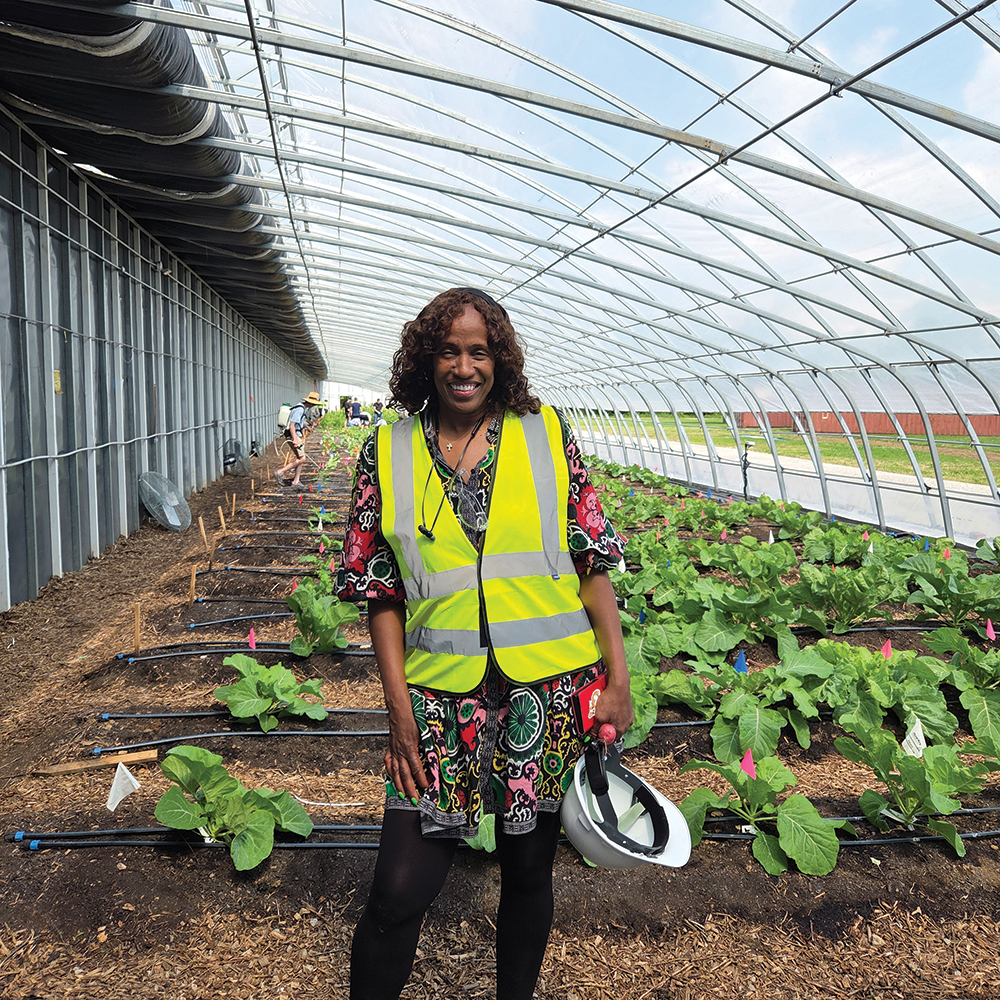
Jackie Joyner-Kersee in JJK FAN’s one-of-a-kind passive solar greenhouse. (Image courtesy of JJK FAN)
“We’re helping our young people to see that when they plant a seed and take care of it, it grows. That’s what we want them to do for themselves.” —Jackie Joyner-Kersee
“We’re helping our young people to see that when they plant a seed and take care of it, it grows,” Joyner-Kersee says. “That’s what we want them to do for themselves. They are the seed. We’re going to surround them with people to help nurture them. If they’re open to that support, they’re going to thrive and blossom.”
The seed for JJK FAN was planted when agricultural technology entrepreneur Mark Scholl, ’73 ACES, happened to sit next to Joyner-Kersee on a flight from Washington, D.C., to St. Louis. As they discussed what it takes to become a world-class athlete and to make it as a farmer, they discovered common ground. “You need the same things,” Scholl says. “You have to have a love of what you’re doing. You have to have a focus. You have to have faith. And you have to be there, day in and day out, and not give up.”
What unfolded over the following years exemplifies not only that determination but also an incredible synergy, where multiple elements combined to produce an outcome far greater than the sum of their individual contributions.
Scholl joined the board of the nonprofit Jackie Joyner-Kersee Foundation. His remit: to work with Joyner-Kersee to increase healthy food access and awareness of in-demand agriculture and science careers as an extension of her existing youth center, which serves as a safe haven and launch pad for thousands of young people each year.
“We talk about the urban-rural divide all the time, but we never invite the urban,” Scholl says. “Agriculture is never going to have another opportunity like this, having Jackie Joyner-Kersee be part of the conversation.”
The pair started in 2016 by organizing field trips to a donated 60-acre plot across the Mississippi River in north St. Louis, Mo., where kids helped grow corn, radishes, and soybeans. But the goal was to be firmly rooted on home ground.
In 2017, while at a Farm Foundation meeting in California, Scholl met Kim Kidwell, ’85 LAS, ’86 ACES, then the dean of Illinois’ College of Agricultural, Consumer, and Environmental Sciences (ACES). After discovering they had common interests in youth development and creating career opportunities in agriculture, Scholl introduced Kidwell to Joyner-Kersee.
“The model was different, to bring our expertise and assets to bear on something operated by someone other than the university,” says Kidwell, who is now associate chancellor for strategic partnerships and initiatives. “But I immediately realized that Illinois Extension, which is housed in the College of ACES, had valuable resources to contribute, because it is well rooted in the communities it serves in a powerful way. This was also a way to connect the ecosystem of what we do on the main campus with the needs of the East St. Louis community.”
Another JJK Foundation board member and ACES alum was already well acquainted with those needs: Mark Mestemacher, ’79 ACES, co-founder of Ceres Consulting LLC barge company. He’d met Joyner-Kersee after launching the East St. Louis Wrestling Club. That club evolved into Lansdowne UP, a workforce development nonprofit for local young men that is transforming its namesake neighborhood where the Olympian’s youth center is located. “After meeting Jackie, God put it in my heart to get involved in East St. Louis in a much bigger way than I ever would have dreamed of,” Mestemacher says. He became a significant patron of Joyner-Kersee’s foundation and provided funding, facilities, and staff for the JJK FAN buildout.
The blossoming initiative also appealed to the Donald Danforth Plant Science Center in suburban St. Louis, which is dedicated to improving the human condition through plant science and making St. Louis the hub of plant science globally. “We wanted to bridge the bi-state divide and do more with the students of East St. Louis, so that they could see themselves as future plant scientists and have pathways into that career field,” says Kristine Callis-Duehl, former executive director of education at the Danforth Plant Science Center.
“With all of us bringing different strengths to the table, JJK FAN has grown at warp speed to bring a collective vision to life.” —Amy Funk, JJK Fan director
United formally under the banner of JJK FAN, these four partners are working closely with one another and with community members to create unprecedented opportunities in one of the most under-resourced cities in the Midwest. “With all of us bringing different strengths to the table, JJK FAN has grown at warp speed to bring a collective vision to life,” says Amy Funk, the facility’s director.
Illinois Extension is usually thought of in connection with rural areas, but it serves all 102 counties in the state. “I cringe every time I hear that Extension is the best-kept secret, because no one here wants us to be a secret,” says Laquitsha Bejoile-Hayes, Illinois Extension outreach associate for JJK FAN.
In St. Clair County, in which East St. Louis is located, Extension’s programs historically have focused on nutrition. Its many creative offerings through JJK FAN highlight Extension’s core tenet that health and wellness are the foundation for individuals, families, and communities to reach their full potential.
For example, over the summer of 2025 alone, 125 students between the ages of five and 12 participated in two Seed to Table camps. A youth-led farmers market taught students about entrepreneurship, accounting, and marketing as they sold fresh produce to JJK FAN families and other community members on a “pay what you can” basis. With their earnings, the students purchased fruit and vegetable costumes to wear at the market. “They’re very eager sellers!” Bejoile-Hayes says.
For the first time, four JJK FAN students entered the 4-H Cooking 101 competition at the St. Clair County Fair. They all won blue ribbons. “I was so proud of their commitment and hard work,” Margherio says. “They worked on their cooking project all year and got to demonstrate their mastery, which I could see made them proud, too.” More than 20 students are now working on projects for this year’s county fair.
The summer also saw the graduation of seven adults from the inaugural Nourish East St. Louis Cottage Foods Training Program. The proud graduates plan to sell goodies ranging from cold-pressed juices to vegan stir-fries. Bejoile-Hayes tailored the class to the needs of the students. Classes were held in the evening, after work, and dinner and childcare were provided. Some sessions were held online to reduce the transportation burden. “We are living up to Extension’s vision of lifelong learning and meeting all audiences no matter where they are,” she says.
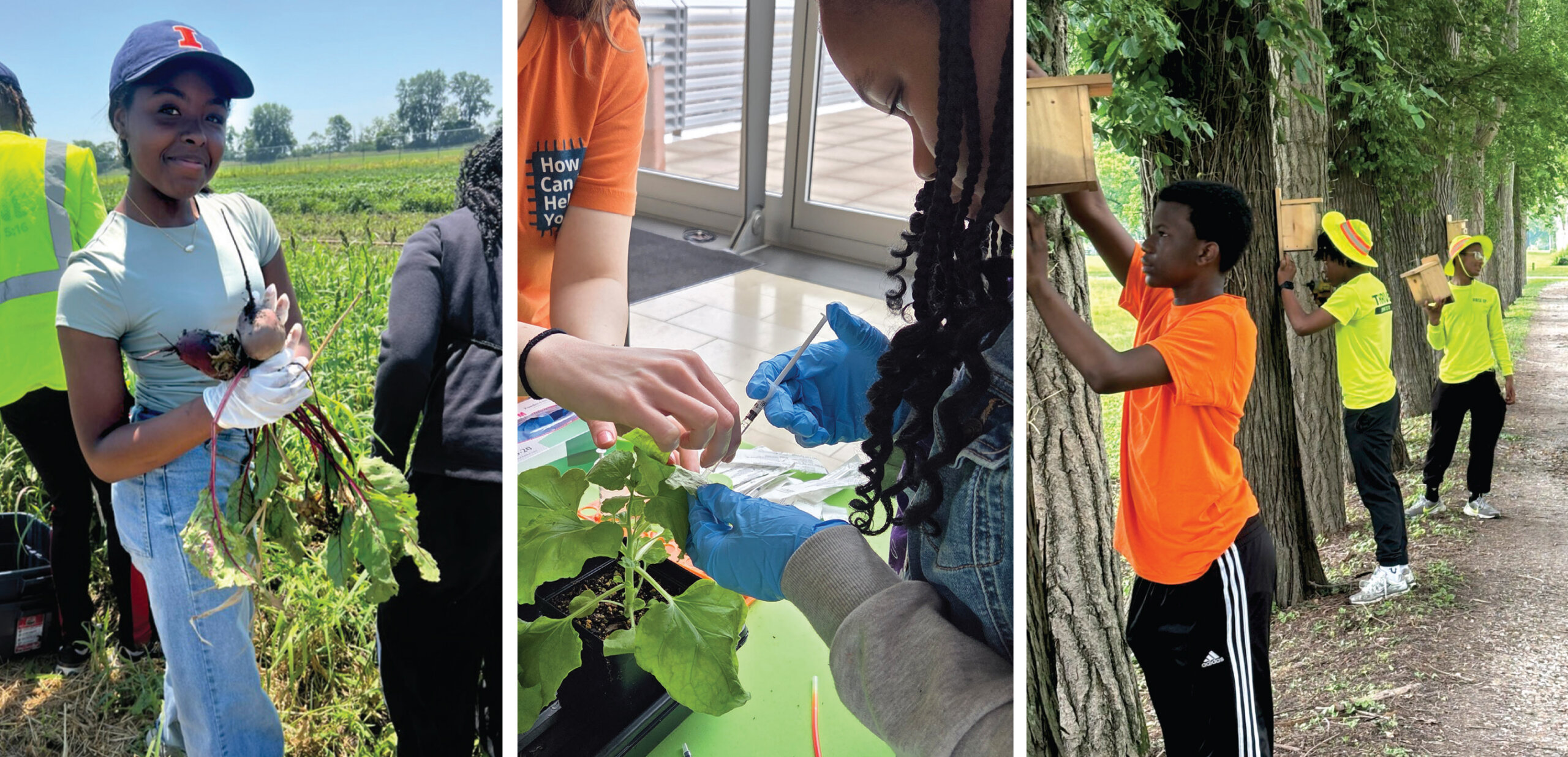
Left: JJK FAN’s field trip to the U. of I.’s Sustainable Student Farm in Urbana. Center: Studying water absorption in leaves at the Danforth Plant Science Center. Right: Students at JJK FAN installing birdhouses they built as part of a summer teen workforce program. (Images courtesy of JJK FAN)
During the school year, many students receive a double dose of Extension curriculum through JJK FAN. The Olympian’s youth center is home not only to the JJK Academy for children in kindergarten through fifth grade, but also to an after-school program that includes students ages five to 18 from the local public school district.
JJK FAN’s embryology and incubation program is a perennial favorite. As students closely monitor the eggs, they learn about embryo development, different chicken breeds, and how to care for the newly hatched chicks, which then go to live on a local farm. And a new pilot class from the University of Illinois Cancer Center, What Is a Scientist?, teaches students how the body works and encourages them to picture themselves in science careers.
JJK FAN brings that picture into sharper focus by pairing students with scientists and researchers at every opportunity. A growing roster of Illinois faculty members is conducting research for, and with, JJK FAN. (See sidebar on page 31.)
Kelley Lemon, ’02 FAA, an assistant professor in the Dept. of Landscape Architecture, has become a familiar face on the East St. Louis campus. She connected with Kidwell by chance when the two participated in a food security conference. “It’s a beautiful example of how JJK FAN rolls,” Kidwell says. “These coincidental grassroots connections have created a core group of people who really want to make a difference in a place that really needs support.”
For Lemon, assisting JJK FAN “was an easy call,” she says. She grew up in the region. Among her contributions, she has created an activity booklet, “Let’s Design a Garden!,” that explains her profession and encourages students of all ages to share ideas on what they’d include in a park on the JJK FAN campus. “It is an opportunity for them to understand they have the power and ability to create the spaces they want and deserve,” Lemon says.
Lemon also was one of nearly three dozen science professionals who met with four high school students who participated in the JJK FAN summer internship with the Donald Danforth Plant Science Center. The nine-week program kicked off with a presentation on “Unlocking Your Potential” by Amy Leman, ’98 ACES, from the U. of I.’s Agricultural Leadership, Education, and Communications program. Among the interns’ 16 field trips was a visit to the Illinois campus and Sustainable Student Farm.
“At every point, we connect our students with professionals so they know these are real pathways and real jobs.” —Kurly Taylor, Danforth Plant Science Center JJK FAN strategic partnership manager
“At every point, we connect our students with professionals so they know these are real pathways and real jobs,” says Kurly Taylor, who oversees the internship program as the Danforth Plant Science Center JJK FAN strategic partnership manager. As a third-generation educator with family roots in East St. Louis, “it’s a full-circle moment for me to be here and support this work,” Taylor says.
Intern Grace Griffin has grown up with a family garden and already knew she wanted to go into agriculture and plant genetics. “But I didn’t have the network to mentor me on how to get there,” she says. “The internship gave me the support I needed.” Griffin, a high-school junior, has since earned an internship at the Missouri Botanical Garden and is working on her lab safety certification. “I’m inspired by the opportunity to help others who don’t have the space or resources to get the fresh food they need,” she says.
That vision is exemplified by JJK FAN’s 11,000-square-foot passive solar greenhouse, the first of its kind in the U.S. It can produce over 30,000 pounds of food each year, year-round, with minimal electricity costs. An adjacent freight container, housing a wash/pack/cool system, ensures the produce is cleaned, packaged, and stored safely.
The greenhouse is not only a vital new source of healthy food for the community, but also a hands-on learning lab. Every row, every season, provides a new teaching opportunity for subjects such as cover crops, wildflowers, and seed banks.
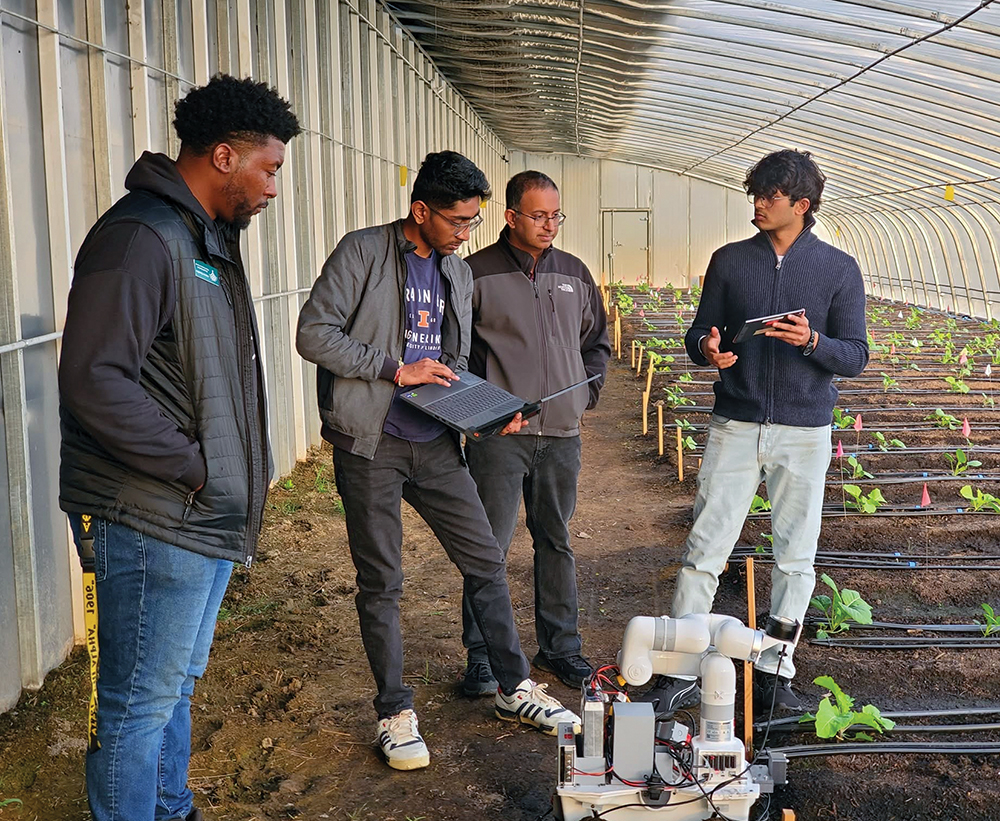
Faculty and students from Illinois’ AIFARMS Institute test their robot in JJK FAN’s greenhouse. Antonio Brazelton, Jr., at left, is a Ph.D. candidate at St. Louis’ Washington University, working on collard greens production at JJK FAN. (Image courtesy of JJK FAM)
One greenhouse project in particular beautifully captures the spirit of JJK FAN. With the help of Lansdowne UP greenhouse staff, Danforth Center plant scientist Antonio Brazelton, Jr., planted 19 varieties of heirloom collard greens, a staple for many Black families. His goal: to study their root architecture and genetic diversity to better understand how different varieties perform in less-than-optimal urban growing conditions.
JJK FAN students, including the interns, came into the greenhouse throughout the growing season to learn about Brazelton’s research. Staff and students helped with the multi-day harvest. After the roots were imaged for further study, the nutritious greens were distributed to community members. “That experience really stood out for me,” Griffin says. “It was really cool to see work that I want to go into happening in my own community.”
The greenhouse also nurtured another proud and promising JJK FAN participant: Jordon Gully, a former intern who is now an Illinois sophomore in the College of ACES, on a full scholarship. He, too, worked on the collard greens research. But he also grew his award-winning state science fair project on corn leaf architecture in the greenhouse. As the first JJK FAN alum to attend Illinois, Gully is a role model for younger students, like those in the Seed to Table camp.
“JJK FAN has been at the core of everything for me,” Gully says. “Our community is a food desert. Learning that we can impact change within our community by growing food and learning the science behind it in order to help others eat healthily has really enlightened me. It’s the reason why I’m in the College of ACES. I want to learn about agricultural policy, so I can make an impact and change the status quo.”
MAKING THEIR MARK(S)

Lansdowne UP staff construct the greenhouse. (Image courtesy of JJK FAN)
Planting seeds, pulling weeds: That sums up the vital roles that Mark Scholl, ’73 ACES, and Mark Mestemacher, ’79 ACES, have played in creating opportunities and removing obstacles in the launch and evolution of the Jackie Joyner-Kersee Food, Agriculture, Nutrition Innovation Center (JJK FAN).
Scholl is president of J and M Scholl, Inc., a family agriculture holding company that includes a farming operation, an export grain business, a wind farm, and real estate holdings. As former chairman of the board of the Farm Foundation, Scholl has tapped his extensive agricultural network to spread the word and support JJK FAN.
“One of Mark’s superpowers is that he gathers people around him who are activators, who are willing to lean in and do the hard work,” says Kim Kidwell, ’85 LAS, ’86 ACES, former dean of the College of ACES, whom Scholl worked with to spark Illinois’ engagement with the JJK Foundation.
Mestemacher is co-founder of Ceres Consulting LLC, which owns and operates roughly 550 barges and focuses on serving grain companies in the export business, including Scholl’s. But the first time the two Marks met in person was at Jackie Joyner-Kersee’s youth center, where Mestemacher was voluntarily pulling weeds on his lunch hour when Scholl happened to drop by for a meeting with the Olympian. “When Jackie introduced us, I said to Mark, ‘“I’ve been talking to you on the phone for six years,’” Scholl remembers with a laugh.
Mestemacher’s nonprofit Lansdowne UP is “like family” with JJK FAN. “They focus more on the youth, where we’ve focused on adults,” he explains. Lansdowne UP’s efforts center on three areas: Clean UP, Build UP, and Grow UP. It has purchased and cleaned up more than 2,500 blighted properties in East St. Louis, and it has trained and built up a workforce of 45 young men.
And it supports JJK FAN’s focus on growing healthy people and a healthy neighborhood by helping fund, construct, and staff the JJK FAN facilities. “To have our partners walking alongside us is huge for this community,” Mestemacher says. “We’re all learning as we go through this together, because there’s never been anything like this.”
The success of the JJK FAN partnership is catching the attention of others beyond the St. Louis metro area. Scholl has fielded inquiries from individuals in Louisville, Indianapolis, and Memphis who are interested in replicating the JJK FAN formula in their respective cities. “I’m proud of the people we’ve brought together to do this,” Scholl says. “We’re not done.”
JJK FAN’S NEXT CHAPTER

JJK FAN’s campus, located just across the Mississippi River from St. Louis, offers local students and community members hands-on learning opportunities related to agriculture and science. (Image courtesy of JJK FAN)
This spring marked the opening of the new, 24,000-square-foot Jackie Joyner-Kersee Food, Agriculture, Nutrition Innovation Center (JJK FAN), bringing together under one roof the organization’s growing multitude of programs. “We want our young people to discover the endless possibilities of agriculture today,” says Jackie Joyner-Kersee. The $23 million center was funded in part by a capital build grant from the State of Illinois.
The center’s large science laboratory is a point of pride. “All these jobs in agriculture and ag tech require a science background,” says Amy Funk, director of JJK FAN. “But we have a lot of kids who’ve never seen a test tube or microscope. This is a space where kids can start at a very young age to get exposed to lab science in a hands-on environment.”
A spacious kitchen with multiple workstations hosts cooking classes for kindergartners through adults, including the popular Seed to Table camp. There’s also an indoor growing area; a 100-person event space for banquets and talks; and a maker lab that introduces teenagers and young adults to trades such as welding and carpentry.
An acre of new growing facilities includes market and research gardens, hoop houses, a greenhouse, and 20 raised beds, built by Lansdowne UP staff. The beds are intentionally located near the JJK youth center’s football fields, to emphasize the connection between healthy eating and optimal athletic performance.
Kelley Lemon, ’02 FAA, an assistant professor in Illinois’ Dept. of Landscape Architecture, helped JJK FAN secure a Tree Equity Grant for Disadvantaged Communities from the Morton Arboretum near Chicago. The grant pays for Lansdowne UP staff to plant 800-plus native and fruit trees over the next three years to shade and transform the campus into a green space and model for food-system resiliency.
SCIENCE AT WORK
Illinois faculty is putting community-based research into action on the JJK FAN campus. Here are just a few of the projects that are underway.
 ASSESSING SOIL HEALTH
College of ACES Associate Professor Andrew Margenot, a soil scientist, analyzed soils for lead contamination on the northern edge of the JJK FAN campus. His results are informing JJK FAN’s plans to safely grow food in the post-industrial landscape of East St. Louis. “This is an example of the potential of partnerships to leverage the expertise of the university with the know-how and on-ground resources of community groups,” Margenot says.
 CALCULATING JJK FAN’S FINANCIAL IMPACT
Sandy Dall’erba, director of the Center for Climate, Regional, Environmental, and Trade Economics, calculated that, between 2021 and 2026, JJK FAN activities generated $7.8 million in total labor income, $2.7 million in total tax revenue, and 126 full-time equivalent jobs throughout Illinois.
 MONITORING URBAN MICROCLIMATES
Sam Stickley, PHD ’21 ACES, a teaching assistant professor in the College of ACES, is using miniature loggers to monitor microclimate conditions on the JJK FAN campus and other sites in East St. Louis. The data collected will help shape urban climate mitigation and adaptation projects and contribute to the broader Illinois Microclimate Extension Team. “A lot of research focuses on Chicago; the St. Louis area gets left out of the mix,” Stickley says. “The second I started talking with the JJK FAN staff, we knew it was a good fit for this research.”
Illinois Alumni, Summer 2026