Well Plotted

Not long before harvest, students walk past the plots—an agricultural oasis on a bustling campus. (Image by Fred Zwicky)
A threat lurks in the shadows, scampering from dense evergreen branches to rows and rows of towering stalks. No corn plant is safe from the scurry of squirrels—the greatest menace to the historic Morrow Plots.
In recent years, the nation’s oldest continuous agricultural experiment has been under siege from these rodents, who’ve devoured up to a third of its grain.
When the plots were established in 1876, the local squirrel population was virtually nonexistent—having been decimated by 19th-century deforestation. But today, squirrels are everywhere, and credit for that goes to University of Illinois President Andrew S. Draper, who in 1901 hatched a plan with geology professor Charles Rolfe, 1872, to reintroduce squirrels to campus, as a nature lesson and morale booster for students.
For Draper, the project’s goal was much loftier than the reintroduction of squirrels. He wrote, “If successful, the influence upon university life, and upon the feelings of students, would be considerable, and students would carry that influence to all parts of the state.”
Though he was writing about squirrels (of all things), he could just as easily have been describing the Morrow Plots—or any experiment at the U. of I.
Draper’s words capture the essence of the land-grant mission that the University of Illinois embodies: that ideas cultivated on campus should not remain there. They should take root and spread across communities—reaching every corner of the state, the nation and, ultimately, the world.
But the land-grant was an experiment in itself, and initially, it was not universally embraced.
In its early years, the university struggled to define its purpose, and many Illinois farmers questioned whether academics could offer practical insights about agriculture. Enrollment in agricultural programs lagged, political battles over their existence were common, and advocates for agricultural education repeatedly found themselves defending the value of research and experimentation.
If the U. of I. was to justify its existence, it needed more than ideals. It needed evidence that research conducted by its faculty is valuable to the farmers and citizens it is meant to serve.
One of the university’s earliest attempts to provide such evidence began in a small field, in what is now the center of campus.
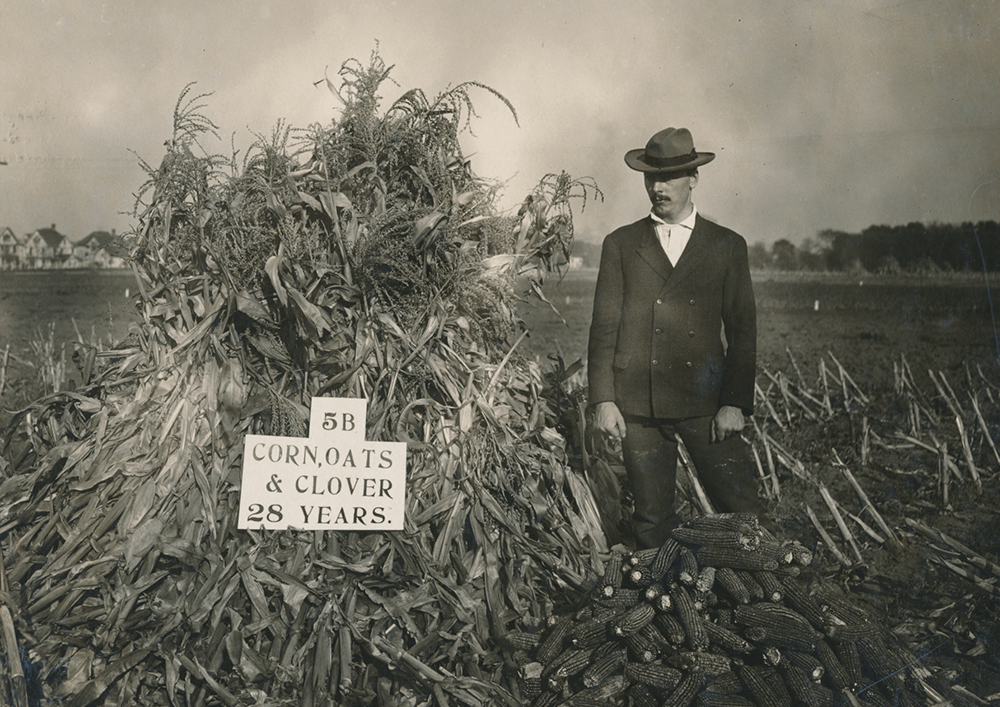
The Morrow Plots have revolutionized agriculture for 150 years. Image ca. 1904. (Image courtesy of U. of I. Archives)
The original idea for the Morrow Plots is often attributed to Charles Wallace Silver, 1872, the university’s second-ever student, who returned to campus just two years after graduating to aid the faltering agricultural program.
During a trip to England, Silver visited the “Classical Experiments” at Rothamsted Experimental Station and became convinced that Illinois should establish a similar long-term study focused on the crop most important to American farmers: corn.
Upon his return in 1875, Silver published an article in The Illini (now The Daily Illini). He argued, at a time when many agricultural decisions were guided primarily by experience and observation, that evidence-based experiments could provide a more reliable foundation for farming and would be a “boon to humanity.”
Thus, Silver grafted from Rothamsted what would become the Morrow Plots. He would not, however, remain at Illinois long enough to see the experiment take root.
Within a year, Silver was replaced by Manly Miles, a faculty member from Michigan State and a scientific superstar of his day, who was the nation’s first professor of practical agriculture. After a five-year pursuit, Illinois lured him away from Michigan State, much to the delight of the Board of Trustees, but to the chagrin of the faculty, who were paid significantly less than Miles.
It was Miles who established the Morrow Plots in 1876, during the U.S. centennial year. On three half-acre plots, he compared continuous corn production with corn-oat crop rotations to understand how those cropping systems influenced soil productivity.
But the historic experiment would not bear his name. Miles was a combative figure who fought with his colleagues, and his relationship with the university’s regent (now known as president), John Milton Gregory, deteriorated to the point that Gregory gave the trustees an ultimatum: Either he goes, or I do. The trustees sided with Gregory.
Though Illinois lost a gifted scientist, Miles’ firing may have turned out to be a blessing.
In 1877, George Epsy Morrow joined the faculty as dean of the College of Agriculture and took over the experiment, expanding it from three plots to 10, comparing continuous corn, continuous oats, and various crop rotations.
The study is said to carry Morrow’s name because he was the first to publish his findings on the plots, in 1890. But more importantly, Morrow ensured its survival.
When Morrow became dean, it was during a period of declining enrollment and uncertainty for the fledgling college. But his writings and public advocacy helped to bolster faith in agricultural education, and to secure support not only for the plots but also for the broader land-grant mission they represented.
Under his stewardship, what began as a modest field trial became a lasting commitment to scientific inquiry—one that would outlive administrators, public skepticism, and many of the agricultural practices it was originally designed to study.
Like the land-grant university itself, the Morrow Plots were showing the value of higher education, put to work for the public good.
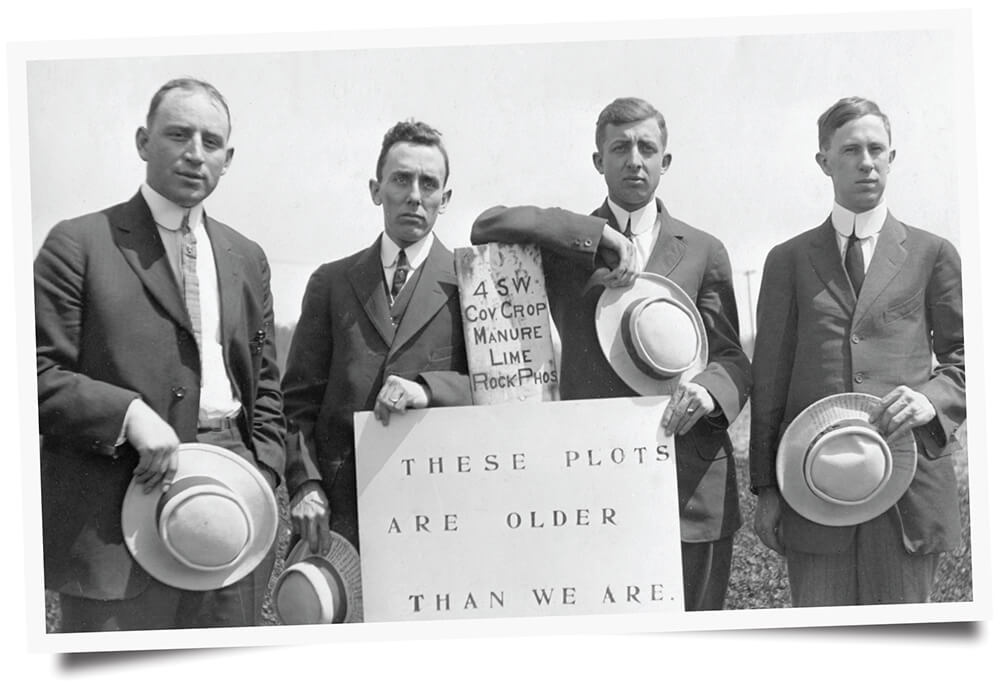
Even in 1913, students marveled at the Morrow Plots’ age. (Image courtesy of U. of I. Archives)
By the turn of the 20th century, campus growth had dramatically reduced the experiment’s footprint. Two plots were sacrificed for the construction of the university’s Observatory in 1895, and five more were returned to grass in 1903.
The three remaining plots were reduced in size and reconfigured, creating the experimental footprint that survives today.
In 1894, Cyril Hopkins expanded the study, adding an experiment on soil fertility and comparing the interaction between soil fertility and crop rotation. He became a leading advocate for what he called “permanent agriculture”—the idea that farming should enhance the soil rather than simply extract from it and, in turn, continue to provide for society.
At the time, most farmers (and the U.S. Dept. of Agriculture) believed Illinois’ deep black prairie soils possessed such abundant reserves of nutrients that crop rotation, manure, and good management would be sufficient to sustain productivity indefinitely.
Hopkins was skeptical.
He discovered that nitrogen and phosphorus were the most limiting nutrients—every harvest removed them from the soil, and without replacement, productivity would eventually decline. While nitrogen could be made by legumes such as clover or soybeans, phosphorus needed to be replaced by adding back what had been removed during the harvest.
Hopkins proved to farmers that they could not indefinitely draw upon the fertility inherited from the prairie without replenishing what had been taken away.
His recommendations helped lay the foundation for modern soil fertility management and fundamentally changed the way farmers and scientists thought about sustaining agricultural productivity.
Most notably, Hopkins advocated for returning phosphorus to the soil, championing the use of naturally occurring rock phosphate as an affordable source of the nutrient.
Again and again, he returned to the same question in his notebooks: “Is the fertilizer paying for itself?” Often the answer was “no” for nitrogen and potassium fertilizers of the day, but “yes” for phosphorus.
His question reveals a researcher who understood that agricultural innovation had to work both in the laboratory and on the ledger.
In an era when many farmers remained skeptical of academics, Hopkins represented the land-grant ideal at its best. He sought answers to questions farmers were asking in real time and measured success not only by scientific discovery, but by whether those discoveries could improve lives.
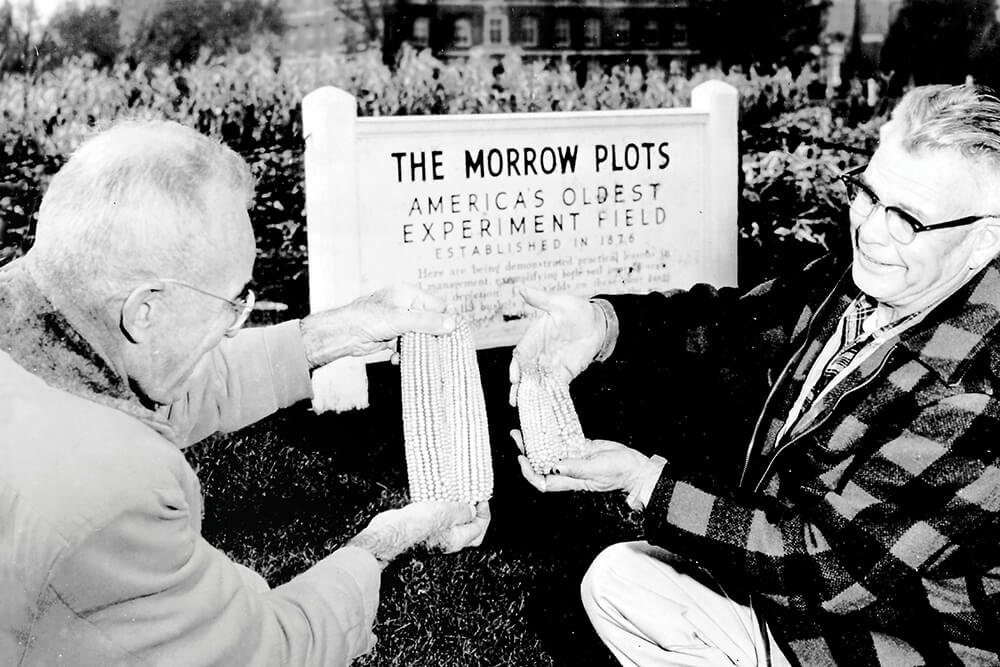
An experimental agricultural field at the U. of I., the Morrow Plots, is the oldest experimental agricultural field in America. Image ca. 1960. (Image courtesy of UIAA)
By the middle of the 20th century, another farming revolution was underway: hybrid corn.
For decades, the Morrow Plots had demonstrated the importance of crop rotation and soil fertility. Now, researchers could measure the impact of improved genetics against nearly 80 years of historical records.
The results were dramatic. As hybrid varieties replaced open-pollinated corn, yields surged.
The Morrow Plots revealed that productivity was not determined by soil management alone. Crop genetics, soil fertility, and farming practices worked together to determine what Illinois farmers could produce.
The era also coincided with the widespread adoption of mechanization, herbicides, and other technological advances that transformed agriculture and ushered in a period of unprecedented productivity.
As tractors replaced horses on Midwestern farms following World War II, the oats that fed them began to disappear from the Illinois landscape. The Morrow Plots evolved alongside these changes, replacing oat-based rotations with the familiar corn-soybean system that now covers most of the Corn Belt.
With each passing season, the experiment accumulated another layer of evidence, documenting how management choices echo through the decades.
Into the 21st century, the crops and fertility treatments in the Morrow Plots have remained largely unchanged in essence, but the questions scientists ask have evolved.
Using tools that would have been unimaginable to the experiment’s founders, researchers are finding new ways to unlock insights from the plots.
Carbon isotope analysis traces organic matter back to Illinois’ native prairie. DNA-based techniques reveal the microbial communities living belowground. Advanced 3D soil imaging and chemical analyses are helping researchers track how carbon, nutrients, and soil structure change over time.
These approaches are helping scientists address questions related to nutrient cycling and the long-term sustainability of soil. (The Morrow Plots is one of the few experiments in the world that provides enough data, over a long enough period, to truly demonstrate sustainability.)
Naturally, questions arise about what comes next for this historic experiment. Cover crops, precision nutrient management, and other emerging agricultural practices are frequently mentioned.
But there is no urgency to rewrite the experiment.
Every management decision becomes part of a record that future generations of scientists will inherit. Each generation gains access to a longer record than the one before it, allowing researchers to ask questions that no short-term experiment could answer.
And now, this data is available for all.
Researchers have undertaken the painstaking work of digitizing nearly 150 years of records from the Morrow Plots. Handwritten notebooks, yield data, fertilizer applications, and field notes have been transformed into a publicly accessible archive, allowing scientists from around the world to leverage one of agriculture’s longest continuous experiments.
In many ways, the effort represents a 21st-century expression of the land-grant mission: making knowledge accessible to anyone who can put it to use.

The final harvest of the season takes place at the Morrow Plots as a combine harvester cuts the corn plants, separates the grain, and stores the grain in a tank to be used for continuing research. (Image by Fred Zwicky)
Over thousands of years, deep-rooted prairie plants deposited vast amounts of organic matter into the soil, building the rich, dark Mollisols that would later make Illinois an agricultural powerhouse. When prairies were converted to farmland, a significant portion of that organic matter—and the carbon stored within it—was lost. By best estimates, soils under agriculture today in Illinois have one-half to one-third of the original amount of organic matter.
Soil fertility is often thought of in terms of nutrients such as phosphorus, nitrogen, and potassium—the essential elements that crops need to grow. But productive soils depend on more than nutrients alone. Biology and soil structure are important, too. Organic matter helps store water, cycle nutrients, support microbial life, and give soil its structure and resilience.
Recent research has found that about half of the carbon present in the Morrow Plots’ soil can still be traced to Illinois’ native prairie ecosystem. In other words, “relic” organic matter from the prairies is still subsidizing crop yields by providing a source of nutrients, in particular nitrogen.
This finding offers a humbling reminder that agriculture still relies on an ecological inheritance built over thousands of years—an inheritance we have steadily drawn down since the first plow broke ground.
While Hopkins demonstrated that nutrients removed through harvest must eventually be replaced, today’s researchers are focused on another challenge. Modern agriculture has become remarkably effective at replenishing many of the nutrients that crops remove from the soil; rebuilding the organic matter and carbon lost since the prairie was first cultivated, however, is a far more difficult task.
The question is no longer simply how to maintain soil nutrient content, but how to restore the complex chemical-physical-biological foundation upon which soil fertility depends.
It is this question that the experiment’s current caretaker, Professor of Soil Science Andrew Margenot, seeks to answer.
For Margenot, the Morrow Plots are much more than a long-running experiment.
They are a living record of agriculture’s evolution. Horses gave way to tractors. Oats gave way to soybeans. Corn planted in hills gave way to precisely spaced rows. Open-pollinated varieties gave way to hybrids. Manure gave way to commercial fertilizers. Mechanical cultivation gave way to herbicides. Yet through each transformation, the experiment endured.
The researchers changed, too, and so did the questions they asked. Miles sought to understand crop rotation. Hopkins sought to understand soil fertility and nutrient replacement. Mid-century agronomists measured the impacts of hybrid corn and modern farming systems. And today, Margenot investigates soil organic matter, nutrient cycling, microbial communities, and the long-term resilience of our prairie inheritance.
More than a century ago, Andrew Draper famously observed, “The wealth of Illinois is in her soil, and her strength lies in its intelligent development.”
For 150 years, the Morrow Plots have helped prove both halves of that statement.
And all three experiments championed by Draper have endured.
The squirrels.
The Morrow Plots.
The land-grant university itself.
All three sprang from the same democratic conviction: that ideas, when cultivated and shared, can improve the lives of ordinary people. It is the belief that opportunity should not be reserved for the privileged few and that knowledge should be shared in service to the public good.
The Morrow Plots have put that ideal into practice—and will continue to do so for generations to come.
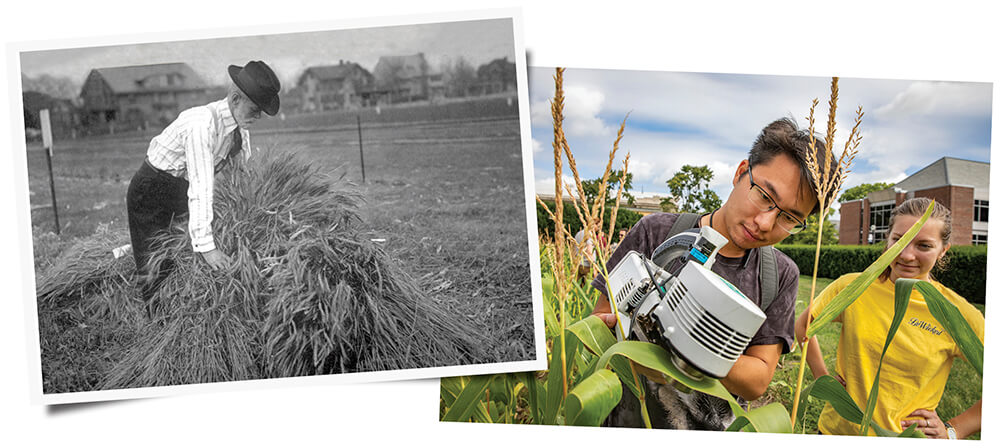
Harvest and research methods have changed dramatically over the decades. Left: Ag Dean Eugene Davenport shucks wheat, 1917. Right: Graduate students use high-tech equipment to test photosynthesis levels, 2019. (Images courtesy of U. of I. Archives and by Fred Zwicky)
Five lessons learned from the Morrow Plots
For 150 years, the Morrow Plots have helped unearth insights into farming practices, land stewardship, and soil health. According to Andrew Margenot, professor of soil science and current steward of the Morrow Plots, these five points are among the experiment’s most important lessons:
1. Illinois soils can remain productive for generations. Even after 150 years without fertilizer, the unfertilized plots still produce about 25 bushels of corn per acre each year, a testament to the extraordinary fertility of Illinois’ prairie-derived soils.
2. Crop breeding can dramatically increase yield potential. The Morrow Plots document the dramatic impact of hybridization and improved genetics coupled with modern fertility management. Together, these advances increased yields from 25 bushels per acre to as much as 250 bushels per acre.
3. Crop rotation can improve long-term productivity. One of the experiment’s earliest findings remains true today: rotating crops can increase yields and support more resilient production systems. The plots also demonstrate that farming decisions are shaped by both agronomic and economic considerations.
4. Soil health can be built through thoughtful management. Healthy, productive soils require both replenishing nutrients, such as nitrogen, phosphorus, and potassium, and returning organic material, which helps maintain soil structure, water-holding capacity, and biological activity. How those resources are returned (i.e., crop rotation, manure, fertilizer, and crop residue) matters less than ensuring that they are replenished over time.
5. Stewardship can shape productivity far into the future. Illinois soils are extraordinarily productive because they began with a tremendous reserve of organic matter and nutrients. Two-thirds of these carbon reserves are gone, yet much of the organic matter supporting today’s crops is an inheritance from Illinois’ tallgrass prairie. Stewardship decisions made today will influence what future generations will inherit in return.

Morrow plots, 1985 and 2004. (Images courtesy of U. of I. Archives and by Michelle Hassel)
Preparing for the next 150 years
For 50 years, a dense evergreen hedge has framed the Morrow Plots.
Planted in 1976 to commemorate the experiment’s centennial year and its designation as a National Historic Landmark, the hedge has become an iconic part of the research site.
Over time, however, the hedge has become a haven for squirrels that feast on the plots. They have consumed up to a third of the experiment’s grain and compromised entire subplots.
Thus, the hedge was removed this past summer as part of a sesquicentennial renovation project supported by Bayer’s Crop Science division.
In its place, visitors will find a new fence and artistic gate inspired by the soils, crops, and landscape that have defined the Morrow Plots for 150 years. The installation will better showcase the experiment while helping to safeguard it for future generations.
Just as generations of researchers have adapted their questions while maintaining the continuity of the experiment, the renovation seeks to honor the site’s history while preparing it for its next chapter.
Soon, the experiment will be poised to continue generating discoveries—and welcoming visitors—for the next 150 years.
Illinois Alumni, Fall 2026