Legacy Builder
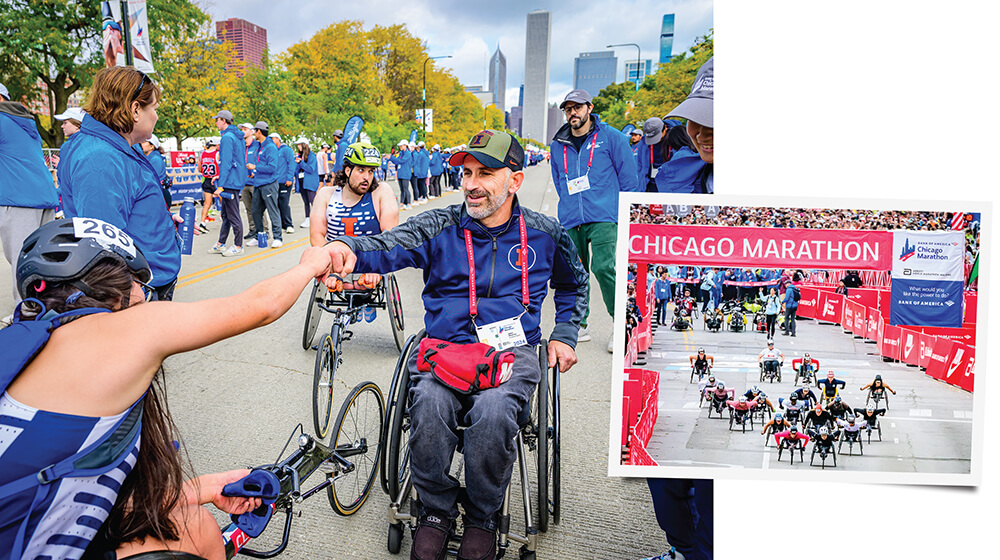
In high-stakes competitions such as the Chicago Marathon, Illinois wheelchair racing coach Adam Bleakney is a calming presence for his athletes. (Images by Fred Zwicky)
It’s just after dawn on a Sunday morning in mid-October, the sun fanning out between the skyscrapers of downtown Chicago, a light breeze coming off Lake Michigan, and in Grant Park, Adam Bleakney, ’00 LAS, MS ’02 MEDIA, sits in his wheelchair near the starting line and waits for the marathon to begin.
All around him is a frenzy of activity: blaring music to pump up the crowd, the exaggerated bravado of the PA announcer, the sound of more than 50,000 runners having their final conversations before the race, a presence that’s so rhythmic and persistent it’s more reminiscent of cicadas than the human voice.
The total effect is a little overwhelming—a bit like being in the bullpen at the Chicago Board of Trade, but outdoors. In fact, there are so many entrants behind the starting line that Bleakney literally can’t see where they end. But, at the front of the pack, waiting to take their positions, 73 racers stand out: These are the wheelchair athletes.
Among them are paraplegics of every stripe, ranging from teenagers to senior citizens, from new racers in beginners’ aluminum chairs to professionals with corporate sponsorships and top-of-the-line, carbon-fiber equipment.
Thirteen of the racers—or 18 percent of the field—are members of the University of Illinois’ wheelchair track and road racing team, a squad of undergraduates, graduate students and alumni who, year after year, stake their claim as the most successful university racing program on the planet.
The person most responsible for that success is Bleakney. The U. of I.’s wheelchair racing coach since 2005, Bleakney is an anomaly in the world of sports: a coach of elite athletes who never yells, speaks only when he really has something to say, and talks in a quiet, gentle way that’s better suited to a library than a gymnasium.
Spend enough time with him, and you’ll find that he’s never flustered, always balanced, measured in word and deed, deep in thought but not lost in it—steadfast, no matter the circumstances.
In a pressure cooker like the Chicago Marathon—one of the “Big Five” marathons, along with Boston, New York, London and Berlin—Bleakney is exactly who you want by your side, and his athletes know it. As they wait for the race to begin, Bleakney’s team surrounds him, almost as if they’re trying to soak up his atmosphere of calm amid the organized chaos.
The music continues to blare, and the 50,000 continue to talk, and Bleakney continues to sit, silent, face thoughtful but otherwise unreadable, barely turning his head, surveying the scene without being obvious about it.
At this point, the coach has done everything he can to prepare his athletes for the race.
But only an hour earlier, when it was still dark outside, the skyline lit as if it were the dead of night, Bleakney and the Illinois team were outside the Art Institute, getting ready for the day ahead.
The athletes put race numbers on their helmets, stretched their arms and trunks, wrists and hands, shared inside jokes and wondered how many dogs they’d see along the course. (They took bets on it.)
Finally, their stretches complete, the athletes gripped the arms of their racing chairs and shifted into position, their biceps downright Herculean, like gymnasts on parallel bars, displaying upper-body strength that puts mere mortals to shame. They settled onto their narrow seats, many leaning forward, looking all of a piece with their machines: one wheel in front, long metal frame, two wheels in back, and the captain at the helm.
Meanwhile, Bleakney wheeled between them, laughing with those whose spirits were light, and talking calmly about race strategy with the more serious-minded, the lone wolves who sat on their own, mentally preparing themselves for the 26.2-mile course.
As Bleakney talked with his athletes, he also inspected their equipment, making final adjustments with the help of his trusty tool kit.
When Bleakney is coaching, he keeps a small, formerly bright-red Nike kit bag on his lap, long faded to a shade of brick that’s made even darker by years of accumulated oil stains. It contains just about everything Bleakney needs to fix a racing chair on the fly—“but nothing major,” he points out. He uses it on everything from loose bolts to flat tires to anything else that might occur during practice or before a race.
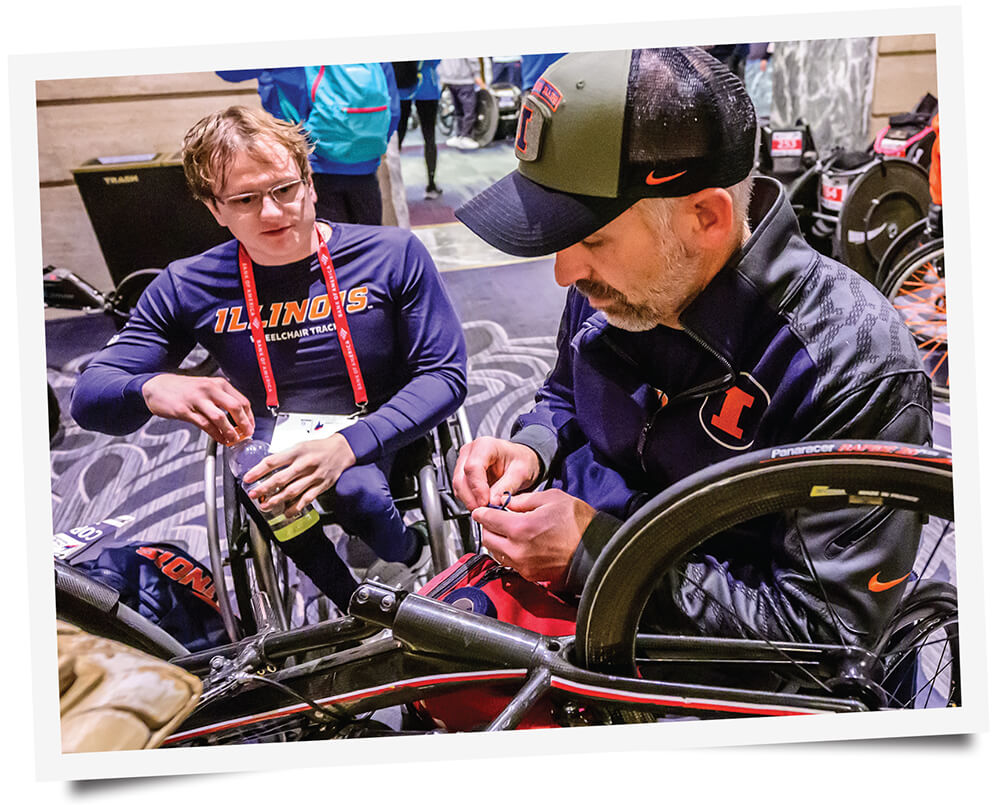
Only minutes before the Chicago Marathon, Coach Bleakney uses electrical tape and ingenuity to reattach Evan Correll’s bicycle computer to his wheelchair. (Image by Fred Zwicky)
This morning, it was a broken bracket on a bike computer, which Evan Correll, ’25 FAA, will use to collect data on his speed, distance and time throughout the marathon.
Bleakney studied the problem, dug through his kit and said, “I’m gonna ‘MacGyver’ it,” before using electrical tape to re-mount the computer on Correll’s chair. When he finished, it looked like you would need a box cutter to take it off.
With that, racers ready, chairs primed, they headed to the starting line.
Now, an hour later, there Bleakney sits, waiting for the race to begin and hoping that all the preparation—the early-morning practices, weightlifting sessions, conversations about race strategy and months of thinking about and developing and adjusting his team’s training plans—will pay off.
Today, many people connected with wheelchair racing think of Coach Bleakney, 49, as the father of the sport. And, indeed, he has been one of its major figures since the 1990s, when he was an Illinois undergrad.
Over the past 30 years, Bleakney has evolved from a novice racer into a Paralympic athlete; from an untested coach into an international authority on rules and training; and from a brand-new paraplegic into an advocate for disability rights and a designer of assistive technologies that could change what it means to be in a wheelchair.
Many people connected with wheelchair racing think of Coach Bleakney as the father of the sport.
Bleakney has been a wheelchair user since age 19, when a cycling accident radically changed his life. Growing up in Mason City, Iowa, Bleakney was both an active and a bookish kid, a standout in baseball and wrestling who spent most of his free time playing sports and reading every tome in sight.
After high school, Bleakney attended the University of St. Thomas in St. Paul, Minn., on a wrestling scholarship. Between his freshman and sophomore years, he went on a summer vacation to Colorado with friends. On his first day there, they were mountain biking in the woods on a challenging trail, and Bleakney hit a downed tree on the path—going over his handlebars and landing on a rock.
The impact was so great that it not only cracked his helmet, but also permanently injured his spinal cord. “And once you traumatize the spinal cord,” Bleakney says, “there’s no going back. It’s kind of like if you hit a banana. It turns brown in that one area, and that’s that.”
In one decisive moment, Bleakney was paralyzed from the waist down—his wrestling career over and his future a giant, looming question mark.
In the aftermath of his accident, Bleakney struggled to find purpose, but he ultimately found renewed interest in his old standby: sports.
A few months after his injury, Bleakney learned about wheelchair racing. “Sports had always been a big part of my life,” he says, “and my big draw to racing was the training element, and just being on the roads. Working out and training were a bridge between my two lives: Life One before the accident, and Life Two being in a wheelchair. For a 19-year-old trying to grapple with that change, it was therapeutic to be able to train—to feel physically competent.”
Once Bleakney decided to race wheelchairs, he was all-in, registering for the 1996 Chicago Marathon only weeks after sitting in a racing chair for the first time.
Not long afterwards, Bleakney’s father handed him the key to his future, when he gave him a magazine article about Illinois’ Disability Resources and Educational Services, or DRES—the university’s legendary program that’s been shaping disability education, rights, legislation and technologies since 1948, changing the lives of millions of people in the process.
Bleakney was sold on Illinois before he’d finished the first page, excited to learn about its long history of providing access to higher education for students with disabilities, which started after World War II, when founding director Tim Nugent, HON ’15, created the DRES program for disabled veterans.
Bleakney was also fascinated by DRES’ research on disability, which had led to the invention of curb cuts for sidewalks and more efficient ramps and had a significant impact on the content of the 1990 Americans with Disabilities Act, the landmark civil rights law that protects disabled Americans from discrimination.
But most of all, Bleakney was excited to learn about DRES’ world-renowned sports programs, which had been a major force in wheelchair athletics since the 1940s, beginning with basketball and eventually including archery and other Paralympic competitions. But most importantly for Bleakney: Illinois had a wheelchair racing team.
In the fall of 1997, Bleakney and his future wife, Laura, EDM ’01, arrived on campus and, except for a two-year period in his late 20s, when he lived in Atlanta, he’s been here ever since—first as an undergrad in English, then as a graduate student in journalism and, all the while, as a world-class wheelchair athlete: winner of major marathons and a Paralympic silver medal and internationally respected for both his sportsmanship and his tenacity. (“He’s one of the hardest-working athletes I’ve ever had the privilege to be around,” says the eight-time Boston Marathon winner Jean Driscoll, ’91 LAS, MS ’93 AHS.)
In 2005, following the retirement of his mentor and Illinois’ longtime wheelchair racing coach, Marty Morse, ’84 AHS, MS ’87 AHS, Bleakney returned to campus to take over the program.
Twenty years later, he’s built Illinois into the most esteemed university racing team in the world, with more than 60 Paralympic medals, multiple victories at the Boston, New York, Chicago and London Marathons, and a legacy of excellence that’s unparalleled.
But even greater than those victories is the reputation he’s built as an advocate for people with disabilities and as a designer of assistive technologies that could improve life for millions of wheelchair users.
“What Adam does here is so much more than just sport,” says wheelchair racer Jenna Fesemyer, ’19 AHS, EDM ’22. “He’s trying to contribute to a better quality of life for all people with disabilities. That’s why the legacy of this program is so much deeper than a fast time on the track or a medal at the Paralympics.”
Bleakney’s workdays are long, often bookended by an early practice at 6:30 a.m. and an afternoon weightlifting session that usually ends after 5 p.m. In between, he juggles administrative duties for the team, studies performance data, catches up on news about wheelchair sports, conducts research and meets with collaborators about ongoing design projects.
On this morning, it’s just after 6 a.m., and Bleakney is in his campus HQ, the basement of DRES. For more than 60 years, the basement was utilitarian, a big, open space that served as a workshop, containing every tool needed to maintain or repair a wheelchair. But in 2014, Bleakney convinced the U.S. Paralympic Committee to designate the U. of I. as the official U.S. Paralympic Training Facility for track and field. As part of that process, the energy company BP made a $30,000 gift to DRES, which allowed Bleakney to renovate the basement, transforming it into the epicenter of innovation and technology for the sport of wheelchair racing.
Today, one part of the basement is the Human Performance and Mobility Maker Lab—the first such lab in the world designed for wheelchair users—where faculty and students from across campus can collaborate on a variety of design projects, including assistive technologies and medical training devices, such as the 3D kidney that students from the Carle Illinois College of Medicine recently printed.
“In many ways, it’s the modern iteration of the old [DRES] workshop,” says Bleakney, who, in addition to his coaching duties, serves as a Beckman Institute research fellow and a College of Fine + Applied Arts faculty member, working on his own assistive designs.

Jenna Fesemyer uses a smart roller machine that Bleakney developed to simulate marathon conditions at the U.S. Paralympic Training Facility inside the university’s Disability Resources and Educational Services building. (Image by Fred Zwicky)
The other part of the basement is a specially outfitted gymnasium. When Bleakney’s athletes train outdoors, many of them attach bicycle computers to their chairs to collect speed, distance and time data. Bleakney analyzes the data and then helps team members prepare for their next race by adjusting the lengths and nature of the workouts based on individual strengths, weaknesses and progress. For their indoor practice facility, Bleakney wanted to simulate the outdoor training by connecting the wheelchairs to smart rollers with adjustable resistance settings, similar to those used by cyclists.
“But there wasn’t anything like that on the market [for wheelchairs],” Bleakney says. So he bought a smart trainer for a bicycle—a pair of round, metal drums within a frame that allows you to cycle in place—and began to experiment. “Through a lot of trial and error,” he redesigned it to work for a wheelchair, removing the front roller and adding a reinforced metal beam down the center to support the chair. He also connected it to an iPad to capture the sort of performance data his athletes track during their outdoor practices. Eventually, Bleakney “Frankenstein’s monstered” 10 of these devices for the DRES basement and even built some for wheelchair racers in Japan.
As Bleakney explains how the devices work, clad in his usual black ballcap, Illinois track suit and house slippers, the first of his athletes arrive for their 6:30 a.m. practice—a distance workout that will take them down city streets and country roads all over Champaign-Urbana.
Bleakney’s athletes train together six mornings a week—sometimes longer distances on the roads, sometimes shorter distances and sprints on the U. of I.’s track—and lift weights twice a week. The training plan is of Bleakney’s own design: informed by his 30 years of experience as an athlete and coach; his research on the science of wheelchair racing and sports, in general; his knowledge of upcoming courses, competition and changes in racing trends; and the individual goals of his athletes.
On a team that includes some of the greatest wheelchair racers in the world, Bleakney gives every athlete equal face time, whether he or she is a record-holder or a rookie. He has an open-door policy with his athletes and spends dozens of hours with them every week, talking about their training and racing strategies, life goals and concerns, and the daily challenges of being a young person in a wheelchair.
On a team that includes some of the greatest wheelchair racers in the world, Bleakney gives every athlete equal face time, whether he or she is a record-holder or a rookie.
“I think the growth process of an athlete is similar to any situation in life,” Bleakney says. “You learn the process of self-development and -improvement, and how to master skills and grow toward whatever goal that you set for yourself. The value of sport is that you can take what you’ve learned and the skills you’ve developed and apply them to your personal life and professional life in ways that will bring you success, however you measure it.”
Perhaps surprisingly, given the program’s legacy of Paralympic glory, his athletes’ success in competition is not the main priority for Bleakney, but rather, their success in life and their long-term physical and mental well-being.
“He’s always seen the Paralympics as a stop along the way,” says gold medalist Amanda McGrory, ’10 LAS, MS ’18 IS. “It is not the destination, and it never has been.…We’re all athletes, but we’re also much more, and Adam never lets us forget that.”
As the last of the team files in for practice, helmets on, racing gloves in hand, Bleakney wheels over to the basement’s white board, grabs a black dry-erase marker, and begins to draw the route for that day’s training: a 13-mile course he calls “the brain loop”—its outline distinctly cerebral—that heads east, deep into residential Urbana, west down Windsor Road and finally back to DRES. As he draws, he keeps things light, asking the team about their weekend plans and cracking them up with his dry, subtle sense of humor. Everyone in the room is smiling and laughing and, in fact, smiling and laughing are huge parts of the team’s dynamic.
As Bleakney continues to draw, the team continues to talk, and their conversation takes several twists and turns and tangents, from local restaurants to stories about family members to the upcoming Boston Marathon. Then, just as Bleakney caps his marker, he starts a discussion about farming techniques in ancient Egypt—and what’s weird is that, within the context of the conversation and the energy in the room, it doesn’t feel weird. It’s just another day at practice, the Illinois team in tune with their coach, learning about racing and human connection and life in equal measure.
“Adam can pretty much talk to you about any subject,” says Susannah Scaroni, ’14 ACES, MS ’22 ACES—Paralympic gold medalist, winner of the Boston, New York and Chicago Marathons, world-record holder and all-around cool customer. “It doesn’t matter what it is: Napoleon, nutrition, sports history, Greek mythology. And he’ll [say] things that are interesting, that you haven’t heard before.”
“Adam’s an intellectually curious person,” adds Paralympian Josh George, ’07 MEDIA. “And that translates to the way he approaches coaching. You can connect with him on so many levels beyond racing, and that makes him a more effective coach.”
After a few minutes, the ancient Egypt discussion winds down and, before he sends the team out on the roads, Bleakney makes sure that everyone understands the route and that their wheelchairs are ready—each one equipped with a tall, yellow pole, topped by a bright-orange, triangular flag, to help drivers see them.
But just before the athletes line up their chairs and head out the basement door, they wait for Bleakney to dismiss them as he always does, with a bad joke—a genuine groaner.
“How does an Eskimo fix his house?” he asks.
He surveys the room, and after no one bites: “E-gloos it!
“Get it? Igloos it.”
Several of them roll their eyes and shake their heads, but they all smile about their daily ritual: a dad joke from the father of modern wheelchair racing.
A few weeks before Chicago, it’s another early morning in the DRES basement, and Bleakney is looking at plastic molds for the PURE chair, a hands-free, robotic wheelchair he conceived of in 2018. “It’s basically a wheelchair on top of BB-8 [the spherical, rolling Star Wars droid],” he says. “It allows you to navigate the chair without having to push with your hands, so you can free them up to do other things while you move.” For Bleakney, that includes carrying a cup of coffee or holding hands with his wife on a walk.
Over the past two decades, Bleakney has evolved from a coach who designed training gear out of necessity (like the smart rollers) to an inventor, who’s helped to develop 3D-printed wheelchair racing gloves (which have become the standard in the sport), a foldable travel wheelchair for airplanes and a 3D-printed mask that protected people with breathing tubes during the pandemic.
Today, Bleakney is an in-demand collaborator for some of the world’s most respected industrial designers, such as the U. of I.’s Deana McDonagh.
Bleakney and McDonagh are research partners at the Beckman Institute’s (dis)Ability Design Studio and serve as co-leads on the PURE chair project, which involves a team of engineers from across the university and has National Science Foundation funding.
“Adam is a thought leader in this field,” McDonagh says. “He has this ability to see a need, look at what’s on the shelf and combine things that have never been put together before, to immediately resolve an issue. He designs for others in a very empathic, respectful way, by immersing himself in people’s experiences.”
Still, despite all his success as an athlete, coach and designer, Bleakney remains modest about his contributions. “There’s nothing that I’m doing that is novel or new in any way,” he says. “It’s just a continuation of what’s happened here at DRES since 1948…. And that’s the truth. I take great pride in extending that legacy, but I didn’t start anything. I just took the ball, and I’m moving it down field to the next person.”
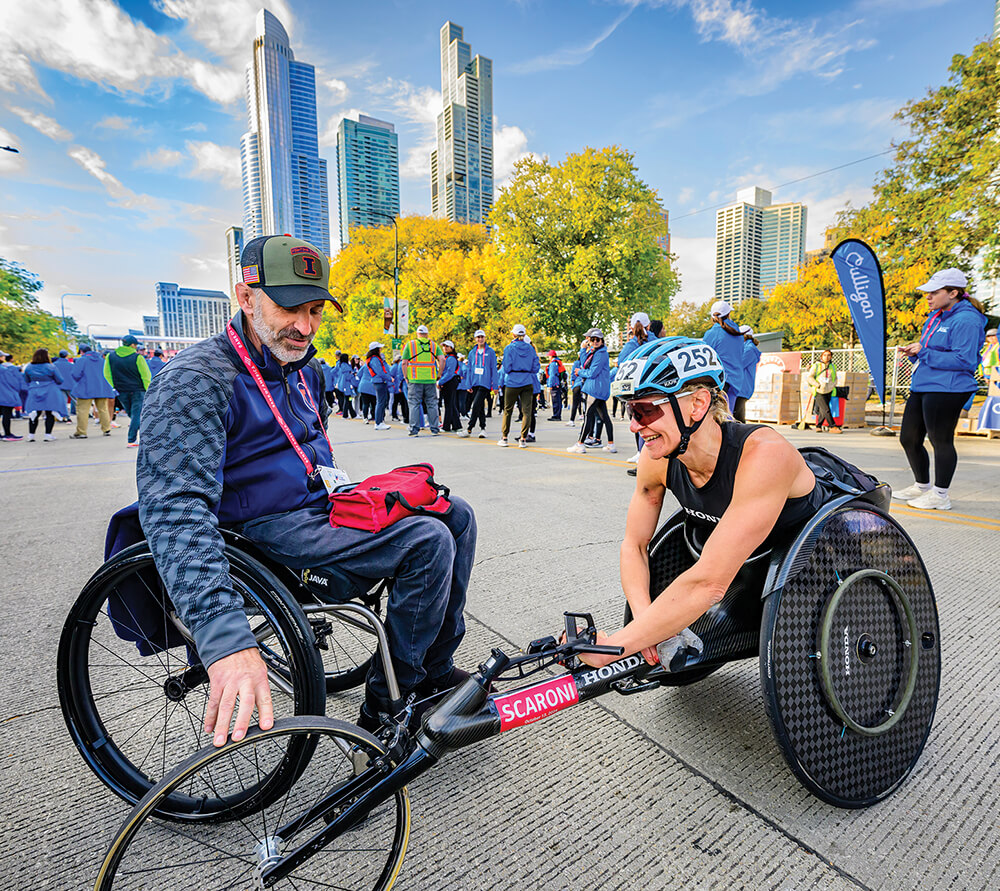
Bleakney and world record-holder Susannah Scaroni examine her missing front tire, following the 2024 Chicago Marathon. (Image by Fred Zwicky)
Back at the Chicago Marathon, Coach Bleakney rushes through Grant Park to join the crowd of onlookers at the finish line.
Along the way, he gets interrupted by virtually everyone he meets. And while Bleakney may be a man on a mission, he approaches each interaction in the same way: with a warm smile and a few sincere words, asking about people’s families and their health.
And then, he’s off again—arriving at the finish line well before the first racers cross.
Settling in, he opens the marathon’s app on his phone and begins to follow his team’s progress.
But soon, there’s a crisis, though the only evidence of this is the rare tone of anxiety in his voice, when he says, “Something happened to Suze.”
It’s three miles into the race, and Susannah Scaroni, who is favored to win, drops from the lead into the middle of the pack.
Bleakney spends the rest of the race wondering if she’s OK—far more concerned about her well-being than her time.
When Scaroni finally comes into view, nearly two hours later—her head bobbing up and down in one fluid motion, arms pumping so fast you wonder how anyone could ever move like that, a golden eagle in flight—Bleakney notices the problem immediately.
“She doesn’t have a front tire!” he says, the most excited he’s sounded all day. And, indeed, she does not.
As Scaroni approaches the finish line, you can hear not only the characteristic chug-a-chug-chug-a-chug of a racing wheelchair in motion, but also the tumult of her front wheel’s metal rim hitting the asphalt of Columbus Drive.
After she finally crosses, her wheelchair comes to rest in front of her coach, and she says, with a slight smile, “I hit a grate in the street at Mile 3.” And just like that, Scaroni’s tire, and her chances of victory, had popped like a balloon.
Miraculously, she kept going, managing to finish the last 23 miles of the race without a front tire, and still beating most of the field.
Despite the enormity of that accomplishment and the disappointing outcome, Scaroni seems neither proud nor tired nor upset. She simply shrugs her shoulders and says, with determination, “I’m looking forward to New York.” Bleakney just nods his head, and in that moment, it’s exactly what she needs.
And when Scaroni wins the New York City Marathon three weeks later, blowing away the competition by a margin of more than 10 minutes, Bleakney will nod his head again and say, “Good job, Suze,” and that, too, will be exactly what she needs.
“I have so much trust in Adam,” Scaroni says. “He’s a steady force. Whether you’re upset and crying or you just won a Paralympic gold medal, he’s the same.
“That quality is amazing to have in a leader because you never feel the pressure to perform in a certain way. You can just race, and you know that he’ll support you, no matter what happens.”
And no matter where Adam Bleakney goes, from the track at the Paralympics to the streets of Chicago to the maker lab at DRES and beyond, you know exactly what you’ll get: a coach, a designer and an advocate, but also a calm, steady presence you can depend on—whether you’re an athlete or an everyday wheelchair user or anyone else who has the good fortune to cross his path.
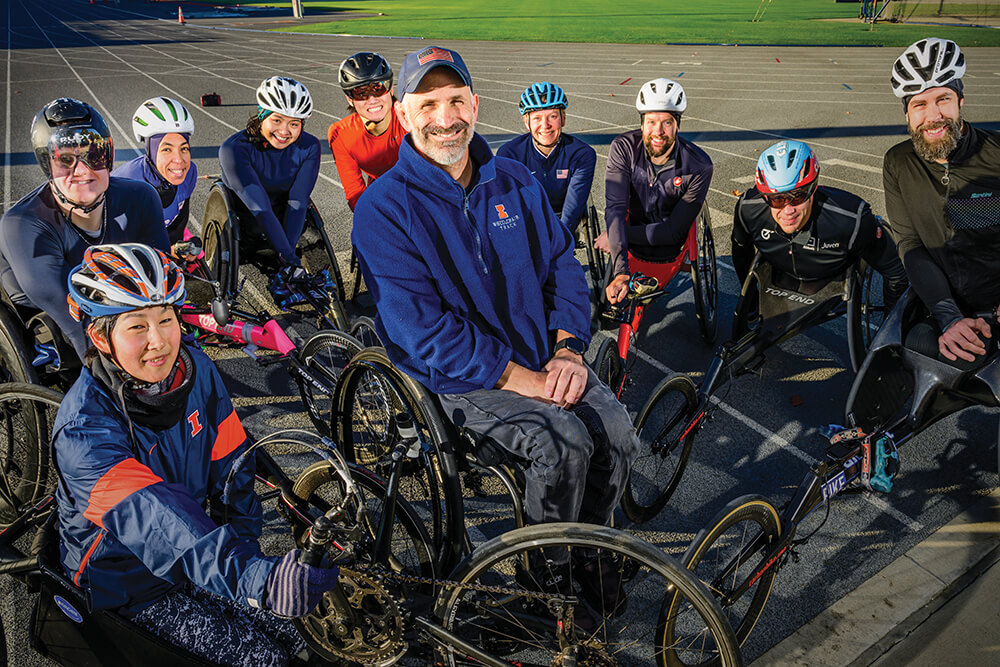
Head coach Adam Bleakney has guided he University of Illinois Wheelchair Track and Road Racing team since 2005, creating a home for athletes to perform at the highest level. Those athletes have won 55 medals across four Paralympic Games while setting 14 world records on the track, as well as champions winning the Boston, London, Chicago and New York City Marathons. (Image by Fred Zwicky)
Enjoy more about racers Susannah Scaroni and Amanda McGrory, and DRES founder Tim Nugent in Illinois Alumni magazine.