Reformer at Heart

Sharone R. Mitchell, Jr., heads one of the nation’s largest public defender offices, with more than 500 attorneys. (Image by David Johnson)
Sharone R. Mitchell, Jr., ’05 LAS, is Chicago South Side born and bred.
It is a fact he proudly states. It is a communal and cultural identity that grounds him and his life’s work as a public servant and a defender. The defenders. That is what he calls himself and the more than 750 employees he leads as Cook County Public Defender.
Mitchell heads one of the nation’s largest public defender offices, with 23 divisions and units, more than 500 attorneys, and a budget of $118 million.
“I really have two jobs,” Mitchell says. “One job is to ensure that our office is providing the strongest legal services we can. My second job is to ensure the environment is so strong that people can work to the top of their ability to do the first thing.”
His journey to the top floors of the George W. Dunne Cook County Administration Building in downtown Chicago started on the South Side where he was born and raised. This journey took him to Champaign-Urbana to earn a degree in political science and brought him back to Chicago to earn a law degree from DePaul University. And it eventually led him to head the office where he started his legal career.
Mitchell says he has only had “two real jobs.”
He began his legal career in the office—first as a clerk during law school and later as an assistant public defender in the Civil, First Municipal, and Felony Trial Divisions in 2009. “My first real full-time job in the law was here,” Mitchell says.
Mitchell left the Public Defender’s office in 2016 to work in public policy at the Illinois Justice Project, eventually becoming policy reform director. In 2021, he returned to his first employer to become the head of the massive office tasked with representing people who cannot afford an attorney. In Cook County, it is estimated that four out of every five defendants cannot afford an attorney, and the vast majority of those defendants are Black or Latino.
“When people feel unsafe, it creates an environment where people create injustice,” Sharone R. Mitchell, Jr., says.
Whether tasked as a young lawyer to represent people accused of crimes from misdemeanors to felonies, to now being the administrator of an office that handles tens of thousands of criminal and civil cases a year, Mitchell considers it all a blessing.
“I really love the Public Defender’s office,” he says. “I love the communities that we serve. I love public defenders who are doing that service. And to have the ability to be in community with them every single day is a dream come true.”
Mitchell was born at Michael Reese Hospital in the Bronzeville neighborhood. He grew up in South Shore until he was 6 years old, when his parents moved the family, which included his younger twin sisters, Natalie, ’10 LAS, and Nicole, ’10 MEDIA, farther south to the historic West Pullman neighborhood. Mitchell and his wife, whom he met in law school, live on the South Side, not far from his childhood home.
“I’m about as South Side as you can get,” Mitchell says with a laugh.
Both his parents worked for the City of Chicago—his father as a truck driver and his mother as a librarian—for 35 years. The kitchen table was not just for eating, but a place where conversation about current events and the importance of education and community service were served consistently.
Mitchell remembers summers riding with his father as he drove throughout the city, listening to National Public Radio and learning about politics. His father also listened to conservative radio personality Rush Limbaugh, whom he would argue with over the radio as if Limbaugh was in the truck.
“My mom and dad were people who impressed on me the privilege of having an education and the duty you have to give back to your community,” Mitchell says.
His mother still lives in the same West Pullman house where Mitchell grew up. His father passed away six years ago.
Growing up, Mitchell says he didn’t know many lawyers, except for his mother’s brother, but early on he figured the law might be a good fit. As a sixth grader at Metcalfe Community Academy, Mitchell was chosen to defend his classmates in a mock courtroom. In high school, Mitchell says, he didn’t have the height for basketball, but did have the skills to join the debate team.
When he graduated from Morgan Park High School in 2001, the University of Illinois Urbana-Champaign was his first choice for college. “It’s one of the best state schools in the country,” he says. “It was a perfect fit for me.”
At Illinois, Mitchell majored in political science and minored in communications and African American Studies. He worked as a research assistant for Dr. Damion L. Thomas, whose project on conservatism and hip-hop made a lasting impression.
“I got to take an art form that I loved and provide academic rigor to it,” Mitchell says. “It was the first time I saw someone take an art form that was uniquely Black and provide some critical thought toward it. It opened my mind to what was possible.”
After graduating from Illinois, Mitchell says, the question he had to answer was, how could he use his God-given talent and “a really great education to help my people?”
His answer was the law.
On the 16th floor of the County Administration Building, a row of black-and-white photos lines the wall, depicting former Cook County Public Defenders—mostly white men. But front and center is a color photo of Mitchell, sporting an orange tie and light-blue shirt. A blue-and-white sign on an office door declares in bold, capital letters in English and Spanish, ICE OUT! (¡FUERA ICE!).
In the corner by the reception desk is a large blue-and-white sign stating the office’s mission: “To protect the fundamental rights, liberties, and dignity of each person whose case has been entrusted to us by providing the finest legal representation.”
In 2022, the office logo got a design update—a dark blue circle with dark blue scales of justice, against an orange backdrop in the middle of the circle. Mitchell says he can neither confirm nor deny the rumors that the logo colors have “something to do with where the Cook County Public Defender went to college.”
When Mitchell started at the office straight out of law school, he worked from the ground level with the community, other attorneys, and staff, but never in management. As a young defender, he quickly realized that justice was difficult to secure, and that many of the outcomes people viewed as failures of the system were not glitches at all, but systemic. “That reality helped motivate me to take my practical experience and move into the policy space,” he says.
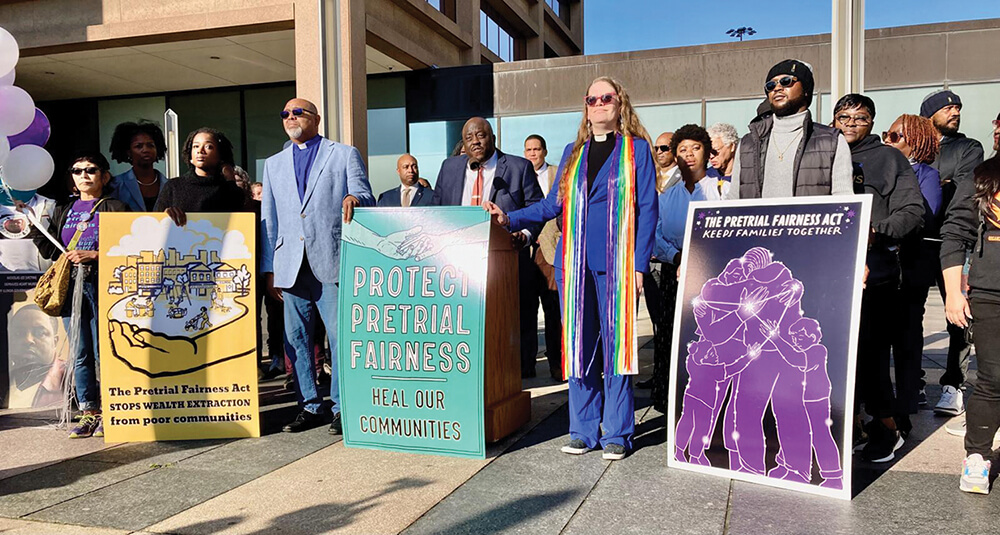
As Cook County Public Defender and policy director of the Illinois Justice Project, Mitchell worked to eliminate cash bail. (Image courtesy of the Law Office of the Cook County Public Defender)
In 2016, Mitchell left the Public Defender’s office to work at the Illinois Justice Project. “I’ve always loved and deeply believed in the mission of the Law Office of the Cook County Public Defender to provide the best legal services for those who cannot afford it,” he says. “Ensuring that poor people get the representation they deserve requires excellent day-to-day, shoulder-to-shoulder representation. But it also requires that we take the experience of [our] thousands of previous clients and attempt to have those experiences be heard by policymakers as laws are written that govern how the criminal legal system works and effects residents, their families, and their communities.
“I took my experience as a young Black man growing up on the South Side but also as a young Black lawyer working in the criminal legal system, and worked on policy change.”
The policy he is most proud of fighting for is the end of cash bail.
In 2023, Illinois eliminated cash bail through the Pretrial Fairness Act, a part of the Safety, Accountability, Fairness, and Equity—Today (SAFE-T) Act.
Whether someone can buy themselves out of jail should not be the determining factor, Mitchell says. It should be determined by a judge based on the facts of the case. The reform has drawn national attention and criticism. In August 2025, President Donald J. Trump described no cash bail as a “disaster” and issued an executive order to block federal funds from state and local governments that have adopted the practice.
Mitchell says the reforms are not perfect, but they are working, and the president’s critique “is not based on fact or reality.”
On a bitterly cold January afternoon, Mitchell sits at the front of a two-tiered lecture hall at the University of Chicago Law School, one of four panelists invited to speak to the Black Law Students Association. About 25 students of varying backgrounds eat lunch on paper plates, listening as the discussion turns to wealth-based detention and the mechanics of pretrial injustice.
Mitchell speaks plainly, moving from cash bail reform to the emerging role of artificial intelligence in courtrooms. The invitation had asked for a “front-line perspective” on how bail reform is reshaping racial equity. He gives the students lived experience from Cook County courtrooms.
“In school, we teach that putting a price on somebody’s head for somebody’s freedom was something that was abolished hundreds of years ago. In reality, that’s not the case,” Mitchell tells the students. “People who are accused of criminal offenses are not people who typically have a lot of power. You can really do anything you want to a poor person or a poor person’s family without a lot of hay being made about what you’re doing.”
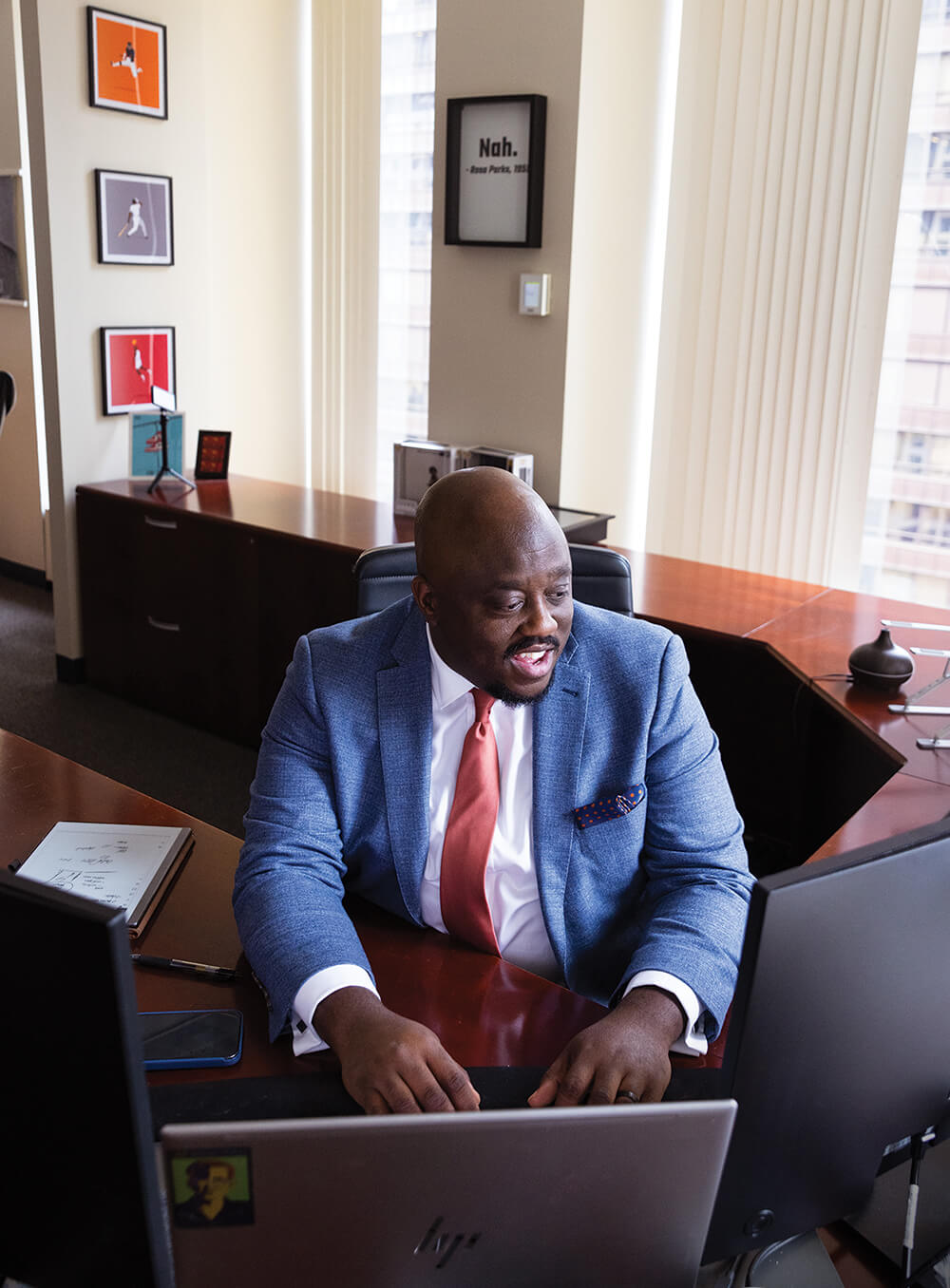
“My mom and dad were people who impressed on me the privilege of having an education and the duty you have to give back to your community,” Mitchell says. (Image by David Johnson)
When he isn’t answering students’ questions, Mitchell glances at his phone, takes a sip of Coke, taps out a quick response. “He’s always connected to the office,” says Sav Felix, his deputy chief of staff. “Calls, texts, emails. And he hears everybody out before he makes a decision.”
Felix has known Mitchell for nearly a decade. They met when he was leading the Illinois Justice Project and she had just finished graduate school in social work at the University of Chicago. She was working as an intern with the policy group. When Mitchell became Cook County Public Defender, he built a policy team and brought Felix into the office. She has been there four years and has served as his deputy chief of staff for the past year.
Felix describes Mitchell as both meticulous and expansive—someone who can articulate a broad vision for systemic reform and then spend hours refining an Excel spreadsheet to understand how a single staffing decision will ripple through the office.
“[Mitchell] gets in the weeds on everything because he cares so deeply,” Felix says. “He wants to understand the intricacies of how things work. He’ll build a spreadsheet for anything—and perfect it—before he moves forward.”
Mondays are a marathon of meetings: staffing and budget sessions in the morning, as well as updates on the Freedom Defense Centers and legislative strategy sessions. By afternoon, he’s in labor meetings—sometimes sitting down with union leadership or fielding workplace concerns. Tuesdays and Wednesdays are frequently devoted to interviewing attorneys, including those just starting their careers. Mitchell conducts every interview himself. He also handles every exit interview.
“He’s very accessible,” Felix says. “He listens.”
“We are in service to the community, not the other way around,” Mitchell says. “Sometimes we forget that in government. We’re here by the grace of the taxpayer, and our goal should be to ask people what they need.”
That attentiveness has shaped larger reforms as well. The passage of Illinois’ Pretrial Fairness Act—years in the making and the first of its kind in the nation—required sustained advocacy and coalition-building. “That was a five- to 10-year project,” Felix says. “It takes passion and dedication to see something like that through.”
Felix knows Mitchell misses the courtroom; she says he was very good at trial work. “But he’s also a great leader. I’m glad we have him at the top.”
Outside the office, Mitchell hosts large gatherings at his home that bring together colleagues and community members. He drops everything for the people he cares about. “One of the best people I know,” Felix says. “One of the kindest and most thoughtful people I know. He’s passionate and dedicated. He’s building something bigger than himself—and he’s doing it by making sure everyone’s voice matters.”
What is real, Mitchell says, is that murder rates are at the lowest they have been since the 1960s. Still, he understands the difference between statistics, public perception, and the realities and impact of gun violence in communities.
“The fact that gun violence is down is not good enough,” Mitchell says. “We’re in a time where the perception of crime is high. Any instance of harm is too much. When people feel unsafe, it creates an environment where people create injustice. People don’t see the downside of locking up so many Black and brown and poor people.”
Mitchell does not dismiss the complexities of crime and safety: “I’m not a bleeding heart,” he says, “but just locking up tens of thousands of people isn’t going to solve what we want to solve.”
Those are the thoughts that keep him up at night as a defender in what he describes as, “the wrongful conviction capital of the world.”
Because the criminal legal system has such a huge impact on Black, brown, and poor communities, Mitchell views the work of his office as a utility and not a luxury for those communities.
“It is paramount to the lives of the community,” he says. “The value of the public defender is ensuring that people’s rights are protected. It’s a lot of pressure, and a lot is on the line.”
Compounding the usual pressure in recent months was the addition of the U.S. Dept. of Homeland Security’s immigration enforcement campaign, “Midway Blitz.” Mitchell says Immigration and Customs Enforcement (ICE) agents were chasing people in the courthouse.
In October, the Cook County Public Defender’s office and a coalition of legal aid groups petitioned the chief judge of the Circuit Court of Cook County to bar ICE agents from making arrests at courthouses without a court order, and the petition was granted. The chief judge banned federal immigration agents from arresting people around local courthouses without a warrant.
In November, Cook County Board President Toni Preckwinkle and Mitchell announced that the Public Defender’s office would be hiring more attorneys to support immigrants facing deportation. The office plans to double the number of public defenders in the Immigration Division from four to eight. The county launched the Immigration Division with a pilot program in 2020 and made the division permanent in 2022.
“A working society needs a place where conflicts can be resolved by a neutral arbiter in a safe and effective way,” Mitchell says. “A legal system can’t work if you are disincentivizing people from coming to court.”
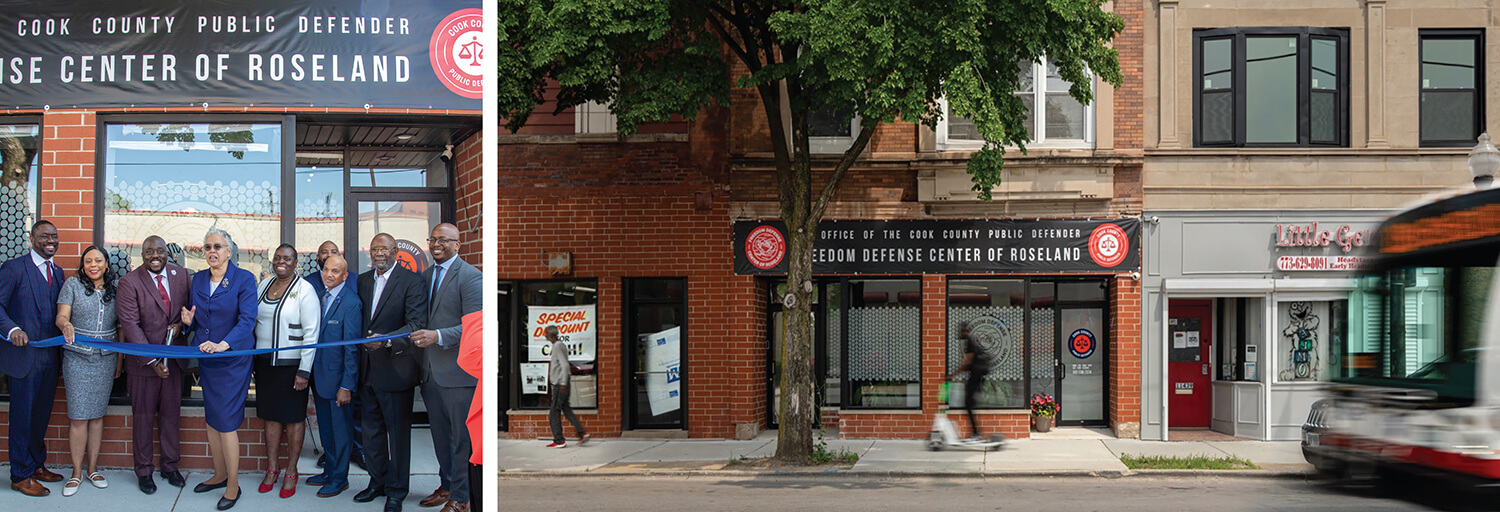
Mitchell and Cook County President Toni Preckwinkle (third and fourth from the left) cut the ribbon on the new Cook County Public Defender’s Freedom Defense Center of Roseland, on Chicago’s Far South Side. (Image courtesy of Cook County Government)
Across from the Family Dollar store on Michigan Avenue sits the Cook County Public Defender’s Freedom Defense Center of Roseland—the first community-based public defender office of its kind in the nation. The storefront space on Chicago’s Far South Side serves as a legal hub where families impacted by the justice system can find free services and support close to home.
“In the past, clients had to travel far from their communities to meet with us,” Mitchell says. “For too long, justice has been something our clients had to navigate alone, surrounded by systems that felt cold and distant. Being in the community, we can connect people to what they need.”
The Roseland center opened in spring 2025, followed in the fall by the Freedom Defense Center of Austin on Chicago’s West Side. Both were designed with community input and are operated in partnership with neighborhood organizations.
“We are in service to the community, not the other way around,” Mitchell says. “Sometimes we forget that in government. We’re here by the grace of the taxpayer, and our goal should be to ask people what they need.”
Being physically present in neighborhoods, he adds, helps counter negative media portrayals of public defenders and rebuild trust in a system many believe “was not built for them.” Public defenders, he says, are too often depicted as overworked and underprepared. Historically, many offices across the country have suffered from underfunding.
“But the reality in Cook County is that we offer very high-quality criminal defense,” Mitchell says. “We have a monopoly on high-quality criminal defense attorneys—not perfect, but very high-quality.”
Since taking office, Mitchell has interviewed hundreds of applicants and helped hire about 120 new attorneys. Their passion gives him hope. “To be in community with folks who decided they want to help people who look like me, there’s no better feeling in the world,” he says.
As a frontline defender in the courtroom, Mitchell often imagined how the office could better serve its neighborhoods. Now, he has the opportunity to turn those ideas into action.
“In my heart, I’m a reformer,” he says. “I try to be a servant leader. I love my job. There are challenges, but what I keep coming back to is that there is a large community of people who want to help their fellow man.”