Alumni Interview: Elizabeth Hausler
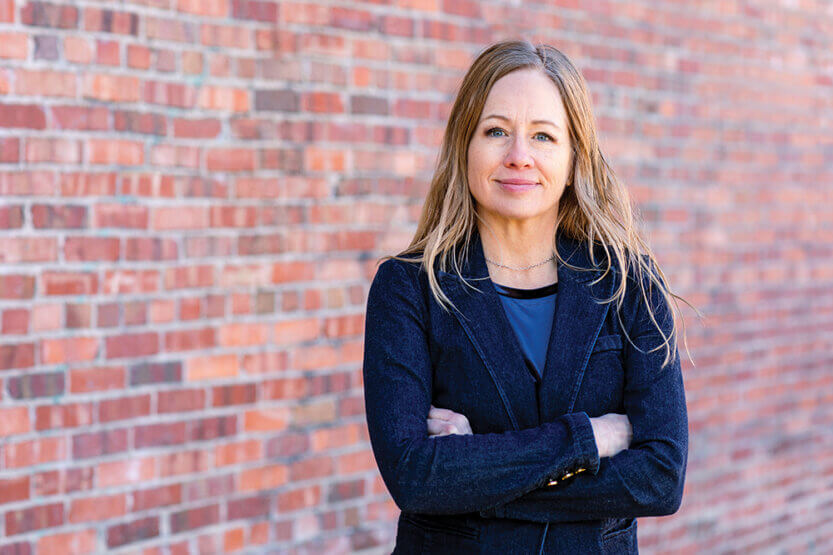 “Natural forces are beyond our control, but their effects are not beyond our influence,” says Elizabeth Hausler, founder of Build Change, a nonprofit organization dedicated to preventing housing and school collapses due to earthquakes, extreme weather, and fires. (Image by Parker Seibold)
 If you look at my LinkedIn page, you’ll see that I identify as a social entrepreneur, safe housing advocate, and bricklayer.
I was a bricklayer first. My dad owned a small construction business in Plano, Ill., building houses and custom fireplaces. I worked with him during the summers. I picked up broken bricks. I learned to drive a forklift. Around age 15, I graduated to laying bricks. I loved knowing how to do something practical. I loved seeing the results of my work.
The seeds of my interest in engineering were planted there. I liked solving problems and was good at math. I had an inspirational high school physics teacher who did lively, fun, hands-on demonstrations. I loved learning about the mechanics of how things move when you apply forces to them. You can see how eventually I was drawn to earthquake engineering.
One of the things from my time at Illinois that stands out is the balsa wood design and construction competition during my junior year Engineering Design Analysis course. We had to build a load-bearing balsa wood structure in the shape of a C. The goal was to design the lightest structure that could hold the most weight. But the kicker was that we had to actually build the thing. I remember my roommate’s bewilderment with the many trials of different glues, lamination patterns, and so on. And I won. That really built my confidence. I ran a successful computer model, and I could build things.
Another eye-opening experience was my engineering law course. I thought engineering was just numbers and calculations, but the course made me realize how engineering interacts with the legal system and the regulatory environment. Both of those experiences have carried through my work.
After graduation, I worked for a litigation support consulting firm in Chicago. Among my clients were waste disposal firms that operated leaky landfills, and we supported them to recover money from insurance companies. I loved my colleagues, I loved Chicago, I loved the pace of consulting, but I wasn’t crazy about the clients. I began to wonder: Why are these companies polluting in the first place?
So I headed to graduate school. I intended to study landfill design, but my professor persuaded me to focus on earthquake engineering. I’m glad I did. We spun buckets of soil around on a NASA centrifuge. We blew up the ground in Japan to simulate an earthquake. I met people from around the world.
In 2001, a massive earthquake struck near Bhuj, India, killing at least 20,000 people and destroying 400,000 buildings. I went to Gujarat on a Fulbright fellowship to study the rebuilding programs. I saw that some organizations were doing great work, building safe houses that people liked.
“Why wait until a home has been destroyed, when for a fraction of the cost we could make houses safer?” —Elizabeth Hausler, ’91 ENG
Natural forces are beyond our control, but their effects are not beyond our influence. Across the globe, a billion people live in disaster-vulnerable housing. Why wait until a home has been destroyed, when for a fraction of the cost, we could make houses safer?
In 2004, I started Build Change to do just that. It turns out that prevention actually is a lot cheaper than the cure. In some cases, a replacement home would cost $20,000, while retrofitting it with resistance measures is about a tenth of that.
We began by building houses and training builders. Now we also facilitate access to financing and influence policy. We can demonstrate what it takes to retrofit a house and show the cost.
We started with earthquake-resilience. We expanded to hurricane- and flooding-resilience. Recently in the U.S., we’ve been looking at fire resilience. We’ve provided safer housing and schools for more than 1.4 million people, trained over 110,000 people in the basics of safe construction, and created more than 46,000 local jobs.
To date, we’ve built 280,000 new or retrofitted buildings, safeguarding $5.2 billion in housing infrastructure assets. That’s $5.2 billion of housing assets protected from loss in the next disaster. It’s a huge number.
But stats are only part of the story. A lot of what Build Change has done is about economic justice. Housing is a right and a basic human need; it is at the base of Maslow’s Pyramid. We’re shifting power to the people, enabling them to make decisions about materials and architecture, and access financing to improve and strengthen their homes.
Everyone deserves the right to a safe house. I remember at the end of one project, one homeowner told me, “Now I can sleep at night.” When I know families can sleep at night, I can sleep at night as well.