Memory Lane: The Flooding of Green Street

Green Street flooding, 1979 (Image courtesy of the City of Champaign)
Today, Boneyard Creek is one of the most beautiful features of the Illinois campus, but for more than a century, it was a trash-filled eyesore with a drainage problem, and it flooded Campustown any time there was a heavy rain.
Green Street businesses, including Bubby and Zadie’s, Abe’s Red Hots, and O’Malley’s, often filled with water and were temporarily forced to close.
Farther east, university buildings also were at the Boneyard’s mercy, with floods endangering valuable equipment in Talbot Lab and the Metallurgy and Mining Building, and depositing as much as 20 inches of water in the Electrical Engineering Research Laboratory.
For building owners, the flooding was a nuisance and an insurance nightmare. But for many U. of I. students, it was an opportunity. To them, the deluge on Green Street wasn’t a threat to one’s livelihood or a public health issue—it was an impromptu water park.
Some alumni, including Lisa Yoder Takeguma, ’83 ED, treated the flooding Boneyard like a flume ride. “There would be about 50 to 75 people that would jump in at the Sixth Street bridge and get caught and helped out at the next bridge,” she says. “It was crazy!”
Other students opted for less crazy activities, such as fishing for catfish, recalls Robert Meyer, MBA ’88. But for many Illinois alumni, “crazy” was the operative word—at least where Green Street water sports were concerned.
Greg Fisher remembers “folks water-skiing behind pickup trucks;” Robb Lucas, ’97 ACES, saw “a dude on a Jet-Ski,” flying past Burger King; and many others witnessed kayakers, rowboaters and, in at least one case, a surfer trying to catch a wave.
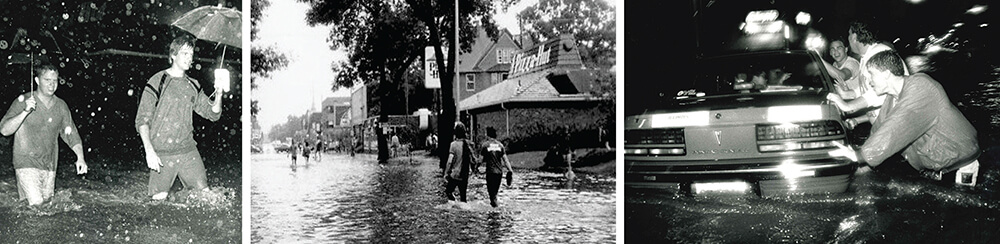
Depending on their circumstances, U. of I. students either rejoiced in the Boneyard’s floodwaters or cursed their existence. (Images courtesy of UIAA and Illini Media)
Sometimes, students’ parents even got in on the action. Bob Hayden, ’83 ENG, recalls a huge flood in the summer of ’82, when his dad was visiting his Green Street apartment. “We joined a party with hundreds of others,” he says, “including some in canoes and inflatable boats and rafts. My dad was swimming laps, and I was tossing around a football in water that was waist-to-chest-deep. It was incredibly fun!”
But the flooding wasn’t all fun and games. In some cases, it became truly hazardous, imperiling motorists and passersby and, in the late 1960s, even causing a student’s death.
A much more common result of the flooding was property damage—most often to vehicles, which were submerged or swept away. “They had to wear scuba gear to rescue our totaled cars!” says Jenn Janovetz, ’90 MEDIA.
But the damage wasn’t limited to students’ vehicles. Occasionally, unlucky students would discover that their first-floor apartment was in the flood zone.
“It was awful,” says Shari Hanneman, ’89 LAS. “All the carpet and furniture had to be replaced, but the musty smell never left.”
Decade after decade, the flooding continued in this fashion, plaguing the campus and local communities. Finally, in the mid-1990s, the cities of Champaign and Urbana found a solution, as part of the large-scale Boneyard Creek Improvement Plan. “They dug a big hole at the west end of Healey Street and replaced the Boneyard [there] with huge, corrugated pipes,” says Chris Alix, ’88 ENG.
And that was that. After a century of regular flooding, 30 years have now passed with no major issues—with Campustown businesses safe from rain, high-tech labs safe from ruin, and students safe from themselves: denied at least one opportunity to practice the foolhardiness of youth.