Still Marching On
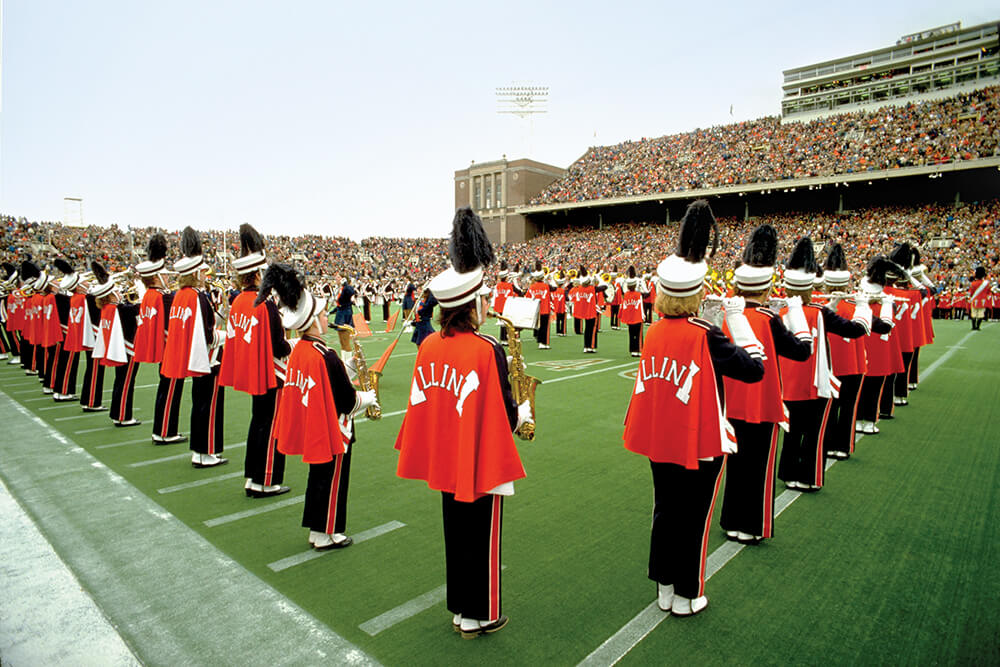
During Gary Smith’s tenure as director of the Marching Illini, he modernized the band’s uniforms and halftime performance. Above: The band in formation, ca. 1985. (Image courtsy of U. of I. STRATCOM)
Eric Lernor, ’80 LAS, came to the University of Illinois campus in the summer of 1976, just before the start of his freshman year.
A trombone player, Lernor auditioned with the Illinois concert band. Guy Duker, ’64 FAA, ’65 FAA, who was associate director of bands, asked Lernor if he would like to play with the Marching Illini.
Lernor, a Rockford, Ill., native and Guilford High graduate, jumped at the chance—sort of.
“I said, ‘Sure, why not?’” Lernor recalls.
Lernor wasn’t the only newcomer with the band that season. Marching Illini director Gary Smith was a “freshman,” too, hired away from Indiana State University.
Smith made an immediate, positive impression on Lernor—one that has lasted a lifetime.
“He was very passionate about everything we did,” Lernor says.
Not only that, but he taught his students how to take a big project and tear it apart into achievable goals, to avoid being overwhelmed by the enormity of the work ahead.
“He has always been an exceptional educator,” Lernor reflects. “I would say he was probably the most influential teacher in my four years of college. He said we should always be striving for excellence—and that’s how I’ve lived my life.”
Now a successful dentist of 42 years in the Phoenix area, Lernor considers his time with Smith and the Marching Illini “life changing.”
Fifty years after their first meeting, Lernor and Smith still maintain a friendship. Just last year, Lernor visited Smith in Florida, attending a concert by a community band that the 83-year-old Smith directs.
Because of their relationship, Lernor has decided that part of his estate will go to support the Illinois bands.
“For what Mr. Smith taught me and how he influenced my career, I thought there needs to be some kind of payback from me to the university,” Lernor says.
Lernor had an up-close view as the Marching Illini modernized under Smith.
“Gary was very innovative—so far ahead of his contemporaries—and he changed almost everything about what the Marching Illini was,” Lernor says. “His changes made the band what it is today.”
For example, Smith modernized the uniforms and changed the marching style, Lernor recalls, and “he made the halftime performances and pregame more exciting and more interesting.”
No disrespect meant towards the previous band director, Everett Kisinger, Lernor is quick to point out. “Mr. Kisinger was an excellent band director,” Lernor says, “and he did a lot of great things.
“But I think people were very excited with what they saw when we first took the field in the fall of 1976.”
The number of musicians then wasn’t close to what it is today. The first year, there were 176 band members. By the time Lernor was a senior, that number rose to 230.
Lernor credits Smith for the lofty status of the modern-day Marching Illini, which includes large numbers (424 today) and auditions required to make the band.
“Gary set the bar very high and always was pushing for being better each and every year,” Lernor says. “I think that has become a tradition with the Marching Illini. They don’t rest on their laurels.”
Lernor will be back in Champaign-Urbana Oct. 3 for the Homecoming game against Purdue, but not just for the football and the usual festivities. The 50th anniversary of Smith’s hiring as director will be celebrated, too. As it should be.
“Gary has been a tremendous mentor to me,” says current Marching Illini director Barry Houser, MMUS ’09 FAA. “He has created a pretty phenomenal legacy that’s going to forever be part of our history.”
Houser, who’s building a legacy of his own, has just finished his 15th year with the band. But he will need to reach 22 years to tie Smith’s record for the longest tenure.
“I never had any intention of teaching at the collegiate level,” Houser says, “but here I am, and I’m able to follow in Gary’s footsteps and carry on the many great traditions he created.”
Smith grew up in Orlando, Fla. His family split its time between the Sunshine State and Indiana, where it ran the summer Smith Walbridge Clinics in Syracuse, Ind. Founded in 1949, the band camp—now located at Eastern Illinois University in Charleston—has trained thousands of musicians and directors over the years, including Houser, who attended as a high school drum major and was later named to the instructional staff, before taking over as director.
“It’s geared for marching bands, drum majors, percussion, and color guards,” Smith says. “And it’s still going strong.”
Smith attended Edgewater High School in Orlando, where he played the euphonium, a small tuba. Then, he was off to Indiana, earning his undergraduate degree from Butler University in Indianapolis, and his master’s from Ball State in Muncie.
After completing his education, Smith started his teaching career as the band director at Northside High School in Fort Wayne, Ind. Next, four years as director of bands at Saint Joseph’s College in Rensselaer, Ind., and that led to a stint at Indiana State from 1972 to 1976.
Illinois had conducted a national search at that time for its next marching band director, and officials weren’t thrilled with any of the applicants. Illinois called Fred Ebbs, the longtime band director at Indiana University, and Ebbs suggested Smith.
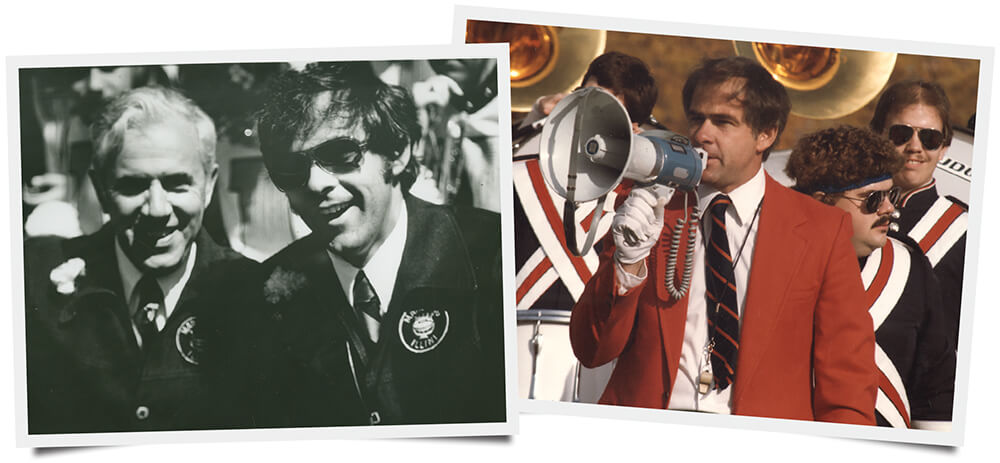
Left: Gary Smith (right)with U. of I. director of bands Harry Begian (left) during his first year at Illinois, 1976. Right: Smith keeps the band in working order, ca. 1980s. (Images courtesy of Sousa Archives and The Center for American Music)
“They called me and asked, ‘Why didn’t you apply?’ And I said, ‘I don’t have a doctorate, nor do I plan on getting one, plus I don’t know anyone there, plus I love my job here,’” Smith recalls. “They asked, ‘Can you be here tomorrow?’”
The answer, obviously, was, “Yes.”
When Smith came to Illinois, he brought film of his bands performing. “They said, ‘We want that here. Just duplicate what you do at Indiana State here at Illinois!’”
It was a complete makeover.
Then-Illinois football coach Bob Blackman offered his support, even showing up at rehearsals. “He was pretty supportive with all the changes being made,” Smith says.
But then-athletic director Cecil Coleman, known for being thrifty, didn’t mention the band’s budget. Or lack thereof. The first year, it was $40,000, a pittance compared to the rest of the bands in the Big Ten.
“I did a lot of begging,” Smith says. “We got some donations to get new uniforms.”
Fortunately, the athletic directors that came after Coleman were supportive: Neale Stoner more than doubled the budget to $85,000.
Always innovative, Smith was the first Marching Illini director to have a preseason band camp. The Big Ten bands were elite, and Illinois had work to do to catch up.
Smith’s first Illinois band was short on strong musicians—no music majors in the group. But the second year, Smith had 30, and 100 by the third year.
The facilities also presented a challenge. The Harding Band Building wasn’t big enough for a full rehearsal. So, the band’s drill field was moved around. Their fields had little grass—mostly weeds—and by the time band camp ended, it was dirt. Rain was the bane of their existence.
One of the first moves Smith made was to bring the Illinettes under the Marching Illini umbrella. That added money to the budget and allowed the group to be part of the show.
Then, he changed the percussion to make it more modern, increased the brass section, and had an arranger put together crowd-pleasing shows. “My first halftime show was the Who’s Tommy,” Smith recalls. “That was brand new then.” The band also performed hits by Stevie Wonder and other contemporary artists. Music to the fans’ ears—literally.
“The crowd immediately liked the band,” Smith says.
In addition to pop songs, the Marching Illini also played popular film scores. In one of Smith’s early years, the Detroit Lions invited the band to play at the Pontiac Silverdome, its home field at the time. The musicians performed a Star Wars show highlighting pieces from the film, playing to both sides of the crowd, which drew a positive reaction, and at the end of the show, a thunderous ovation from the fans. It was a big confidence booster, Smith recalls.
Rival bands in the Big Ten were friendly, and the directors were some of Smith’s mentors.
But they all had their pride.
“The Ohio State people said we are the only band that they liked,” Smith recalls. One year in Columbus, Smith ended the show with a novel formation—“Illini” in script letters—then had Ohio State’s sousaphones dot the i’s.
“That went over really well,” Smith says.
A.A. Harding, the first U. of I. band director, used to say, “We have the second-best college band in America.” When his band members asked, “What do you mean second best?” Harding said, “Everybody else thinks that they’re the best, but they all agree that we’re the second best.”
Smith often shared Harding’s words. And the band’s reputation—as well as Smith’s—always preceded it.
During Smith’s final season at Illinois, in 2004—a return engagement for one semester, following his initial retirement, in 1999—the football team opened with Florida A&M, known for its exceptional band. The two directors agreed to a joint halftime show.
“It was a huge success,” Smith says.
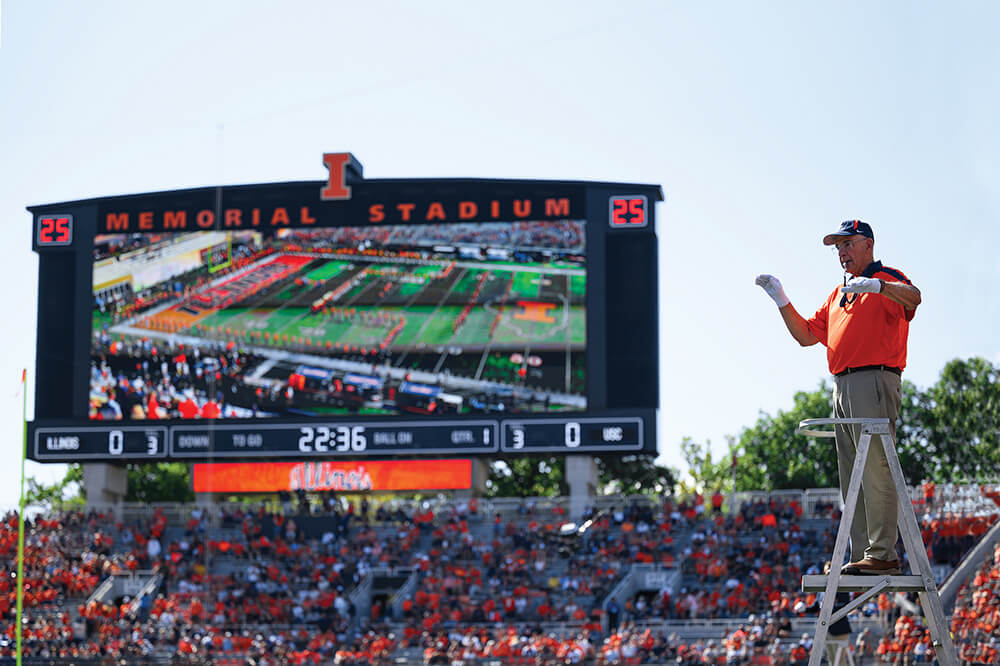
Gary Smith continues to have a relationship with the Marching Illini, 50 years after taking over as director. Here, Smith is guest conducting the band in 2025. (Image courtesy of Gary Smith)
Today, the octogenarian Smith lives in Naples, Fla., with his wife of 61 years, Beverly. The couple has two sons, Stuart and Sean, and four grandchildren.
Smith remains in good health. He goes to the gym three times a week, swims, and plays golf.
Though technically retired, Smith remains active in music. Until a year ago, he oversaw bands at Atlanta’s Peach Bowl, and he remains conductor of the Bonita Springs (Fla.) concert band, a position he has held for 13 years.
The band, featuring musicians ranging in age from 15 to 85, performs six times a year in front of crowds of 2,000.
“I really missed it so much, being with students,” Smith says. “When this community band position opened up, it really filled a void for me.”
The Smiths are looking forward to their return to campus in October for Homecoming. Houser put together a large alumni band, and Smith picked the music for the halftime show, giving Houser a list of 15 options.
How does it make Smith feel to see the band today?
“The greatest fear I had when I retired was I didn’t want to see the band regress or move in another direction that would not be appropriate,” Smith says. “Barry Houser is a former student of mine. He’s maintained all the tradition and the style, and at a high level. It’s considered one of the best marching bands in the country.
“I’m so proud to know I’m the one that laid the foundation for all that to happen.”
Illinois Alumni, Fall 2026