Ingenious: Origami in the Body
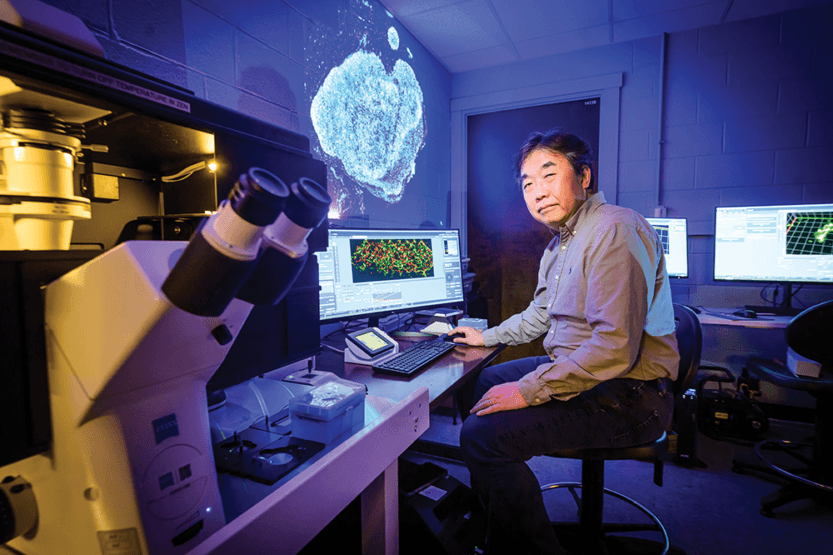 U. of I. mechanical science and engineering professor Bumsoo Han is finding new ways to fight pancreatic cancer. (Image by Fred Zwicky)
The ancient art of origami, or folding paper, gives us all sorts of sculpted wonders, from paper cranes to butterflies. But in a surprising twist, University of Illinois researchers have found ways to fold “DNA origami” into structures that can carry cancer-fighting drugs to tumors.
“We fold the DNA material into a tubular shape or sometimes a triangle or a ring,” says Bumsoo Han, professor of mechanical science and engineering and the Phil and Ann Sharp Scholar in Cancer Research. Once they find the sweet spot in size, this folded DNA strand, with the drug tucked inside, can deliver the treatment to the tumor without affecting nearby healthy tissue.
Han and his team have been testing this innovative approach on one of the deadliest cancers: pancreatic.
“It is difficult to diagnose early,” he says. “When patients get the diagnosis, the cancer is often already quite advanced, and treatment options are limited. When patients are diagnosed, they may have only months to live.”
The other complication, Han adds, is that drugs have a difficult time penetrating the stroma tissue that surrounds the pancreatic tumor. Researchers have been trying to loosen up the stroma tissue so cancer drugs can reach the tumor. But they have discovered that stroma tissue also has a beneficial effect; it keeps the tumor contained. Therefore, when stroma tissue is removed, cancerous cells can grow much faster and more aggressively.
The goal of Han’s research is to deliver the drugs through the stroma to the tumor using DNA origami without affecting the normal cells around it. They are currently testing two drug candidates, and though the treatments haven’t yet entered clinical trials, “the results so far are promising,” he says.
Han notes that drug delivery is not the only purpose of this research. “Surgeons want to be able to see the clear boundary between a tumor and healthy tissue,” he says. “That way, they can cut out the tumor precisely without damaging the normal, surrounding tissue.”
Their origami DNA can carry dye packets that mark the boundary between the tumor and normal tissue. When Claudius Conrad, a surgical oncologist at the Carle Illinois College of Medicine, heard about this use of DNA origami, he realized it could directly apply to his surgeries. As a result, Conrad began collaborating with Han, fine-tuning the dyes to fit their imaging system.
Han’s lab has created a sophisticated cancer model to test their work, minimizing animal testing. What’s more, this model can be used for other cancers. Han is often contacted by other labs that want to test their own compounds.
When Han started out in mechanical engineering over 30 years ago, the biotechnology connection in his field was just being made. His Ph.D. concentrated on heavy industry—the movement of fluids in large turbine engines in airplanes and power plants.
However, he says, whether you’re studying the transport of fluids within an engine or the human body, “it’s basically the same principles.”
Illinois Alumni, Fall 2026