Memory Lane: Long Live the King
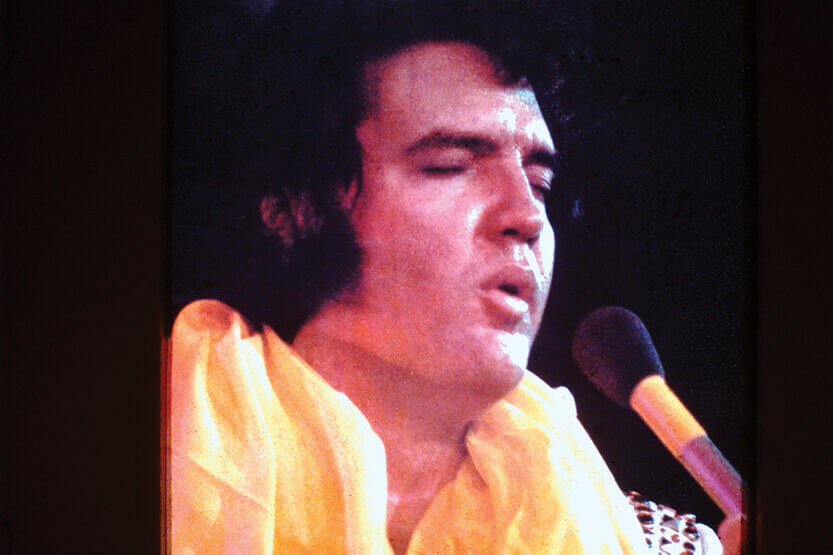 On Oct. 22, 1976, Elvis Presley performed at Assembly Hall for the first and only time, before a record-setting, all-ages crowd of 17,177 fans. (Image courtesy of Don Webber)
The room went dark, and the crowd began to scream. Then a majestic mix of pipe organ, contrabassoon, trumpet, and timpani blared from the speakers—Thus Spake Zarathustra, from 2001: A Space Odyssey—and there he was, standing in the spotlight, looking as otherworldly as anything from Kubrick’s film.
It was Oct. 22, 1976, and the King of Rock and Roll, Elvis Presley, was playing the Assembly Hall for the first and only time, before a record-setting, all-ages crowd of 17,177 fans.
Elvis arrived on stage in his “Inca Gold Leaf” jumpsuit, an off-white number ornamented with a lavish design of shiny gold, red, and blue metal that absolutely no one else could have pulled off. But Elvis did. Despite everything. Despite the years of drug abuse and the fate-tempting diet—his favorite food was a fried peanut butter, banana, and bacon sandwich—that would result in his early death less than a year later.
Standing on the Assembly Hall’s stage, the 41-year-old Elvis looked like a tired, heavier version of his former self. But he was still unmistakably Elvis—which is to say, glorious—and he launched into his performance with a passion that few musicians could match on their best day.
Elvis and his crackerjack band—themselves decked out in red, sequined leisure suits—played a wide range of hits from his catalog, including “Jailhouse Rock” and “Heartbreak Hotel,” mixed with covers of songs by artists as varied as Ray Charles and Olivia Newton-John.
Whatever Elvis sang, he made his own. “There were times that his singing during ‘The Battle Hymn of the Republic’ made you want to cry, it was so beautiful and emotional,” recalls Joan Lawson, ’82 ACES.
Elvis’ emotion was contagious, and it would be fair to say that he whipped the audience into a frenzy. Women rushed the stage all evening, and some even threw their underwear at him, says Joyce Pittman Angell, ’79 ACES.
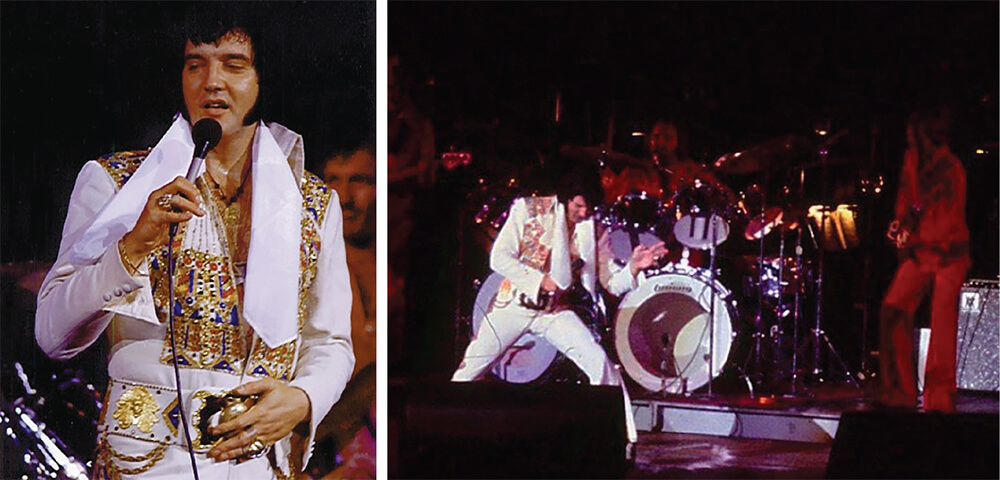
Elvis and his band performed in the round, and from the moment he walked on stage, flash-bulbs were a constant presence. “Every time Elvis turned to face another section of the audience, that section would be illuminated,” recalls Mike Salazar, ’78 BUS. The set-up virtually guaranteed that fans would spend part of the show rubbing their eyes and regaining their sight. (Images courtesy of Don Webber and Dave Roesch)
Always eager to give the audience what it wanted, Elvis gifted fans with some souvenirs of their own. Throughout the show, he would don a flowing, white scarf, and after a few minutes he’d use it to wipe the sweat from his brow, then give it to one of the many fans up front, recalls Bob Castillo, ’79 LAS. Then he’d receive a new scarf from his assistant and go through the routine all over again. “I still talk about it whenever the topic of Elvis comes up!” Castillo says.
Crowd-control, obviously, proved a challenging assignment for the Assembly Hall’s ushers. “We were supposed to block the aisles and keep people in their seats,” says Tamara Ducey, ’78 ACES. “But they didn’t pay us enough to risk our lives, even for the King!”
Still, the assignment was worth it. “Elvis was fabulous,” says former usher Kris Kuna Beaudette, ’76 LAS, MA ’77 LAS. “It was probably my most memorable show ever at the Assembly Hall.”
But not everyone was impressed. “My mom and every woman over a certain age cried and gushed [over Elvis] the whole time,” recalls Kathy Matlock Corniels, ’77 ACES. “I remember thinking he was awful!”
Nevertheless, most of the record-setting crowd went home happy, having seen a legend in their own time. “It was a great cultural and fun experience,” says Nora Keating Ligurotis, ’80 ACES, “like so many others at Illinois!”
At the end of the concert, the King’s iconic sign-off played over the PA: “Elvis has left the building.” Only 10 months later, he would be dead—a heart attack, at age 42—and that phrase would take on a new meaning, appearing in countless obituaries (in a supreme example of poor taste).
But another phrase appeared just as often: “The King is dead. Long live the King.”
Illinois Alumni, Fall 2026