Alumni Interview: Rebecca Rusch
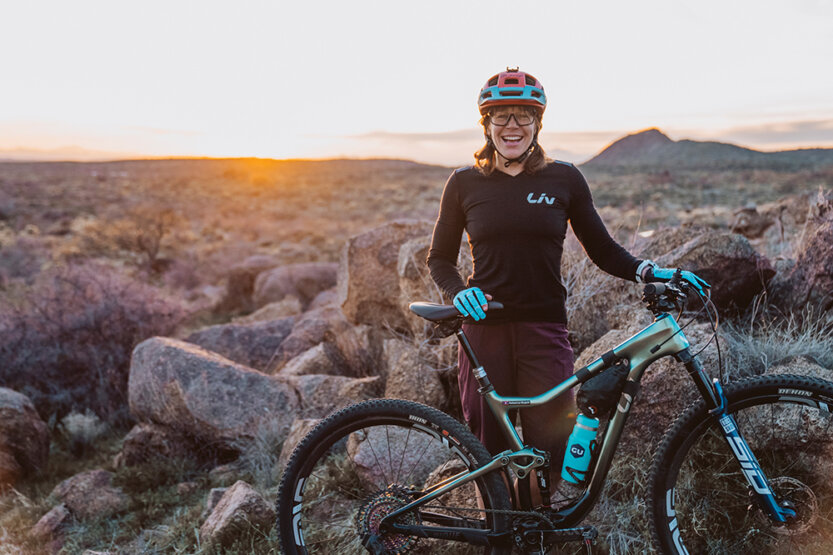 “I launched the Be Good Foundation to help clear unexploded ordnance along the Ho Chi Mihn Trail and to enrich communities by using the bicycle as a catalyst for healing, empowerment and evolution,” says Rebecca Rusch. (Image by Annemarie Hennes/Adventure Scout Media)
If I have to label myself, I consider myself an explorer. Athletics has been the lens for it, but I want to explore not only the world but what I’m capable of.
Early on, I joined my high school cross-country team, where I found an outlet for my energy and found community. It shaped the trajectory of my entire life.
I was typically the team’s best runner. But during a regional meet in my senior year, I wasn’t having a good race, so I just quit. I still remember the shame and embarrassment. I disappointed my team and myself. Since then, I haven’t quit a race.
I had no idea what I wanted to do with my life when I entered the U. of I. on a scholarship. I certainly wasn’t thinking that I’d be a professional athlete. My high school advisor encouraged me to pursue a business degree because of the Gies College of Business’ strong reputation.
As a sophomore, I became the first president of newly formed Delta Zeta sorority. It was such a positive experience, building something from the ground up with a diverse group of women. I’ve frequently been among the few female athletes in male-dominated sports, so I’ve always tried to lift up other women with me. It’s so important that we have a community and mentors, that we stick together and help each other.
After college, I worked my way up from folding towels to writing the newsletter at an upscale Chicago fitness club that had a 100-foot climbing wall. Many people consider working out a chore. But I saw the people at the climbing wall were coming for the sheer joy of it. There was a sense of community; I quickly joined them.
“I was invited on many adventures not because I was the fastest or best but because people saw that I had grit and wouldn’t quit.” —Rebecca Rusch, ’90 BUS
The three decades of incredible adventures that followed resulted from saying “yes” when invited to try something new, asking a lot of questions and diving in. I was the first woman to climb the Bermuda Dunes route up Yosemite’s El Capitan. My climbing skills gave me the upper-body strength to compete in international outrigger canoe racing. Clients at the climbing gym I ran in southern California recruited me to compete in endurance racing—grueling multi-sport expeditions that took me to Tibet, Kyrgyzstan, Vietnam and beyond. I’ve filled three passports as I’ve traveled the world for competitions.
I was invited on many adventures not because I was the fastest or best but because people saw that I had grit and wouldn’t quit. You say yes, even if things terrify you. You tackle that fear by taking your preparation seriously. You ask questions. You listen. You pay attention. You find mentors and teammates who have different skill sets than you.
In the fall of 2005, I thought my athletic career was over when the main sponsor for my endurance racing team terminated its contract. But then my one remaining sponsor, Red Bull, told me, “You have another year on your contract. Find something amazing to do.”
I had biked in endurance races. I was technically very unskilled, but I had the endurance and mindset for it. So, I started mountain bike racing at the age of 38. The second half of my athletic career is arguably more successful than the first. Well into my 40s, I won world championships and big races, including the legendary Leadville Trail 100 MTB race four times.
But the most important bike ride of my life was in 2015 along the entire 1,200-mile Ho Chi Mihn Trail, in search of the site in Laos where my father died in a helicopter crash during the Vietnam War in 1973, when I was three years old. The film of my journey, Blood Road, won an Emmy Award. It brought me closer to my father and helped me reflect inward. I needed to use my accolades for more than winning podiums.
During the war, my dad closed every letter he wrote home with the phrase, “Be good.” After Blood Road, I launched the Be Good Foundation to help clear unexploded ordnance along the Ho Chi Mihn Trail and to enrich communities by using the bicycle as a catalyst for healing, empowerment and evolution. Since 2019, the foundation has given more than $550,000 to 60 organizations.
Recently, I’ve been doing my own healing. In November 2021, I catapulted off my bike and suffered a severe concussion. Once I admitted that I wasn’t going to muscle my way through this, I started getting professional care. Training for sports is a lot simpler than the training to heal a brain injury.
I’m on the mend now and doing a lot better. Part of my work now is educating people about brain health and concussion care. My podcast, What’s the Rusch?, is about navigating transitions and changes. I’m not going to be breaking records anymore, but I am still an athlete and still connected to my values and the joy of being outside for the sheer fun of it and of connecting with my community.