The Impresario
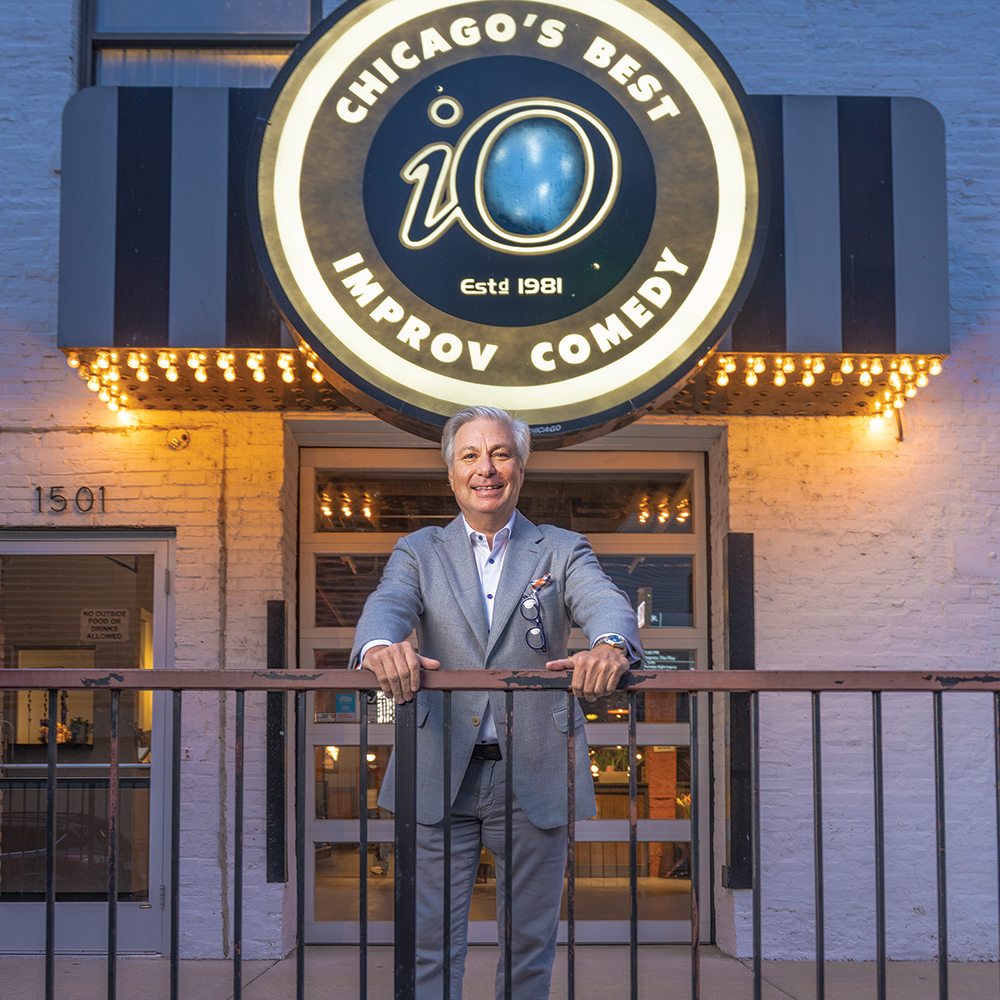
Scott Gendell bought the iO Theatre with his business partner, Larry Weiner, in 2021. (Image by Lenny Gilmore)
What’s a tycoon of commercial realty doing atop the Olympus of improv comedy? We’ll find out shortly, but first let’s join Scott Gendell, ’79 MEDIA, on a tour of his unlikely kingdom—a cavernous, 31,000-square foot warehouse on Chicago’s Near North Side, called iO.
“Here’s a picture of the 25th anniversary. There’s Amy Poehler, Seth Meyers, Andy Dick. Tina Fey”—he’s already down the hall—“was in the bathroom. This is one of the theatres.
“Hi, I’m Scott Gendell,” he says, to a group of rehearsing performers. “I co-own this place. Don’t let me interrupt.”
“You’re never interrupting. What’s up?”
Everyone’s got a cheery comeback. These are improv performers, after all. Per the dictum of iO co-founder and demi-god improviser Del Close—“Yes, and…”—they’re responsive and then some. An oil portrait of Close himself is stuck behind the chair in a cluttered office. Clumps of young people pass in the dark halls or pause to talk. Doors are opened, more performers caught rehearsing. More long halls, half a dozen shut doors.
“I don’t know what’s in here. That’s a writer’s room. This would be perfect for a podcast. I’ve wanted to do a podcast forever. Those people are probably auditioning for a show. They love it here, they love performing. It’s a way for them to interact with other people. We’ve got five levels of training. That’s The Ass Menagerie—they’re rehearsing a show for Valentine’s Day. Hello, there. You are….”
Three young women are lounging on chairs and a couch, surprised but pleased.
“Improvised Jane Austen.”
“Jane Austen. Of course. So let me ask: Does Emma go with the rich guy or the guy she really loves?”
Next, Scott’s talking about marketing with one of the women, who’s an executive assistant at a construction company. She loves iO. But she thinks it needs more publicity. Second City ads are plastered on buses, she says. Scott’s moved in closer.
“I want to talk to you,” he says. “Call me and set up a meeting.
“You see,” he tells me as we set off down another dark hall, “it’s all about improv.”
Before improv, there was real estate—a lively dinner table in Skokie, the Chicago suburb, where Scott’s parents, both Realtors, chatted about rents and frontage and listings. Scott was a latchkey kid—two older sisters had long since fled the nest—so he paid attention while eating. He liked the byplay, the activity. After graduating from Illinois in 1979, he got a Juris Doctor degree from Kent Law School and went home to Skokie and started a real estate company.
Called Terraco, the company was founded in 1986 by Scott and his then-fiancée, Lisa. Originally focused on neighborhood shopping centers, it now owns or manages over 80 properties across the country, totaling more than 5 million square feet in retail and office space. With legacy tenants such as McDonald’s, Walmart, and Target, it boasts an aggregate value of more than $1 billion.
Scott’s the first to admit that iO initially caught his eye as real estate. The building itself was vacant, but the surrounding neighborhood showed serious promise.
“Look at that new 26-story high-rise,” he says, pointing out the window. “Over there’s another—20 stories.”
Across Kingsbury—the diagonal avenue that slashes across Chicago’s Near North Side—is the country’s second-highest-grossing Whole Foods store. Behind it, a succession of new residential buildings overlooks the Chicago River.
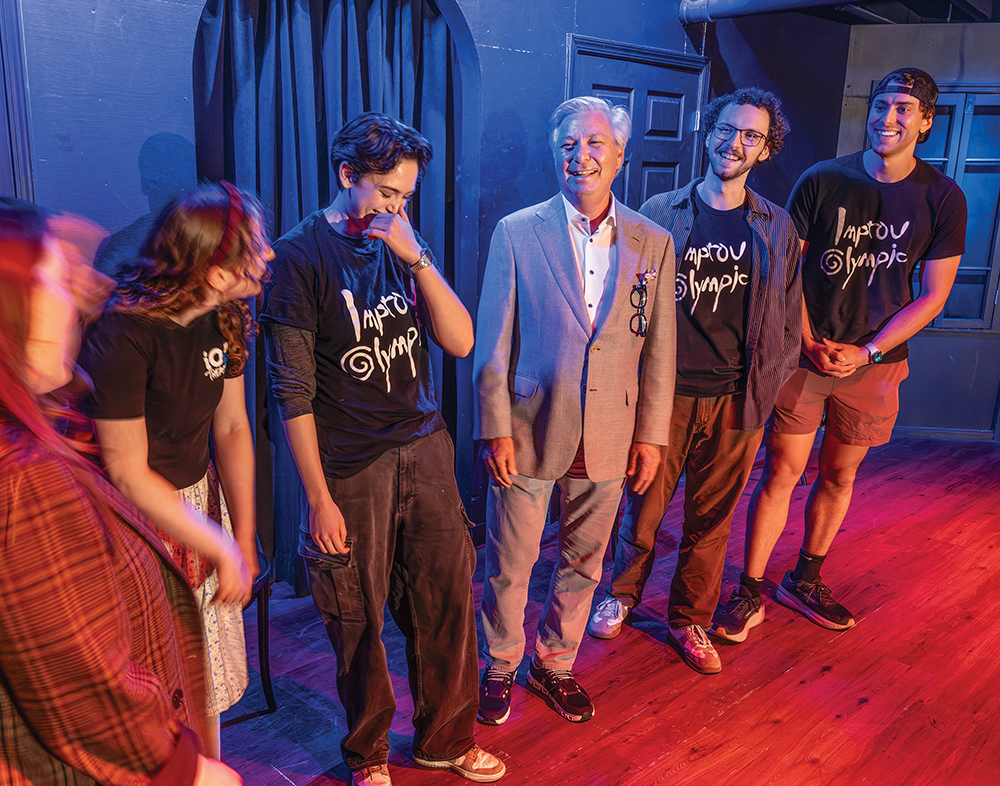
Scott Gendell yuks it up with improv performers from the iO Theatre (Image by Lenny Gilmore)
“If I’d been born in Los Angeles, I think I’d have been a movie producer or writer… Buying iO was the chance to scratch a creative itch.”
“If I’d been born in Los Angeles, I think I’d have been a movie producer or writer,” says Scott, with only a hint of regret in his voice.
You could argue he did become a writer, at least for a while. At Illinois, Scott wrote for the Champaign Courier in the paper’s final year. As a senior, he took a small, memorable class with film director Ang Lee, ’80 FAA, who went on to win two Academy Awards for Best Director, for Brokeback Mountain and Life of Pi. He also liked performing, and hosted a weekly sports show on the Dorm Broadcasting Service. Later, he teamed up with his friend Scott Bosley, ’78 AHS, nephew of the actor Tom Bosley, for a show on Talk Zone Radio called Talking Illini with the Boz and Mr. G, which ran for several years. It was radio, but they insisted on funny costumes for the Talk Zone web page.
“Buying iO,” he says, “was the chance to scratch a creative itch.”
iO was founded in 1981 by Charna Halpern and Close, largely as an alternative to the sketch comedy at Second City. Originally the “Improvisational Olympics”—until the International Olympic Committee forced a change to “iO”—it celebrated unscripted narrative and agile twists of the imagination. Improv could start one place and go another.
Around the world, and especially in Europe, improv often has a serious intent. But in the U.S. and Chicago, it’s usually comedic. Practiced in various performance spaces, improv took up formal residence in the Kingsbury building in 2014 and lasted there until 2020, when the COVID-19 pandemic killed off live performance. (A staff revolt objecting to Halpern’s seeming racism after the murder of George Floyd helped to seal its closure.) In 2021, Scott and his friend, Marc Realty head Larry Weiner, ’79 BUS, took over the abandoned mausoleum.
Over the past five years, Scott has turned iO into a bustling hub of shows, workshops, and bars. His secret?
“You spend a lot of money,” says Scott, “and put a lot of faith in people who know this business.”
To start, he talked with people who know the comedy scene. He consulted with Chicagoans who are intimate with the city’s central role in the history of sketch comedy, going back lifetimes to Mike Nichols and Elaine May. He familiarized himself with improv and learned to distinguish a “short form” sketch from “long form”—the impromptu style that often plays off audience prompts or a teammate’s reaction.
The resurrection wrought by Scott and Weiner, his frequent behind-the-scenes business partner, is impressive. Today, the iO building is a buzzing beehive with a dozen-plus weekly shows that range from special-appeal draws like Improvised Shakespeare to the variety hit The Devil’s Daughter. There are also training classes and workshops, and special events such as an Australian comedian’s combination performance and wine-tasting, which drew 200 guests the night Scott and I first talked. Beyond the single, unobtrusive front door are assorted lounges, five theatres, and a huge ground-floor bar, with an adjacent restaurant that specializes in pizza.
But there are challenges.
“iO has been an incredibly rewarding experience for Larry and me,” says Scott, “but COVID and social media changed the way Generation Z relates to the world. A good many young people under 30 haven’t experienced live entertainment, social drinking, or face-to-face interactions. Improv classes and shows would be a wonderful way to re-engage with the outside world.”
“COVID and social media changed the way Generation Z relates to the world. A good many young people under 30 haven’t experienced live entertainment, social drinking, or face-to-face interactions. Improv classes and shows would be a wonderful way to re-engage with the outside world.”
The shows vary in their appeal. The women we encountered in the hall, the Improvised Jane Austen actors, are among seven in Regency get-up, in a modestly attended second-floor theatre. They pop from doors and peep from windows, spinning a propulsive, fun drama based on an audience member’s name and suggested cues. Predictably for a Jane Austen narrative, there are heartsick maidens, an anxious mother, a devastating male arrival, letters and more letters, wry asides, mix-ups, and sighs.
The performances are terrific, though it’s hard to believe the seamless show is all improvised—a not uncommon question. But Gretchen Eng, a veteran performer and iO’s head of training, insists there’s no script.
“There are certain conventions and affectations, like pretending to be British—which is inherently funny,” Eng says. “There’s a romantic story line and a pivotal engagement and a parent who’s pressuring a child, all ideas they play with. But it’s entirely different every single week!”
Eng herself is a founding member of the reliably sold-out The Devil’s Daughter, which is clearly improvised, transparently so, and captures the special delight of watching speedster performers play off each other’s reactions. A larger cast, 10-plus, whirls through invented scenes—at least one prompted by an audience member—often breaking into laughter and having to cover their mouths. The audience clearly gets their money’s worth. It’s the spontaneity and wit of peers that’s so much fun. Only the 20-something blonde seated beside me underscores Scott’s concern; she laughs a lot but also texts on her phone a half-dozen times during the performance.
Which is why Scott’s banking on another revenue stream to keep iO afloat: training. Not workshops for budding performers or first-timers, though there’s no shortage of these on Kingsbury. Instead, these are serious sessions for corporate groups, social media companies, and career professionals. Clients such as Siemens, Google, the Chicago Public Libraries, and large law firms have sent groups to be trained at iO. Whether it’s dealing with a grilling in front of Congress or a performance at a conference, improvisation offers an invaluable skill to have in one’s toolbox. Who hasn’t seen a lawyer arrive for trial totally prepared, only to become a flat-footed fool when suddenly faced with the unexpected in court?
“In the words of Mike Tyson,” says Scott, “everyone’s got a plan until they get hit in the face with a punch.”
The ability to pivot in a new direction is valuable whatever your industry, whether you’re a writer paralyzed by writer’s block or a chef looking to break free from a tired cuisine.
“These workshop skills are of fundamental importance to the ecosystems at work,” says Eng, “especially now that companies are outsourcing communication to AI and taking short cuts or meeting over Zoom. You’ve lost the quality of interaction. Improv provides that supplement.”
Eng’s words sounded almost prescient, because the week after we spoke, Second City—the vaunted home to sketch comedy—announced that its second stage would henceforth be dedicated exclusively to improv.
“Del Close must be looking down in triumph,” began Chicago Tribune critic Chris Jones in a long story on January 22. “For the first time in its 43-year history, Chicago’s Second City e.t.c. Stage is changing over its storied venue to an all-improv show titled Improv Supernova.”
He then described how Second City’s co-founder and head honcho, Bernie Sahlins, had been vehemently opposed to improv as a performance medium, insisting it was only a tool to create satiric material that could be shaped and scripted. Sahlins, he suggested, might be twisting in his grave, before concluding: “Chicago’s comedy and improv scene have reason to be gobsmacked.”
After buying the iO Theatre, Scott Gendell (left) spoke with experts on the history of Chicago improv and “put a lot of faith in [those] who know this business,” such as veteran performer and iO’s head of training, Gretchen Eng (right). (Image by Lenny Gilmore)
Eng is less than surprised. Sketch comedy, she says, riffs on current events, but today’s world shifts too fast. Late-night hosts can feature the dizzying twists from Washington in their monologues, but for the rest of the pack, yesterday’s Capitol news goes into the wastebasket.
To get a sense of how iO helps bolster a non-sketch world, I drop by a training session. This is in a small, second-floor theatre where Eng is working with an improv group of Princeton undergrads called Quickfire—here to fine-tune their skills in a seminal format that Close invented called “The Harold.”
“The Harold” is a complicated, long-form structure that turns an audience prompt—in this case, another visitor suggests the word “lighthouse”—into a full-length show. Working in pairs, the group reacts; one student expresses concern over all the lighthouse switches, while another worries about the dark ocean. It reminds a third of missing his grandmother and the fear of loss, which prompts his partner to reassure him not to worry about it. Whereupon Eng has everyone imagine they are in a bouncy house, and soon all seven of the Ivy Leaguers are hopping madly around the stage—an “energy reset,” per Close—and yelling, “Don’t worry about it!”
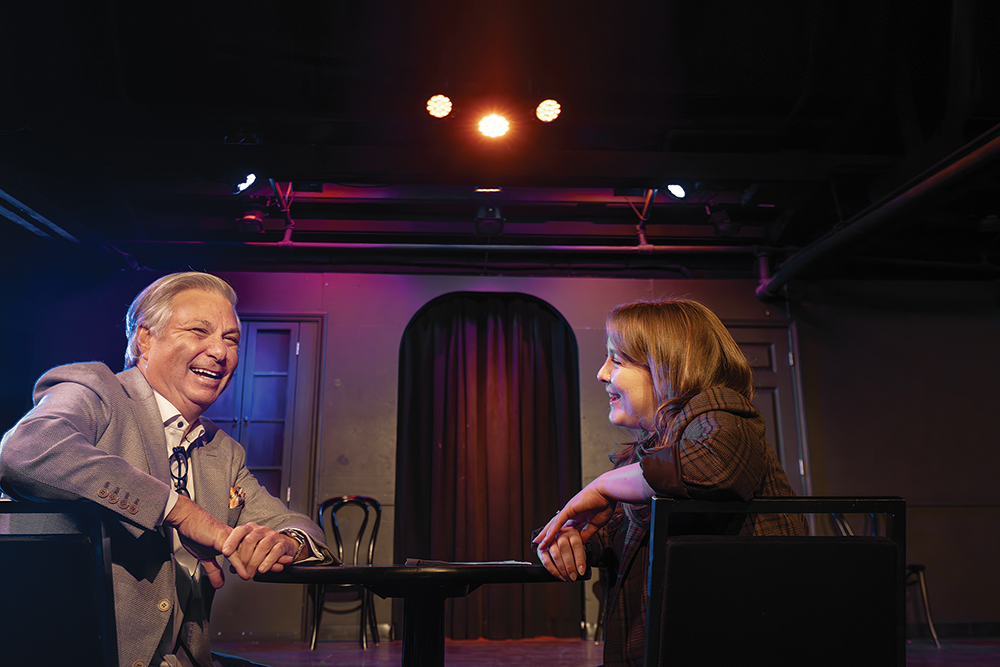
After buying the iO Theatre, Scott Gendell (left) spoke with experts on the history of Chicago improv and “put a lot of faith in [those] who know this business,” such as veteran performer and iO’s head of training, Gretchen Eng (right). (Image by Lenny Gilmore)
It is a far cry from where the group started, a true transformation. And it helps to illustrate why Eng has such an in-demand schedule. Her workshop clients have included social media companies, tech giants, and an entire department at DePaul.
All this activity, designed to react to the unexpected in life, might seem a curious business for Scott Gendell, whose ascent from a neighborhood realty company to the chief of a multi-pronged realty giant suggests less improvisation than steady vision and a certainty of purpose. But there have also been wrinkles, diversions, unusual shifts in the narrative.
Any number are rooted in his hometown, Skokie, the Chicago suburb with a strong Jewish identity. A group of friends all caddied at the snooty Evanston Golf Club in Skokie, where they were known as “b-jocks,” a slangy reference to the lowest class of caddies. Eight of nine attended Illinois, where they retained that bond, even as they pledged different fraternities or remained independent. Most had played on a local basketball court at Skokie’s Devonshire Park, which Scott memorialized in a novella called Devonshire that he plots to turn into a feature film. He got ChatGPT to create a review by Illinois alum Roger Ebert, ’64 MEDIA, and two film veterans to turn the novella into a screenplay, which is now in the hands of Sony Pictures.
And then there was the notorious, 1978 planned march by neo-Nazis through Skokie, which was thwarted only at the last minute.
“It had a profound influence on me and my obligation to stand up for those around me and for the Jewish people,” he says.
That resolve led him to become a major financial supporter of Israel and to join the boards of the Jewish National Fund and Illinois Holocaust Museum. It’s what led him to submit an essay to Steven Spielberg in hopes of doing interviews for his Holocaust documentaries through the USC Shoah Foundation. That essay won Scott a 60-
hour training and, ultimately, the hon-
or of doing about 50 interviews, which he calls “next to my family, the most meaningful experience in my life.”
One interview was with General William Levine, the highest-ranking Jewish officer to liberate a concentration camp, Dachau. That interview was one of several featured in the film Liberation Heroes, produced by the Discovery Channel in 2019.
Another was with Francis Akos, a violin virtuoso from Budapest who became assistant conductor of the Chicago Symphony. Akos was on the SS Cap Arcona, a boat carrying 7,500 camp survivors and flying the Nazi flag when it was spotted by the British Royal Air Force just two days before World War II ended. Seconds before the ship was strafed, he jumped overboard and swam through ice-cold, 40-degree seas to a supply ship he’d spotted, thus saving his own life.
At the end of the interview, Scott asked him to play something that reminded him of his native Budapest, anticipating part of a symphony. Instead, Akos took out his priceless Stradivarius and, in a moment Scott called “ethereal,” played a Hungarian folk tune, his mind and body transported to the 1930s, before the onset of horrors.
Scott recounts these extraordinary stories in moving, vivid detail and returns to the subject of iO almost reluctantly. He pauses to remember a writer and his famous quote.
“‘Dying is easy,’” he says, finally. “‘Comedy is hard.’”
Illinois Alumni, Summer 2026