Alumni Interview: Dr. Maria Carrillo
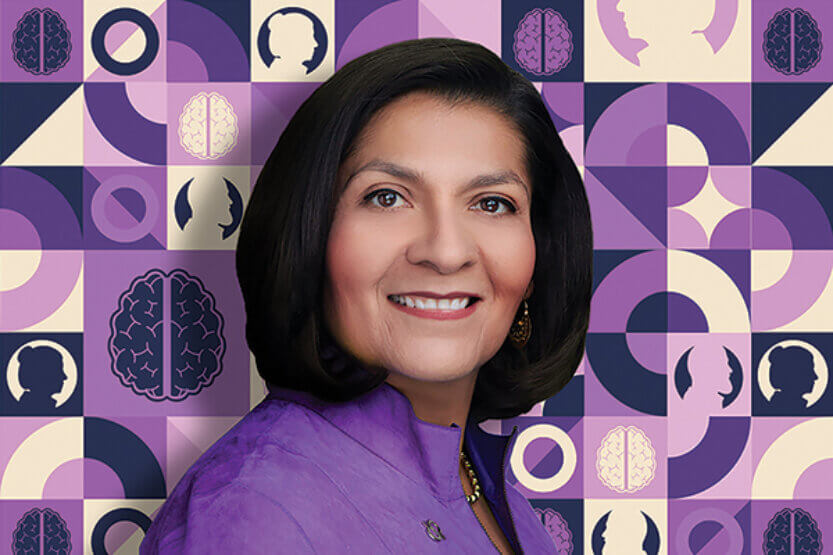 The lessons in leadership that Dr. Maria Carrillo learned as an Illinois undergraduate have prepared her for success as an Alzheimer’s researcher and administrator. (Image courtesy of Alzheimer’s Association)
I grew up on Chicago’s South Side. As a first-generation Mexican American, I was the first in my family to go away to college. The University of Illinois offered me a President’s Award—a full scholarship covering tuition, fees, and housing. At first, my parents didn’t approve of me going away to college. In our culture, you stayed home until you got married.
I broke that mold.
I was pretty headstrong, and since I was getting a full ride, I told them, “I’m not asking you to financially support me, so you actually can’t say no.”
At the time, there was no college major called neuroscience. The discipline was just beginning to emerge in the late 1980s and early 1990s, so I majored in psychology and minored in biology. But I took a lab course called Experimental Psychology just to see what neuroscience would look like. Instead of studying the social science side of psychology, we focused on the brain—and I fell in love with it.
Outside of the lab, I became active with both La Casa Cultural Latina and the Black Student Union. Those organizations expanded my world beyond academics. (I even met my future husband at La Casa.) During my junior year, I got involved in student government and ran for executive vice president on a slate—and we won! I believe that experience and participation in other student groups really set me up for leadership later on.
I learned one of my biggest leadership lessons during my senior year. The Black Student Union asked student government to bring civil rights activist Kwame Ture (Stokely Carmichael) to campus. As a Mexican kid from Chicago, I wasn’t aware of Ture’s anti-Zionist views and all the geopolitical issues surrounding the invitation. The university’s Jewish community protested, and I found myself talking with the dean of students and leaders at Hillel.
That experience taught me about the diplomacy that leadership requires. In any leadership position, there are politics, and diplomacy is a key ingredient for success. I learned that lesson as an undergraduate through some challenging moments.
After graduating from Illinois, I went straight to Northwestern University for my Ph.D. I imagined that I would spend my career as an academic, and after completing a postdoctoral fellowship in neurology at Rush University Medical Center, I became an assistant professor at Rush.
“I am grateful…to have been able to participate in activities that have shaped [Alzheimer’s research] and helped lead us to where we are today.” —Dr. Maria Carrillo, ’91 LAS
But then an opportunity came to me from my mentor at Northwestern, who thought I was perfect for a position with the Alzheimer’s Association. The association was looking for someone to lead its research program—someone with a neuroscience background who could also explain the science in an understandable way. That’s a huge part of my job—whether I’m communicating with families, policymakers, donors, or fellow scientists.
Now, I’ve been with the Alzheimer’s Association for 21 years.
Everything I experienced had prepared me for a career in which I was not going to be a passive funder but an active participant in advancing Alzheimer’s science. I still publish scientific papers, and I am still a principal investigator for several studies. I am grateful to the association because I have been able to participate in activities that have shaped the field and helped lead us to where we are today. I feel great about where I am, and I’m confident that I landed in the right place.
When I first came to this organization, there were only five of us on staff, and now I have a staff of more than 30. We have grown because everything we do has grown. We don’t simply fund research anymore—we lead it.
In the last five years, we’ve made incredible progress. Blood tests now make it easier to diagnose Alzheimer’s earlier, and we’re testing treatments before memory loss begins. That’s huge, because treatment changes the story—treatment changes stigma.
I love my job. I travel about 70 percent of the time, and since I’m on the road, I create breaks in my schedule to spend time with my family. My husband and I have been married for 34 years, and he sometimes travels with me. We have an amazing family, a huge family, with four adult children—the Carrillo clan. I’ve always felt supported and loved by my family.
Every step of my path has been helped by the mentors around me. If I could give advice to my younger self, I would say, “Nurture those relationships because you have no idea where your next opportunity will come from.”
My relationships have shaped who I am.
I also would tell my younger self not to be in such a hurry—I didn’t pause to smell the roses very often. I’m still fighting my instinct to go 100 miles-an-hour, and I have to force myself to slow down. I’d say, “Don’t be in such a hurry, just stop and enjoy life and the people around you who you might lose along the way.”
Illinois Alumni, Fall 2026